Types of motion: straight, zigzag, circular, periodic (Force &Motion)
Watch this topic in 60 seconds
Free preview · Lesson 1
Understanding Types of motion: straight, zigzag, circular, periodic (Force &Motion)
Understanding Motion: Straight, Zigzag, Circular, and Periodic!
Hello, young scientists! Have you ever noticed how things move around you? From a car zooming down the street to a swing swaying back and forth, everything is in motion! Today, we're going on an exciting adventure to explore the different ways things can move. We call these 'types of motion.' It's like learning the different dance moves objects can do!
What is Motion?
Before we dive into the different types, let's understand what motion is. Motion is simply when an object changes its position over time. If something is in one place now and a different place later, it's moving! Think about when you walk from your classroom desk to the door – you've changed your position, so you were in motion!
1. Straight Motion: Like a Rocket Launch!
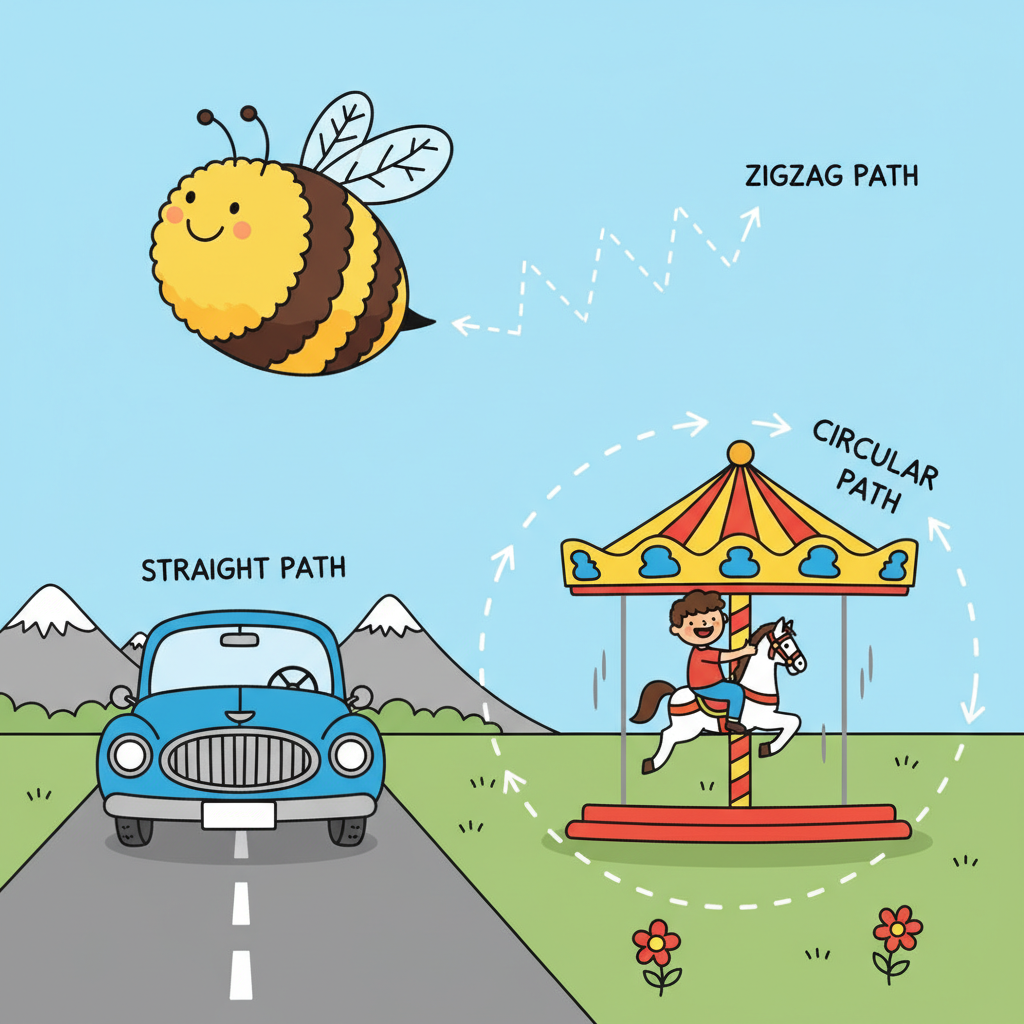
Imagine a toy car rolling perfectly straight across a smooth floor, or an arrow shot directly at a target. This is what we call straight motion.
- Definition: Straight motion is when an object moves in a single, unbending line from one point to another. It's the simplest kind of movement.
- Analogy: Think of a train moving on a straight track. It doesn't turn left or right; it just goes straight ahead! Another great example is sliding down a straight slide at the park.
- Examples in Real Life:
- A person walking directly down a long hallway.
- A sled going straight down a gentle snowy hill.
- A bowling ball rolling down the lane towards the pins.
- A book falling straight down from a table to the floor.
2. Zigzag Motion: Like a Lightning Bolt!
Have you ever seen a lightning bolt flash across the sky? It doesn't go in a smooth straight line; it jumps and turns! That's a bit like zigzag motion.
- Definition: Zigzag motion is when an object moves in sharp, quick turns, changing direction back and forth, often unpredictably. It's like making a 'Z' shape over and over again.
- Analogy: Imagine a squirrel darting across your yard. It doesn't run in a straight line; it might run a little this way, then quickly turn and run a little that way. Or think about dribbling a basketball – you push it forward, but it bounces up and down, and you might move it side to side a little.
- Examples in Real Life:
- A skier weaving back and forth down a snowy mountain slope.
- A fly buzzing around a room, changing direction constantly.
- A snake slithering on the ground, making S-shapes as it moves.
- A robot vacuum cleaner cleaning a room, bumping into walls and turning.
3. Circular Motion: Like a Merry-Go-Round!
Who doesn't love a merry-go-round at the park? When you're spinning around on it, you're experiencing circular motion!
- Definition: Circular motion is when an object moves in a path that forms a circle or part of a circle around a central point.
- Analogy: Think of the hands on a clock. They go round and round in a circle, always returning to the same general path. Another great analogy is a car going around a round-about or a hula hoop spinning around your waist.
- Examples in Real Life:
- A car driving around a roundabout or a race car on an oval track.
- The blades of a fan spinning around.
- A spinning top toy.
- The moon orbiting around the Earth (it's a very big circle!).
4. Periodic Motion: Like a Swishing Pendulum!
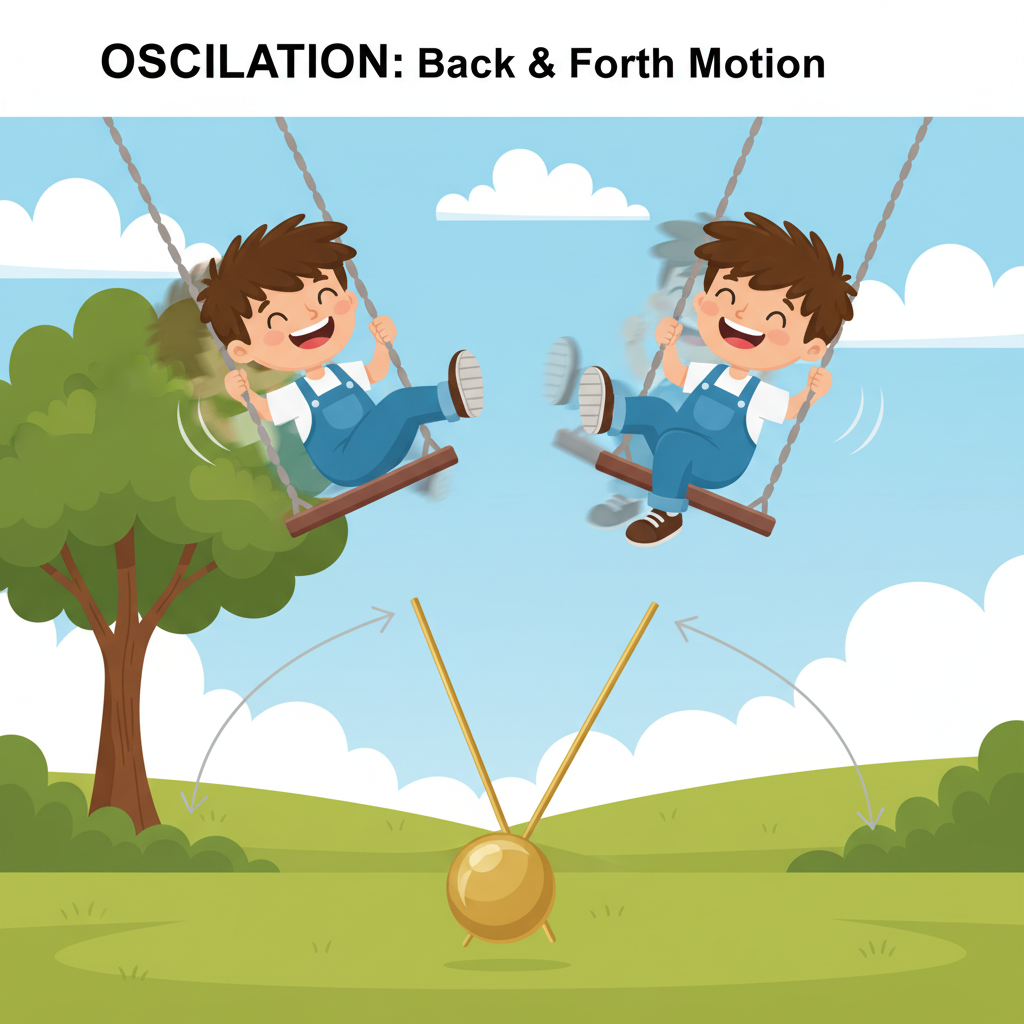
Some movements are super regular. They happen again and again, like a beat in music! This is called periodic motion.
- Definition: Periodic motion is a type of motion that repeats itself over and over again in a regular and predictable way, often taking the same amount of time for each repeat.
- Analogy: Imagine a child on a swing. They swing forward, then back, then forward again, over and over. Each swing takes roughly the same amount of time. Or think of your own heartbeat – thump-thump, thump-thump, a regular beat! Another analogy is a bouncing ball that always bounces to the same height.
- Examples in Real Life:
- A pendulum in an old clock swinging back and forth.
- A child on a playground swing.
- The up-and-down movement of a pogo stick.
- The vibrating string of a guitar when you pluck it.
- The Earth spinning on its axis (causing day and night) and orbiting the Sun (causing years).
 ⚠️ This picture may have spelling mistakes. Trust the words in the lesson.
Putting It All Together!
Now you know the main types of motion! It's fun to look around and try to identify them. Is the door opening in a straight line or circular? (Circular, around its hinges!). Is a basketball player running straight or zigzagging? (Often zigzagging!). Is a see-saw moving in periodic motion? (Yes, up and down, repeating!).
Understanding these different types of motion helps us describe the world around us and even predict how things will move. Keep observing, keep questioning, and keep exploring the amazing world of science!
Keep learning, free
Create a free Syllabax account to unlock practice questions and games for this topic.
Visual Learning Enhanced! 🚀
To help you master this topic, we use Advanced Syllabax AI to generate detailed diagrams and visual models.
Note on Visuals: The AI sometimes makes spelling errors in image labels. Please refer to the lesson text for the correct terminology.