Climate Change & Global Warming – Environment & Ecology
Watch this topic in 60 seconds
Free preview · Lesson 1
Climate Change & Global Warming – Environment & Ecology (Foundational)
Climate Change & Global Warming – Environment & Ecology (Foundational)
This lesson introduces the fundamental concepts of climate change and global warming, focusing on their impact on the environment and ecology.
What is Climate Change?
Climate change refers to long-term shifts in temperatures and weather patterns. These shifts may be natural, such as through variations in the solar cycle. But since the 1800s, human activities have been the main driver of climate change, primarily due to burning fossil fuels (like coal, oil, and gas), which produces heat-trapping gases.
What is Global Warming?
Global warming is the long-term heating of Earth's climate system observed since the pre-industrial period (between 1850 and 1900) due to human activities, primarily fossil fuel burning, which increases heat-trapping greenhouse gas levels in Earth's atmosphere. It is a major aspect of climate change, and the two terms are sometimes used interchangeably.
The Greenhouse Effect
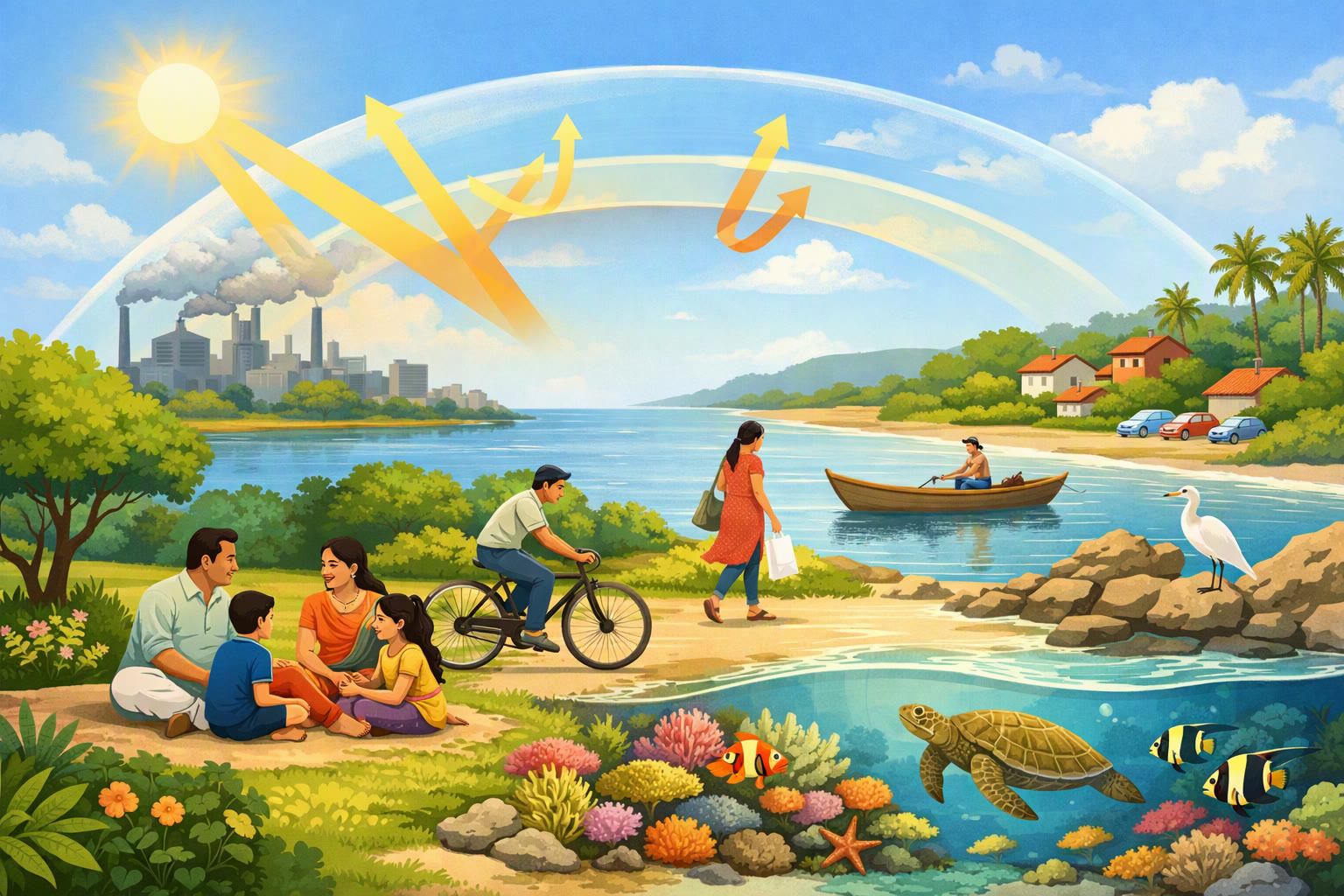
The greenhouse effect is a natural process that warms the Earth’s surface. When the Sun's energy reaches the Earth’s atmosphere, some of it is reflected back into space and the rest is absorbed and re-radiated by greenhouse gases. Greenhouse gases include water vapor, carbon dioxide, methane, nitrous oxide, ozone and some artificial chemicals such as chlorofluorocarbons (CFCs).
The absorbed energy warms the atmosphere and the surface of the Earth. This process makes Earth much warmer than it would be without an atmosphere. The problem we’re facing now is that human activities – particularly burning fossil fuels – are increasing the concentrations of some of these gases, leading to an enhanced greenhouse effect and global warming.
Key Greenhouse Gases
- Carbon Dioxide (CO2): Released through burning fossil fuels (coal, oil, natural gas), deforestation, and cement production.
- Methane (CH4): Emitted from livestock, natural gas and petroleum production, and decaying organic matter in wetlands.
- Nitrous Oxide (N2O): Released from agricultural and industrial activities, as well as burning fossil fuels and solid waste.
Impacts on the Environment & Ecology
Climate change and global warming are having significant impacts on our environment and the delicate balance of ecosystems. Some of these impacts include:
- Rising Sea Levels: As global temperatures increase, glaciers and ice sheets melt, adding water to the oceans. This leads to rising sea levels, which can flood coastal areas and displace communities.
- Changes in Weather Patterns: Climate change can cause more frequent and intense heatwaves, droughts, floods, and storms.
- Impacts on Biodiversity: Changes in temperature and precipitation patterns can disrupt ecosystems, leading to habitat loss and species extinction. Some species may be able to adapt or migrate to new areas, but others will not.
- Ocean Acidification: The absorption of excess carbon dioxide by the ocean is causing it to become more acidic. This can harm marine life, particularly shellfish and coral reefs.
What Can Be Done?
Addressing climate change requires global cooperation to reduce greenhouse gas emissions. This can be achieved through:
- Transitioning to renewable energy sources (solar, wind, hydro).
- Improving energy efficiency.
- Reducing deforestation.
- Adopting sustainable agricultural practices.
- Developing and implementing carbon capture technologies.
Keep learning, free
Create a free Syllabax account to unlock practice questions and games for this topic.
Visual Learning Enhanced! 🚀
To help you master this topic, we use Advanced Syllabax AI to generate detailed diagrams and visual models.
Note on Visuals: The AI sometimes makes spelling errors in image labels. Please refer to the lesson text for the correct terminology.