Patterns in numbers [Whole Numbers]
Watch this topic in 60 seconds
Free preview · Lesson 1
Understanding Patterns in numbers [Whole Numbers]
Uncovering the Secrets of Number Patterns!
Welcome, young mathematicians, to a fun-filled adventure into the amazing world of number patterns! Have you ever noticed how some numbers seem to follow a special rule or a predictable rhythm? That's exactly what we're going to explore today: the hidden patterns within whole numbers. Think of it like being a detective, but instead of solving mysteries with clues, we're solving them with numbers!
What is a Pattern?
Imagine a train. It has a locomotive at the front, followed by several carriages, and then another locomotive, and so on. The pattern is: Locomotive - Carriage - Carriage - Carriage - Locomotive - Carriage - Carriage - Carriage... See how it repeats? A number pattern is very similar! It's a sequence of numbers that follows a specific, repeating rule. This rule tells us how to get from one number to the next, or how to find the next number in the sequence.
Let's Look at Some Examples:
1. The "Add 2" Train:
Let's start with the number 2. What if we decide to add 2 to it every single time?
- Start with 2.
- Add 2: 2 + 2 = 4
- Add 2 again: 4 + 2 = 6
- Add 2 again: 6 + 2 = 8
- And so on...
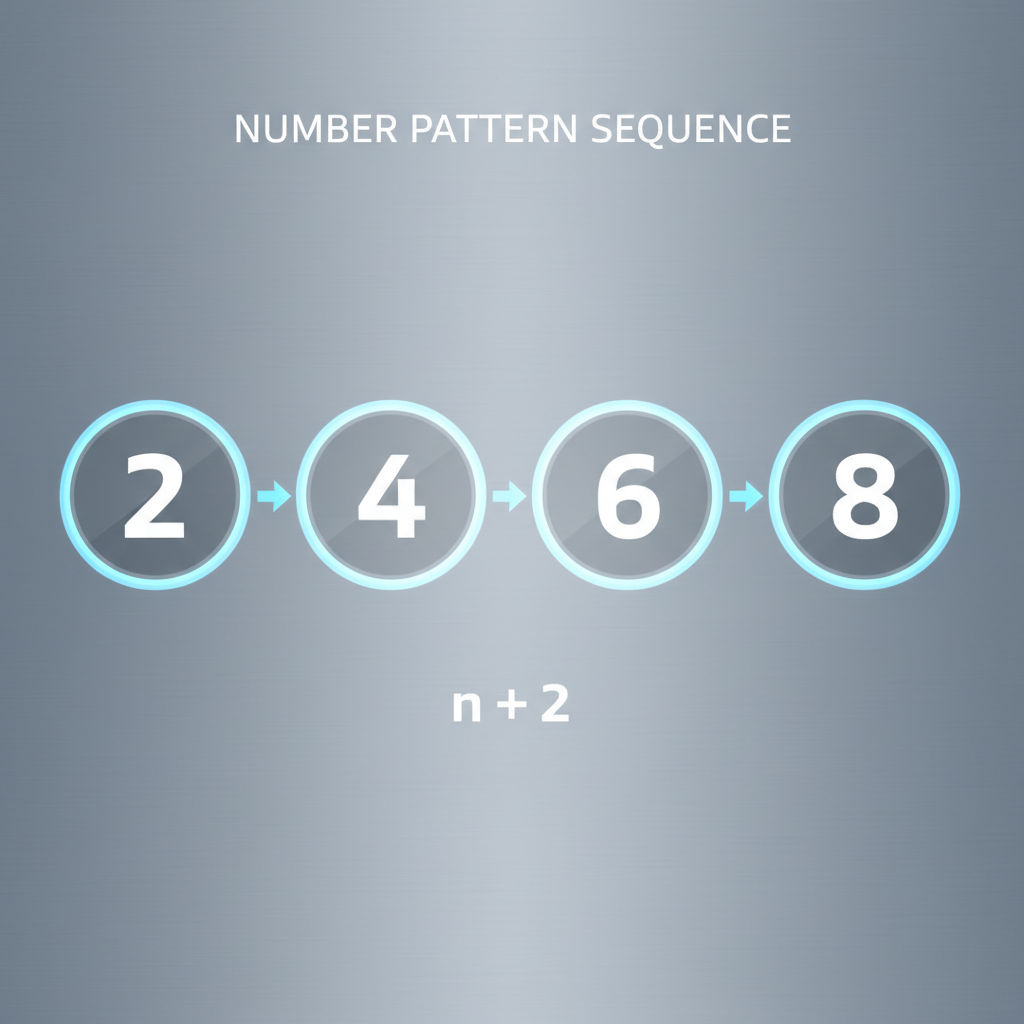
Our sequence looks like this: 2, 4, 6, 8, 10, 12, 14... This is a pattern where the rule is "add 2." It's like a train where each carriage is exactly 2 units longer than the one before it!
2. The "Multiply by 3" Ladder:
Now, let's try a different rule. What if we start with 1 and multiply by 3 each time?
- Start with 1.
- Multiply by 3: 1 * 3 = 3
- Multiply by 3 again: 3 * 3 = 9
- Multiply by 3 again: 9 * 3 = 27
Our sequence is: 1, 3, 9, 27, 81... This pattern's rule is "multiply by 3." Imagine climbing a ladder where each rung is 3 times higher than the one before it!
3. The "Subtract 5" Slide:
Sometimes, numbers can go down, too! Let's start with 50 and subtract 5 each time.
- Start with 50.
- Subtract 5: 50 - 5 = 45
- Subtract 5 again: 45 - 5 = 40
- Subtract 5 again: 40 - 5 = 35
The sequence becomes: 50, 45, 40, 35, 30... The rule here is "subtract 5." It’s like sliding down a hill, losing 5 steps with each slide.
Why are Patterns Important?
Patterns are everywhere in math and in the world around us! They help us:
- Understand the world: Think about the days of the week (Monday, Tuesday, Wednesday... it repeats!). Or the seasons (Spring, Summer, Autumn, Winter... they cycle!).
- Make predictions: If you know the pattern, you can guess what comes next. If you see 2, 4, 6, 8, you can predict the next number is 10.
- Solve problems: Many math problems involve finding or using patterns.
- Develop logical thinking: Figuring out rules and sequences sharpens your brain!
Types of Number Patterns
We've seen patterns that involve adding, subtracting, and multiplying. These are the most common types for whole numbers:
Arithmetic Patterns:
These patterns involve adding or subtracting the same number each time. The number you add or subtract is called the "common difference."
- Example: 3, 6, 9, 12, 15... (The common difference is +3)
- Example: 100, 90, 80, 70... (The common difference is -10)
Think of it like a steady march – always taking the same size step.
Geometric Patterns:
These patterns involve multiplying or dividing by the same number each time. The number you multiply or divide by is called the "common ratio."
- Example: 2, 4, 8, 16, 32... (The common ratio is *2)
- Example: 81, 27, 9, 3... (The common ratio is /3, or multiplying by 1/3)
This is more like a growth spurt – getting bigger (or smaller) by a certain factor each time.
Finding the Rule
How do we become pattern detectives? Here's how:
- Look at the first few numbers: Write down the sequence.
- Check the difference: Subtract the first number from the second, the second from the third, and so on. Is the difference the same each time? If yes, it's likely an arithmetic pattern (addition or subtraction).
- Check the ratio: If the difference isn't the same, try dividing the second number by the first, the third by the second, and so on. Is the ratio the same each time? If yes, it's likely a geometric pattern (multiplication or division).
- Test your rule: Once you think you've found the rule, use it to find the next few numbers in the sequence and see if they make sense.
Let's try one together! Look at this sequence: 5, 10, 15, 20...
- Step 1: Numbers are 5, 10, 15, 20.
- Step 2: Difference: 10 - 5 = 5. 15 - 10 = 5. 20 - 15 = 5. The difference is always 5!
- Step 3: We found a consistent difference, so it's an arithmetic pattern.
- Step 4: The rule is "add 5." Let's test it: The next number after 20 should be 20 + 5 = 25. The next after that is 25 + 5 = 30. The sequence continues: 5, 10, 15, 20, 25, 30... It works!
Here's a visual representation of a simple pattern:
 Patterns in Real Life
Patterns aren't just in math books! You see them everywhere:
- Tiling a floor: The tiles might be arranged in a repeating square or diamond pattern.
- Building blocks: Stacking blocks in a specific order (red, blue, red, blue...).
- Music: Songs often have repeating verses and choruses – that's a pattern!
- Nature: The petals on many flowers follow a pattern. The way branches grow can show a pattern.
Let's Practice!
Now that you're a pattern expert, let's test your skills with some fun questions!
Keep learning, free
Create a free Syllabax account to unlock practice questions and games for this topic.
Visual Learning Enhanced! 🚀
To help you master this topic, we use Advanced Syllabax AI to generate detailed diagrams and visual models.
Note on Visuals: The AI sometimes makes spelling errors in image labels. Please refer to the lesson text for the correct terminology.