Learning Journey
Watch this topic in 60 seconds
Free preview · Lesson 1
Understanding Laws of exponents & scientific notation (Real Numbers)
Unlocking the Power of Numbers: Exponents & Scientific Notation (Grade 9 - Foundational)
Welcome, young mathematicians! Today, we're diving into two super-powerful tools that help us work with very large and very small numbers: Exponents and Scientific Notation. Think of them as special superpowers for your math toolkit. Don't worry, we'll break everything down into simple terms with lots of easy-to-understand examples and analogies.
Part 1: The Magic of Exponents
What are Exponents? (Your Math Shorthand!)
Imagine you have to write "2 multiplied by itself 5 times." That would look like: 2 x 2 x 2 x 2 x 2. It's a bit long, right? This is where exponents come to the rescue! Exponents are a super-efficient way to write repeated multiplication.
Think of it like shorthand for mathematicians. Instead of writing out a long phrase, you use a symbol or a shorter way to express the same idea.
Definition: An exponent (also called an index or power) tells us how many times a number (called the base) is multiplied by itself.
Let's look at the parts:
- Base: The big number being multiplied. In 25, '2' is the base.
- Exponent: The small number written slightly above and to the right of the base. In 25, '5' is the exponent.
- Power: The entire expression (base and exponent together) is called a power. So, 25 is read as "2 to the power of 5" or "2 raised to the 5th power."
Example:
- 34 means 3 x 3 x 3 x 3 = 81 (Here, 3 is the base, 4 is the exponent).
- 52 means 5 x 5 = 25 (This is often called "5 squared").
- 103 means 10 x 10 x 10 = 1000 (This is often called "10 cubed").
The Super-Useful Laws of Exponents
Just like there are rules for playing a game, there are rules for working with exponents. These are called the "Laws of Exponents," and they make calculations much, much easier. Let's explore them one by one.
Law 1: Product of Powers (Multiplying Powers with the Same Base)
The Rule: When you multiply powers that have the same base, you add their exponents.
In symbols: am ⋅ an = am+n
Analogy: Imagine you have two boxes of identical building blocks. The first box (am) has 'm' blocks. The second box (an) has 'n' blocks. When you combine them (multiply them), you simply count all the blocks together (m + n). The type of block (the base 'a') doesn't change.
Example:
- 23 ⋅ 24 = 23+4 = 27 (which is 128)
- Let's check: (2 ⋅ 2 ⋅ 2) ⋅ (2 ⋅ 2 ⋅ 2 ⋅ 2) = 2 ⋅ 2 ⋅ 2 ⋅ 2 ⋅ 2 ⋅ 2 ⋅ 2 = 27. It works!
- x5 ⋅ x2 = x5+2 = x7
Law 2: Quotient of Powers (Dividing Powers with the Same Base)
The Rule: When you divide powers that have the same base, you subtract the exponent of the denominator from the exponent of the numerator.
In symbols: am / an = am-n (where a ≠ 0)
Analogy: You have 'm' pieces of pizza from one pizza (base 'a'). You give away 'n' pieces (divide). How many do you have left? 'm - n' pieces of the same pizza type. The pizza type (base 'a') doesn't change.
Example:
- 36 / 32 = 36-2 = 34 (which is 81)
- Let's check: (3 ⋅ 3 ⋅ 3 ⋅ 3 ⋅ 3 ⋅ 3) / (3 ⋅ 3) = 3 ⋅ 3 ⋅ 3 ⋅ 3 = 34. The two 3s on the bottom cancel out two 3s on top.
- y8 / y3 = y8-3 = y5
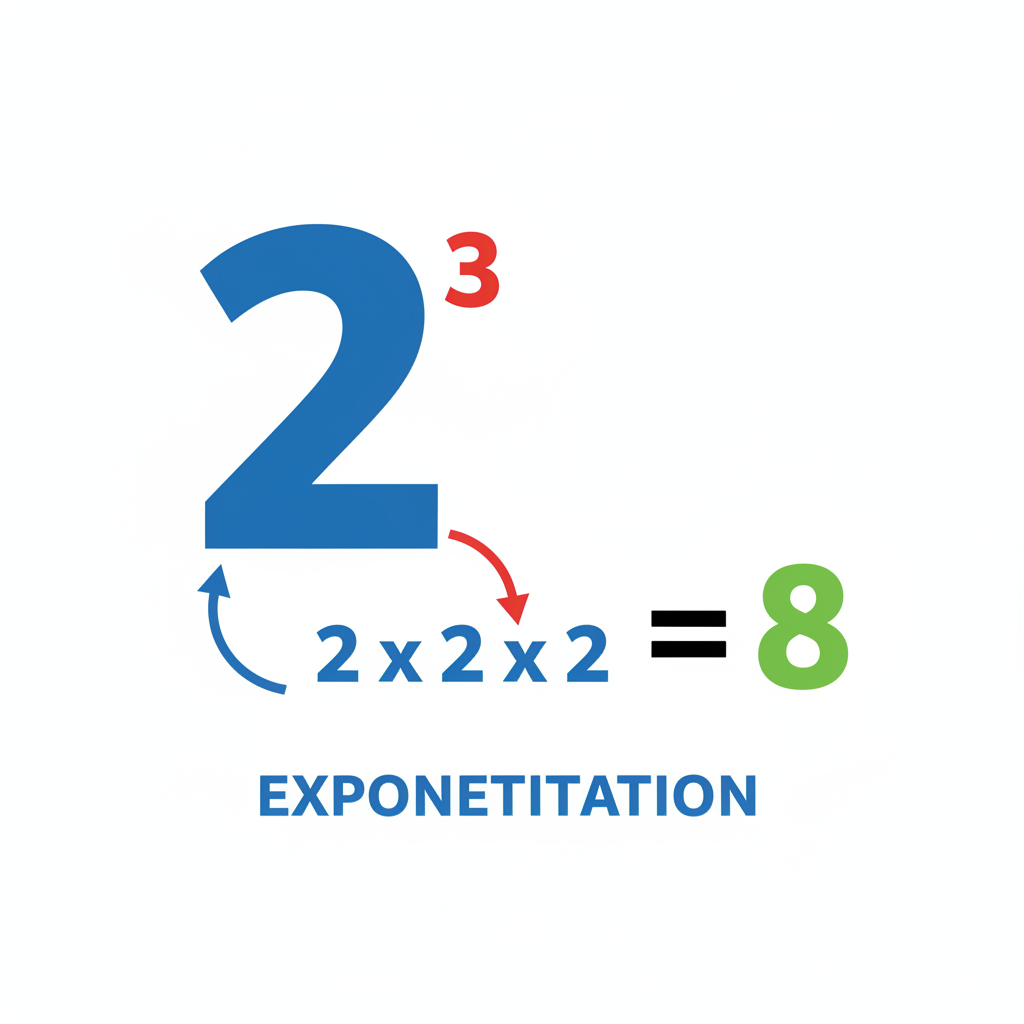 ⚠️ This picture may have spelling mistakes. Trust the words in the lesson.
Image: A visual representation of how exponents work, showing base and exponent leading to repeated multiplication.
Law 3: Power of a Power (Raising a Power to Another Power)
The Rule: When you raise a power to another power, you multiply the exponents.
In symbols: (am)n = am⋅n
Analogy: Imagine you have a gift box (am) that contains 'm' small gifts. Now, you put 'n' identical gift boxes inside a larger container (raise it to the power of 'n'). To find the total number of small gifts, you'd multiply the number of gifts per box ('m') by the number of boxes ('n').
Example:
- (52)3 = 52⋅3 = 56 (which is 15,625)
- Let's check: (52)3 = (5 ⋅ 5) ⋅ (5 ⋅ 5) ⋅ (5 ⋅ 5) = 5 ⋅ 5 ⋅ 5 ⋅ 5 ⋅ 5 ⋅ 5 = 56.
- (z4)5 = z4⋅5 = z20
Law 4: Power of a Product (Raising a Product to a Power)
The Rule: When you raise a product of numbers to a power, you raise each factor in the product to that power.
In symbols: (ab)m = ambm
Analogy: You have a duo, like a singer and a guitarist (a and b). They both get an award (raised to the power 'm'). You don't just give the award to one; both the singer and the guitarist receive it! The exponent 'm' is distributed to each part of the product.
Example:
- (2 ⋅ 3)4 = 24 ⋅ 34
- Let's check: (2 ⋅ 3)4 = 64 = 1296. And 24 ⋅ 34 = 16 ⋅ 81 = 1296. It matches!
- (xy)7 = x7y7
Law 5: Power of a Quotient (Raising a Quotient to a Power)
The Rule: When you raise a quotient (a fraction) to a power, you raise both the numerator and the denominator to that power.
In symbols: (a/b)m = am / bm (where b ≠ 0)
Analogy: Similar to the product rule, if you have a team (a divided by b), and the whole team wins a trophy ('m'), then both members (numerator and denominator) get a piece of that victory. The exponent 'm' applies to both the top and the bottom.
Example:
- (2/5)3 = 23 / 53 = 8 / 125
- (x/y)6 = x6 / y6
Law 6: Zero Exponent
The Rule: Any non-zero number raised to the power of zero is always 1.
In symbols: a0 = 1 (where a ≠ 0)
Analogy: Imagine you have a certain number of identical items (say, apples). If you are asked to take zero of those items (a0), it's like saying you have one 'set' of zero apples, meaning the original 'state' of having apples remains, but you haven't taken any. A better way to understand this is using Law 2: am / am = am-m = a0. We also know that any number divided by itself is 1 (e.g., 5/5 = 1, x/x = 1). So, a0 must be 1!
Example:
- 70 = 1
- (-100)0 = 1
- (xy2)0 = 1 (as long as xy2 is not zero)
Law 7: Negative Exponents
The Rule: A number raised to a negative exponent is equal to its reciprocal with a positive exponent.
In symbols: a-n = 1 / an (where a ≠ 0)
Analogy: Think of a negative sign on an exponent as a magical "flip switch." If a number (like an) is in the numerator with a negative exponent, it flips down to the denominator and its exponent becomes positive. If it's in the denominator with a negative exponent, it flips up to the numerator and becomes positive. It's like sending something to the "other side" of the fraction bar!
Example:
- 2-3 = 1 / 23 = 1 / 8
- x-5 = 1 / x5
- 1 / 3-2 = 32 = 9
Part 2: Scientific Notation (For Really Big or Really Small Numbers!)
Why Do We Need Scientific Notation? (The Compact Car for Numbers!)
Have you ever seen numbers like the distance to the sun (about 150,000,000,000 meters) or the size of a hydrogen atom (about 0.000000000053 meters)? These numbers are either incredibly huge or incredibly tiny, and writing them out with all those zeros is cumbersome and prone to errors. It's like trying to drive a giant truck through a narrow city street – inefficient!
Scientific notation is like a compact car for these numbers. It's a neat, standardized way to write them using powers of 10, making them much easier to read, write, and use in calculations.
What Does Scientific Notation Look Like?
A number in scientific notation always has two parts:
- A coefficient (a number between 1 and 10, but not including 10). This means it can be 1, 1.2, 5.75, 9.99, but NOT 0.5 or 10.
- A power of 10 (like 102, 10-5, 1012).
In symbols: a × 10n
- 'a' is the coefficient (1 ≤ |a| < 10)
- 'n' is an integer (a whole number, positive, negative, or zero)
Converting Standard Form to Scientific Notation
Let's turn those long numbers into their compact scientific notation form:
Steps:
- Find the coefficient: Move the decimal point in the original number until you get a number that is between 1 and 10 (the coefficient).
- Count the moves: Count how many places you moved the decimal point. This number will be your exponent for the power of 10.
- Determine the sign of the exponent:
- If the original number was large (greater than or equal to 10), you moved the decimal to the left, and the exponent will be positive.
- If the original number was small (between 0 and 1), you moved the decimal to the right, and the exponent will be negative.
Examples:
- Large Number: 7,500,000
- Original decimal is at the end: 7,500,000.
- Move left 6 places to get 7.5.
- Since we moved left, the exponent is positive 6.
- Scientific Notation: 7.5 × 10⁶
- Small Number: 0.0000032
- Original decimal is at the beginning: 0.0000032
- Move right 6 places to get 3.2.
- Since we moved right, the exponent is negative 6.
- Scientific Notation: 3.2 × 10⁻⁶
Converting Scientific Notation to Standard Form
Now, let's reverse the process and expand those compact numbers back into their full form:
Steps:
- Look at the exponent: This tells you how many places and in which direction to move the decimal point in your coefficient.
- Determine the direction:
- If the exponent is positive, move the decimal to the right. Add zeros as placeholders if needed. (Makes the number larger).
- If the exponent is negative, move the decimal to the left. Add zeros as placeholders if needed. (Makes the number smaller).
Examples:
- Positive Exponent: 4.1 × 10⁵
- Exponent is 5 (positive). Move the decimal in 4.1 five places to the right.
- 4.1 becomes 410,000. (We added four zeros after the 1).
- Standard Form: 410,000
- Negative Exponent: 8.9 × 10⁻³
- Exponent is -3 (negative). Move the decimal in 8.9 three places to the left.
- 8.9 becomes 0.0089. (We added two zeros before the 8).
- Standard Form: 0.0089
Why are these foundational?
Mastering exponents is crucial because they appear everywhere in higher math, science, and engineering – from algebra to calculus, from calculating compound interest to understanding radioactive decay. Scientific notation is your everyday tool for handling astronomical distances, microscopic sizes, and all sorts of data in chemistry, physics, and computing. These aren't just abstract rules; they are practical skills that will empower you to tackle complex problems with confidence!
Keep learning, free
Create a free Syllabax account to unlock practice questions and games for this topic.
Visual Learning Enhanced! 🚀
To help you master this topic, we use Advanced Syllabax AI to generate detailed diagrams and visual models.
Note on Visuals: The AI sometimes makes spelling errors in image labels. Please refer to the lesson text for the correct terminology.