Theoretical Probability
Watch this topic in 60 seconds
Free preview · Lesson 1
Understanding Theoretical Probability
Understanding Theoretical Probability: What Are the Chances?
Welcome to the exciting world of probability! Have you ever wondered what the chances are of something happening? Like, what's the likelihood it will rain tomorrow? Or what are your odds of winning a game? Probability is all about figuring out just how likely (or unlikely!) events are. It's a fundamental concept in mathematics that helps us make sense of uncertainty and make informed decisions.
What is Probability? A Simple Idea
Imagine you have a jar filled with different colored candies. If you close your eyes and pick one, you don't know for sure which color you'll get, right? But you might have a feeling that you're more likely to pick a red candy if there are a lot more red ones than blue ones. That 'feeling' or 'likelihood' is what probability tries to measure with numbers.
At its core, probability gives us a number between 0 and 1 (or 0% and 100%) to describe how likely an event is to occur:
- 0 (or 0%) means the event is absolutely impossible. It will never happen.
- 1 (or 100%) means the event is absolutely certain. It will definitely happen.
- 0.5 (or 50%) means there's an even chance of the event happening or not happening, like flipping a coin and getting heads.
Introducing Theoretical Probability: The 'What Should Happen'
When we talk about probability, there are two main types: Theoretical Probability and Experimental Probability. For Grade 9, we'll focus on Theoretical Probability. Think of it as the 'perfect world' or 'what should happen' probability. It's calculated by thinking about all the possible outcomes of an event and then figuring out how many of those outcomes match what we're looking for, without actually doing the experiment.
Let's go back to our candy jar. If you know exactly how many red candies and how many blue candies are in the jar, you can calculate the theoretical probability of picking a red candy. You don't need to pick any candies to figure this out; you just need to know the numbers inside the jar.
This is different from Experimental Probability, where you actually perform the experiment (like picking candies many, many times) and see what happens to estimate the probability. Theoretical probability relies on logic and what's possible, not on observations.
Key Vocabulary: The Language of Probability
Before we dive into calculations, let's learn some important terms that probability experts use:
-
Experiment or Trial
This is any process that has a well-defined set of possible results. Think of it as an 'action' that you perform. Examples:
- Flipping a coin
- Rolling a standard six-sided die
- Spinning a spinner
- Drawing a card from a deck
Analogy: An experiment is like pressing the 'play' button on a game. Something is about to happen!
-
Outcome
An outcome is a single, specific result of an experiment. It's what actually happens when you perform the action. Examples corresponding to the experiments above:
- Getting 'Heads' when flipping a coin
- Rolling a '4' on a die
- The spinner landing on 'Blue'
- Drawing the 'Ace of Spades'
Analogy: An outcome is like the specific result you see on the screen after you press 'play' in your game – maybe you won, maybe you lost, or maybe you got a specific score.
-
Sample Space
This is the complete list of ALL possible outcomes for an experiment. Every single thing that could possibly happen. We often use curly braces {} to list the items in a sample space. Examples:
- Coin Flip Sample Space: {Heads, Tails}
- Die Roll Sample Space: {1, 2, 3, 4, 5, 6}
- Spinning a spinner with Red, Blue, Green: {Red, Blue, Green}
The number of possible outcomes is just how many items are in the sample space. For a coin, it's 2. For a die, it's 6.
Analogy: The sample space is like seeing all the different paths or endings possible in a 'choose your own adventure' book, before you've even started reading! It's the full picture of what could happen.
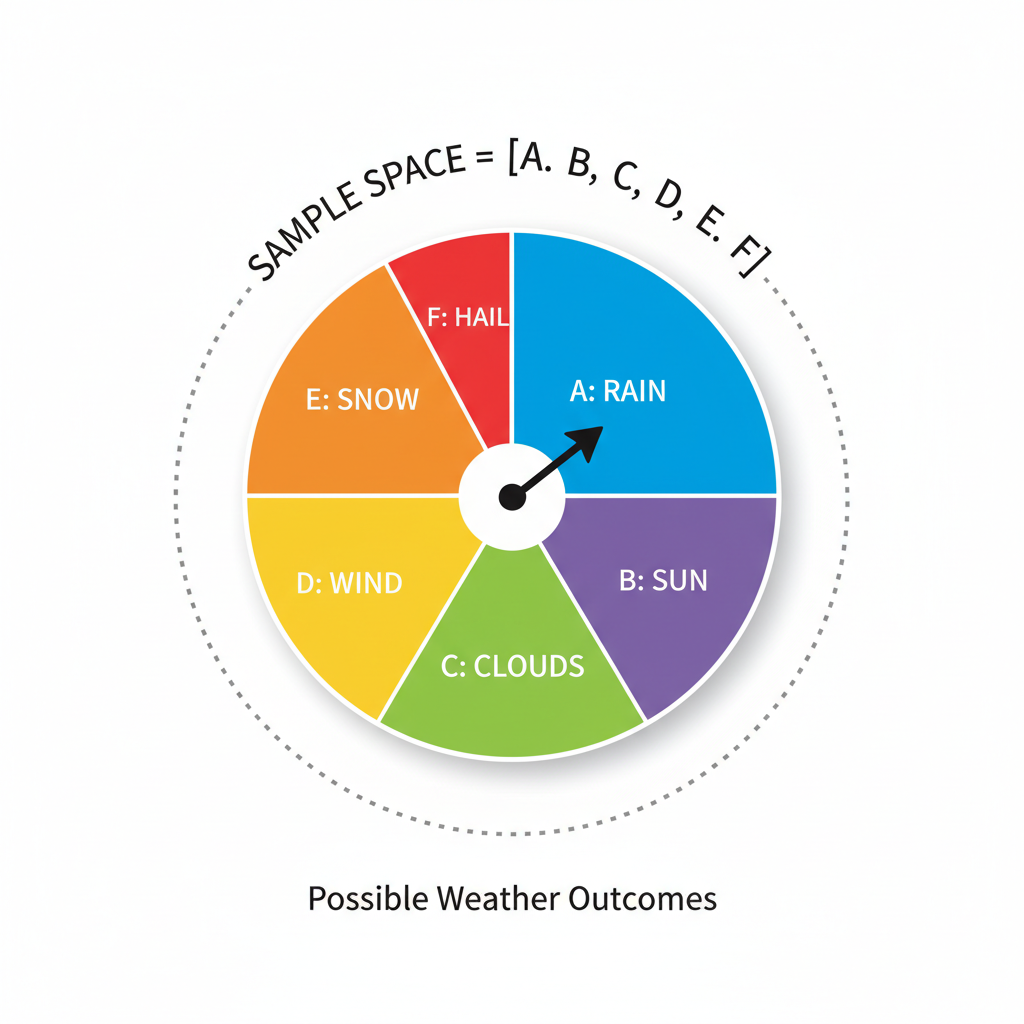 ⚠️ This picture may have spelling mistakes. Trust the words in the lesson.
-
Event
An event is one specific outcome or a collection of specific outcomes that we are interested in. It's a subset of the sample space. Examples:
- Getting 'Heads' (when flipping a coin)
- Rolling an 'even number' (when rolling a die). The outcomes that make up this event are {2, 4, 6}.
- Spinning a 'primary color' (if the spinner has Red, Blue, Green, Yellow). The outcomes are {Red, Blue}.
Analogy: An event is like saying, 'I hope to win the game' or 'I hope to get a specific high score.' It's the particular thing you're wishing for or focusing on from all the possibilities.
The Golden Formula for Theoretical Probability
Now that we know the terms, we can introduce the simple yet powerful formula for theoretical probability:
P(Event) = (Number of Favorable Outcomes) / (Total Number of Possible Outcomes)
Let's break it down:
- P(Event): This is read as 'The Probability of the Event'. We put the name of the event in the parentheses.
- Number of Favorable Outcomes: This is how many outcomes in the sample space match the event we are interested in. These are the outcomes we 'favor' or want to happen.
- Total Number of Possible Outcomes: This is the total number of items in the sample space. It's all the things that could happen.
Example 1: Flipping a Coin
What is the theoretical probability of flipping a coin and getting 'Heads'?
- Experiment: Flipping a coin.
- Sample Space: {Heads, Tails}. So, the Total Number of Possible Outcomes = 2.
- Event: Getting 'Heads'.
- Favorable Outcomes: {Heads}. So, the Number of Favorable Outcomes = 1.
Using the formula:
P(Heads) = (Number of Favorable Outcomes) / (Total Number of Possible Outcomes) = 1 / 2
So, the probability of getting Heads is 1/2, or 0.5, or 50%.
Example 2: Rolling a Die
What is the theoretical probability of rolling a standard six-sided die and getting an even number?
- Experiment: Rolling a die.
- Sample Space: {1, 2, 3, 4, 5, 6}. So, the Total Number of Possible Outcomes = 6.
- Event: Rolling an even number.
- Favorable Outcomes: The even numbers are {2, 4, 6}. So, the Number of Favorable Outcomes = 3.
Using the formula:
P(Even Number) = (Number of Favorable Outcomes) / (Total Number of Possible Outcomes) = 3 / 6
This fraction can be simplified to 1/2. So, the probability of rolling an even number is 1/2, or 0.5, or 50%.
Example 3: Marbles in a Bag
A bag contains 3 red marbles, 5 blue marbles, and 2 green marbles. If you pick one marble without looking, what is the theoretical probability of picking a blue marble?
- Experiment: Picking a marble from the bag.
- Sample Space: All the marbles in the bag. Total marbles = 3 (red) + 5 (blue) + 2 (green) = 10 marbles. So, the Total Number of Possible Outcomes = 10.
- Event: Picking a blue marble.
- Favorable Outcomes: There are 5 blue marbles. So, the Number of Favorable Outcomes = 5.
Using the formula:
P(Blue Marble) = (Number of Favorable Outcomes) / (Total Number of Possible Outcomes) = 5 / 10
This simplifies to 1/2. So, the probability of picking a blue marble is 1/2, or 0.5, or 50%.
The Probability Scale: From Impossible to Certain
Remember how we said probability is a number between 0 and 1? Let's visualize that on a scale:
0 <------------------> 1
Impossible <- Unlikely <- Even Chance -> Likely -> Certain
- Impossible (0 or 0%): An event that cannot happen. Example: The probability of rolling a 7 on a standard six-sided die. (There's no 7 on the die!). P(7) = 0/6 = 0.
- Unlikely (between 0 and 0.5): An event that has a small chance of happening. Example: The probability of picking an Ace from a full deck of 52 cards (there are 4 Aces). P(Ace) = 4/52 = 1/13 ≈ 0.077.
- Even Chance (0.5 or 50%): An event that is equally likely to happen or not happen. Example: Flipping a coin and getting heads. P(Heads) = 1/2 = 0.5.
- Likely (between 0.5 and 1): An event that has a good chance of happening. Example: The probability of picking a card that is NOT an Ace from a full deck. P(Not Ace) = 48/52 = 12/13 ≈ 0.923.
- Certain (1 or 100%): An event that is guaranteed to happen. Example: The probability of rolling a number less than 7 on a standard six-sided die. (All numbers 1-6 are less than 7!). P(number < 7) = 6/6 = 1.
Theoretical probability is a powerful tool because it allows us to predict the likelihood of events without having to perform countless experiments. It's the foundation for understanding risk, making predictions, and even playing games fairly. As you continue your math journey, you'll find probability woven into many different areas, helping you understand the world around you in a whole new way!
Keep learning, free
Create a free Syllabax account to unlock practice questions and games for this topic.
Visual Learning Enhanced! 🚀
To help you master this topic, we use Advanced Syllabax AI to generate detailed diagrams and visual models.
Note on Visuals: The AI sometimes makes spelling errors in image labels. Please refer to the lesson text for the correct terminology.