Proper, improper & mixed fractions [Fractions]
Watch this topic in 60 seconds
Free preview · Lesson 1
Understanding Proper, improper & mixed fractions [Fractions]
Understanding Fractions: Proper, Improper, and Mixed Numbers
Imagine you have a delicious pizza! Fractions are a way to talk about parts of a whole, like slices of that pizza. Today, we're going to become fraction experts by learning about three main types: proper fractions, improper fractions, and mixed numbers. Don't worry, we'll use lots of fun examples to make it super clear!
What is a Fraction?
A fraction has two important parts:
- Numerator: This is the top number. It tells us how many parts we have. Think of it as the number of pizza slices you're holding.
- Denominator: This is the bottom number. It tells us how many equal parts the whole is divided into. Think of it as the total number of slices the entire pizza was cut into.
We write fractions like this: Numerator / Denominator. For example, if a pizza is cut into 8 slices and you have 3 slices, the fraction is 3/8. You have 3 out of the 8 total slices.
1. Proper Fractions: When You Have Less Than a Whole
A proper fraction is like having a small piece of candy from a whole bar. The numerator (the number of pieces you have) is smaller than the denominator (the total number of pieces the bar was cut into).
Think of it this way:
- If you have 2 cookies out of a dozen (12) cookies, that's 2/12. You have less than the whole dozen.
- If you eat 1 slice of a cake cut into 6 slices, you ate 1/6 of the cake. That's less than the whole cake.
- If you have 3 apples in a basket that can hold 5 apples, you have 3/5 of the basket's capacity.
In a proper fraction, the top number is always less than the bottom number. The value of a proper fraction is always less than 1 whole.
Examples of Proper Fractions:
- 1/2 (One out of two parts)
- 3/4 (Three out of four parts)
- 5/7 (Five out of seven parts)
- 9/10 (Nine out of ten parts)
So, if your mom cuts a pie into 10 slices and gives you 3, you have a proper fraction (3/10) of the pie. You don't have the whole pie yet!
2. Improper Fractions: When You Have a Whole or More!
An improper fraction is the opposite of a proper fraction. Here, the numerator (the number of parts you have) is equal to or larger than the denominator (the total number of parts in one whole).
Imagine these scenarios:
- You have a whole pizza (which is 8/8) and then someone gives you one more slice. Now you have 9 slices, and the pizza was originally cut into 8 slices. So you have 9/8. This means you have more than one whole pizza!
- You baked 2 batches of cookies. Each batch made 6 cookies. If you count all the cookies you baked, you have 12 cookies. If you think of one batch as a 'whole', you have 12/6 worth of cookies. That's two whole batches!
- You have 5 halves of an apple. Each 'half' is a piece, but a whole apple is made of 2 halves. So, 5 halves (5/2) means you have more than one whole apple.
In an improper fraction:
- The numerator is greater than the denominator (e.g., 5/3, 9/4).
- OR the numerator is equal to the denominator (e.g., 4/4, 7/7). When the numerator and denominator are the same, it always equals 1 whole.
Examples of Improper Fractions:
- 5/3 (Five thirds - more than one whole)
- 7/2 (Seven halves - more than one whole)
- 4/4 (Four fourths - exactly one whole)
- 10/5 (Ten fifths - exactly two wholes)
An improper fraction tells you that you have at least one whole thing, possibly more!
3. Mixed Numbers: Combining Wholes and Parts
A mixed number is a way to write improper fractions more easily. It's like saying "I have one whole pizza and two extra slices." It combines a whole number with a proper fraction.
Let's look at our earlier examples:
- 9/8 pizzas: This means you have one whole pizza (which is 8/8) and one extra slice (1/8). So, 9/8 is the same as 1 and 1/8 pizzas. We write this as 1 1/8. The '1' is the whole number, and '1/8' is the proper fraction part.
- 5 halves of an apple (5/2): A whole apple is 2 halves. You have 5 halves. How many wholes can you make? You can make 2 wholes (which is 4 halves: 2/2 + 2/2 = 4/2), and you'll have 1 half left over. So, 5/2 is the same as 2 and 1/2 apples. We write this as 2 1/2.
A mixed number has three parts:
- A whole number (like 1, 2, 3)
- A numerator for the fractional part
- A denominator for the fractional part
The fractional part of a mixed number is always a proper fraction (the numerator is smaller than the denominator).
Examples of Mixed Numbers:
- 1 1/2 (One and one-half)
- 3 2/5 (Three and two-fifths)
- 2 3/4 (Two and three-quarters)
Mixed numbers are super helpful for telling us exactly how much we have when it's more than one whole thing.
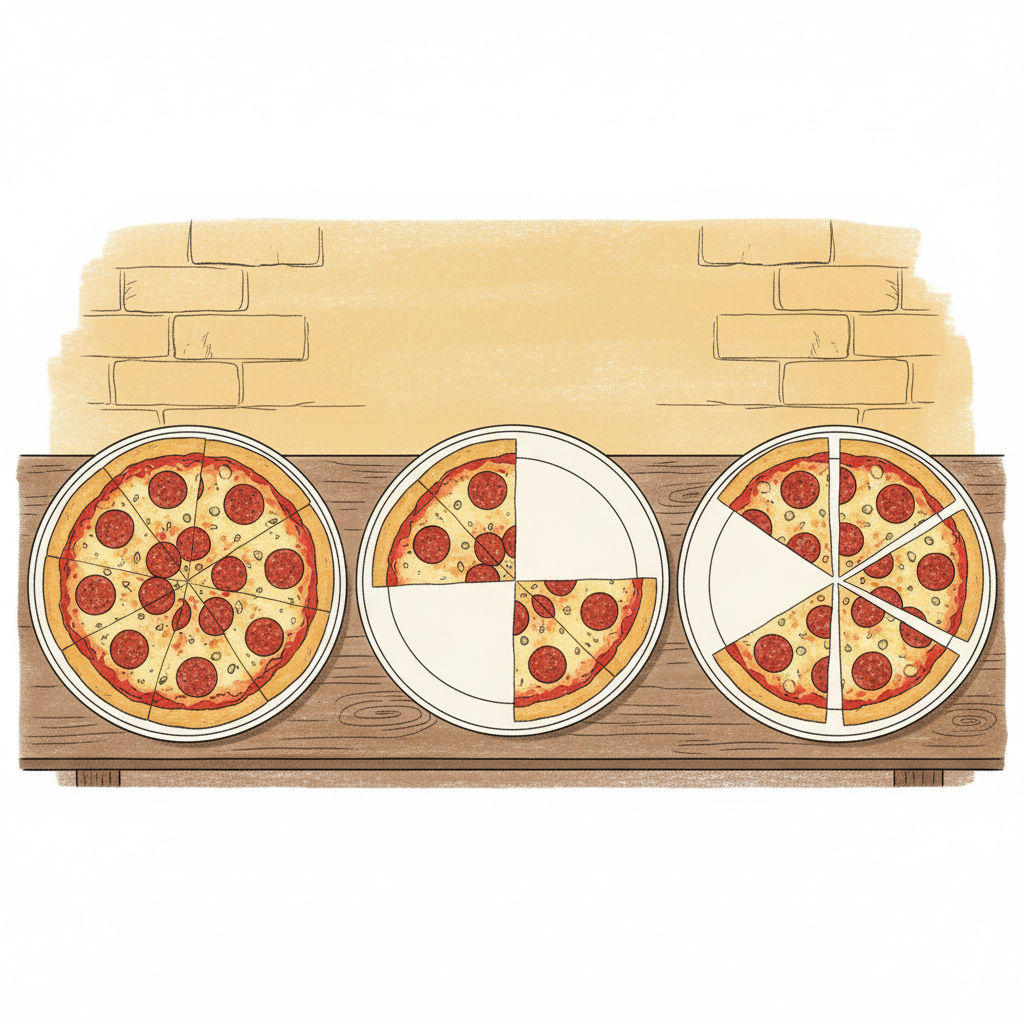
Visualizing fractions helps us understand how parts relate to the whole.
Putting It All Together
Let's recap the main ideas:
- Proper Fraction: Top number (numerator) is smaller than the bottom number (denominator). You have LESS than one whole. (e.g., 3/4)
- Improper Fraction: Top number (numerator) is equal to or larger than the bottom number (denominator). You have ONE WHOLE or MORE. (e.g., 5/4, 4/4)
- Mixed Number: A whole number combined with a proper fraction. It's another way to write an improper fraction, showing how many WHOLES and how many EXTRA parts you have. (e.g., 1 1/4)
Understanding these different types of fractions is the first step to doing amazing things with them, like adding, subtracting, multiplying, and dividing!
Keep learning, free
Create a free Syllabax account to unlock practice questions and games for this topic.
Visual Learning Enhanced! 🚀
To help you master this topic, we use Advanced Syllabax AI to generate detailed diagrams and visual models.
Note on Visuals: The AI sometimes makes spelling errors in image labels. Please refer to the lesson text for the correct terminology.