Which Group Has More?
Watch this topic in 60 seconds
Free preview · Lesson 1
Understanding Which Group Has More?
Let's Find Out: Which Group Has More?
Hello, young learners! Today, we're going on an exciting adventure to become super-duper detectives who can figure out which group has more things! It's like a fun game where we count and compare.
What Does 'More' Mean?
Imagine you have two bowls. One bowl has 5 yummy cookies, and the other bowl has 2 yummy cookies. Which bowl would you want? The one with 5 cookies, right? That's because 5 cookies are more than 2 cookies! 'More' means there's a bigger number of things in one group compared to another.
Let's Count and See!
The first step to finding out which group has more is always to count! Counting helps us give a number to each group. It's like giving each group a score.
Example 1: Toys!
Look at these toys:
- Group A has red balls: (ball) (ball) (ball)
- Group B has blue cars: (car) (car) (car) (car)
Let's count! Group A has 1, 2, 3 red balls. Group B has 1, 2, 3, 4 blue cars. Since 4 is a bigger number than 3, Group B has more toys!
Comparing Groups: The Buddy System!
Sometimes, we can compare groups without even counting all the way up, especially when the numbers are small. We can use the 'Buddy System' or 'One-to-One Matching'. It's like giving each item in one group a friend from the other group until one group runs out of friends!
Example 2: Buttons and Stars!
Imagine you have some buttons and some stars:
Let's pair them up!
- Button 1 with Star 1
- Button 2 with Star 2
- Button 3 with Star 3
Oh no! We ran out of buttons, but there are still stars left over! This means the group of stars has extra friends, so the group of stars has more! The group of buttons has fewer.
What About 'Fewer'?
If one group has more, then the other group automatically has fewer. 'Fewer' means there's a smaller number of things. Like in our cookie example, the bowl with 2 cookies has fewer cookies than the bowl with 5 cookies.
Practice Time!
Let's try another one. Look at these delicious fruits:
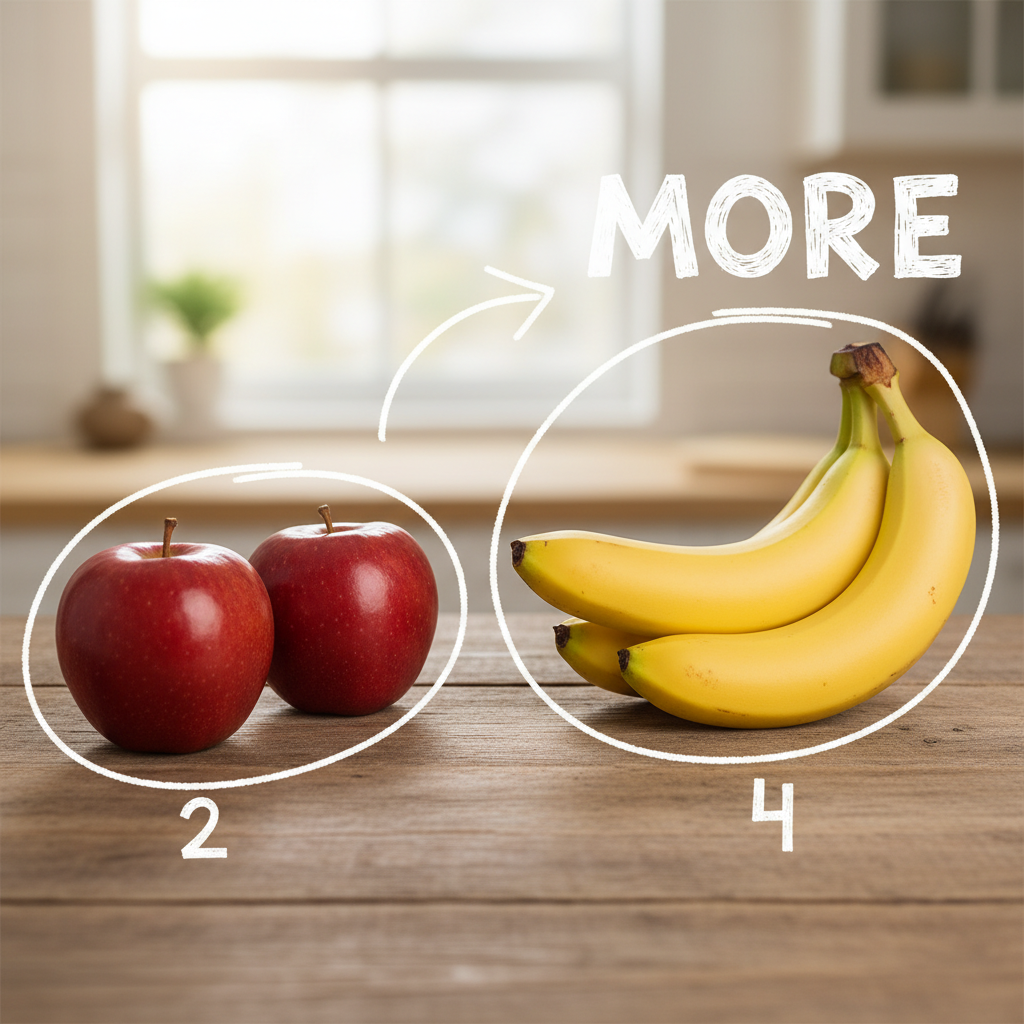
Group 1: Apples (apple) (apple)
Group 2: Bananas (banana) (banana) (banana) (banana)
- Count the apples: 1, 2 apples.
- Count the bananas: 1, 2, 3, 4 bananas.
Now, compare the numbers: 2 and 4. Which number is bigger? That's right, 4 is bigger than 2! So, the group of bananas has more!
Key Ideas to Remember:
- To find which group has more, first, count how many things are in each group.
- Then, compare the numbers. The group with the bigger number has more.
- You can also use the 'Buddy System' (one-to-one matching) to see which group has items left over. The group with leftovers has more!
- If a group has 'more' items, the other group has 'fewer' items.
You are now a 'More or Fewer' detective! Keep practicing, and you'll become a champion at comparing groups!
Keep learning, free
Create a free Syllabax account to unlock practice questions and games for this topic.
Visual Learning Enhanced! 🚀
To help you master this topic, we use Advanced Syllabax AI to generate detailed diagrams and visual models.
Note on Visuals: The AI sometimes makes spelling errors in image labels. Please refer to the lesson text for the correct terminology.