Habitat & adaptation[BIOLOGY]
Watch this topic in 60 seconds
Free preview · Lesson 1
Understanding Habitat & adaptation[BIOLOGY]
Habitat & Adaptation: Where Life Thrives!
Welcome, young scientists, to an exciting journey into the world of living things! Today, we're going to explore two very important ideas: habitats and adaptations. Think of them as the "home" and the "special tools" that help animals and plants survive and thrive.
What is a Habitat?
Imagine you're a fish. Where would you feel most at home? Probably in a pond, a lake, or the ocean, right? That's because a habitat is like an animal's or plant's natural home. It's the place where they live and find everything they need to survive.
What do living things need to survive? They need:
- Food: Something to eat to get energy.
- Water: To drink and for their bodies to work properly.
- Shelter: A safe place to rest, hide from predators, and raise their young.
- Space: Enough room to move around, find resources, and reproduce.
Think of a habitat as a complete package deal for a living thing. It provides all the ingredients for a happy and healthy life.
Types of Habitats: A World of Homes!
Habitats come in all shapes and sizes, and in many different places on Earth. Let's look at a few!
1. Forests: The Green Giants
Forests are full of trees, plants, and shade. Animals like squirrels, deer, bears, and many birds live here. They find food like nuts, berries, and insects. The trees provide shelter from the rain and sun, and a place to build nests or dens.
2. Deserts: The Sandy Sprawls
Deserts are very dry and often very hot (though some can be cold!). It might seem hard to live here, but special plants like cacti and animals like camels, lizards, and snakes have figured out how. They get water from the few plants that grow or from the food they eat. They often come out at night when it's cooler.
3. Oceans: The Deep Blue Sea
The oceans are vast and filled with water! Fish, whales, dolphins, sharks, and even tiny plankton call the ocean home. They find food like smaller fish or algae. The water itself is their shelter and the place they swim and play.
4. Grasslands: The Wide Open Plains
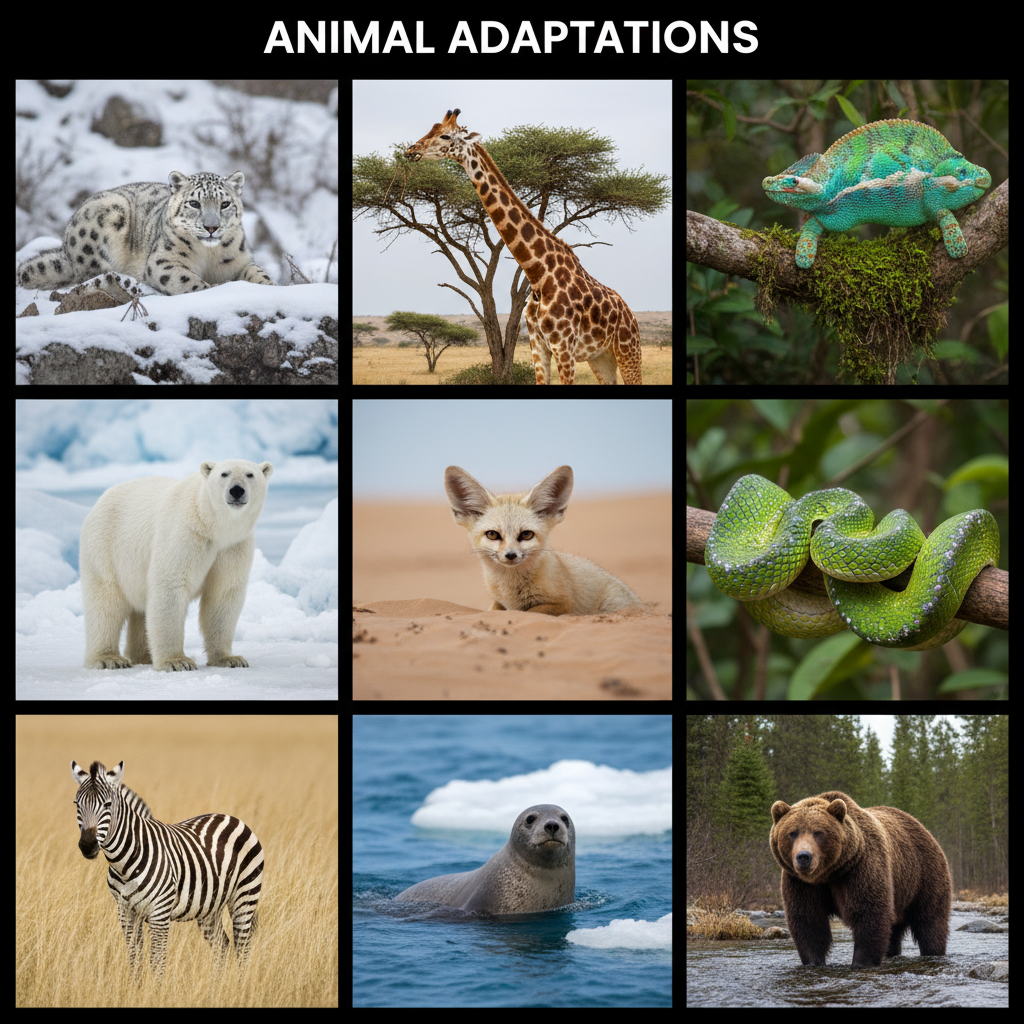
Grasslands are covered in grass, with few trees. Animals like zebras, lions, and giraffes roam here. They eat grass or other animals that eat grass. The open space allows them to see danger coming from far away.
5. Arctic/Polar Regions: The Icy Worlds
These are the coldest places on Earth, covered in snow and ice. Animals like polar bears, seals, and penguins are built for the cold. They have thick fur or blubber to stay warm and find food like fish in the icy waters.
Every habitat has its own unique conditions – like temperature, amount of water, and the types of plants and animals that live there.
What are Adaptations?
Now, let's talk about adaptations. If a habitat is the "home," then adaptations are the "special tools" or "superpowers" that living things have to help them survive and do well in their specific home.
An adaptation is a trait (a special feature or behavior) that helps an organism survive and reproduce in its environment. Think of it like having the right tools for a job. If you're building a house, you need a hammer, a saw, and nails. Animals and plants have their own amazing tools!
Types of Adaptations: Built for Survival!
Adaptations can be physical (parts of the body) or behavioral (actions they take).
1. Physical Adaptations: Body Superpowers!
These are parts of an animal's or plant's body that help it survive.
- Thick Fur/Blubber: Polar bears have thick fur and a layer of fat called blubber to keep them warm in the freezing Arctic. It’s like wearing a super-warm winter coat and scarf all the time!
- Sharp Claws/Teeth: Lions have sharp claws and teeth to catch and eat their prey. These are like built-in knives and forks for their meals.
- Long Necks: Giraffes have long necks to reach leaves high up in trees that other animals can't reach. It’s like having a built-in ladder to get to the best snacks!
- Camouflage: Some animals, like chameleons or certain insects, can change their color to blend in with their surroundings. This helps them hide from predators or sneak up on their food. It’s like having an invisibility cloak!
- Spines: Cacti have sharp spines instead of leaves. These protect them from thirsty animals and help them save water. Think of them as natural armor.
- Webbed Feet: Ducks have webbed feet that help them swim easily in water. It’s like having built-in flippers.
2. Behavioral Adaptations: Actions Speak Louder!
These are things that animals do to help them survive.
- Hibernation: Bears and some other animals sleep through the cold winter months to save energy when food is scarce. It’s like taking a very long nap until spring arrives.
- Migration: Birds often fly long distances to warmer places when winter comes. They do this to find food and a better climate. It’s like going on a long vacation to a sunny beach!
- Nocturnal Behavior: Many desert animals, like the fennec fox, are active at night. This helps them avoid the extreme heat of the day. They are like night owls, doing their best work when it's cool.
- Seeking Shelter: Animals will build burrows, nests, or dens to protect themselves from weather and predators. This is like building a safe house.
How Habitats and Adaptations Work Together
Habitats and adaptations are like two pieces of a puzzle that fit perfectly together. An animal's adaptations are usually perfectly suited for its habitat.
For example:
- A fish lives in the ocean (habitat). Its gills to breathe underwater and its fins to swim are its adaptations.
- A camel lives in the desert (habitat). Its ability to store water, its wide feet to walk on sand, and its ability to close its nostrils against sandstorms are its adaptations.
- A squirrel lives in a forest (habitat). Its bushy tail for balance and warmth, and its sharp claws for climbing trees are its adaptations.
If an animal is moved to a different habitat where its adaptations don't help it survive, it might have a hard time. Imagine trying to wear a thick fur coat in the desert – you'd get way too hot!
Why are Habitats and Adaptations Important?
Understanding habitats and adaptations helps us understand how life on Earth is so diverse and amazing! It shows us how living things have evolved over millions of years to fit into their special places in the world.
It also helps us understand why it's important to protect different habitats. When a habitat is destroyed, the animals and plants that live there lose their homes and their chances of survival.
So, remember: every creature has a home (habitat) and special tools (adaptations) to help it live there. It's a beautiful and complex system that makes our planet so full of life!
Keep learning, free
Create a free Syllabax account to unlock practice questions and games for this topic.
Visual Learning Enhanced! 🚀
To help you master this topic, we use Advanced Syllabax AI to generate detailed diagrams and visual models.
Note on Visuals: The AI sometimes makes spelling errors in image labels. Please refer to the lesson text for the correct terminology.