What is a Data Set?
Watch this topic in 60 seconds
Free preview · Lesson 1
Understanding What is a Data Set?
What is a Data Set?
Hello, young learners! Have you ever collected anything? Maybe rocks, stickers, or even toy cars? When you put all your similar things together, it becomes a collection. Well, in our lesson today, we're going to talk about collecting something called data, and when we put that data together in an organized way, we call it a data set!
What is Data?
Before we talk about a data set, let's understand what data is. Imagine you're a super detective, and you're looking for clues. Data is like those clues! It's any piece of information, fact, or detail we collect. Data can be lots of different things:
- Numbers: Like your age (8 years old), the number of brothers or sisters you have (2), or how many pets are in your house (1).
- Words: Like your favorite color (blue), your favorite animal (dog), or the name of your best friend (Sarah).
- Pictures: A photo you took, or a drawing you made.
- Sounds: The sound a bird makes, or the music you like.
So, data is just information! It's all around us, all the time. Every time you count something, describe something, or even take a picture, you are collecting data!
Think of a Data Set Like a Toy Box!
Let's use an analogy! Imagine your toy box at home. You don't just throw all your toys everywhere, do you? (Well, maybe sometimes!) But ideally, you put all your building blocks in one section, all your action figures in another, and all your board games neatly stacked. Your toy box helps you keep your toys organized so you can find them easily when you want to play.
A data set is a lot like that organized toy box! Instead of toys, it holds data. It's a collection of related pieces of information, all grouped together in an organized way. When data is organized in a set, it's much easier to look at, understand, and use.
Why Do We Create Data Sets?
Why bother putting information into a data set? Here are a few good reasons:
- To Be Organized: Just like your toy box, a data set keeps information tidy. Imagine trying to find one specific toy if they were all mixed up in a giant pile! It's the same with information.
- To Find Answers: When data is organized, we can easily find answers to questions. For example, if you have a data set of all your classmates' favorite colors, you can quickly find out which color is the most popular!
- To Discover Patterns: Sometimes, when we look at a data set, we can see interesting patterns or trends. Maybe most kids in your class like blue, or maybe a lot of students share the same height.
More Analogies for a Data Set:
- A Sticker Book: Each sticker is a piece of data. Your whole sticker book, with all your stickers grouped by theme or color, is a data set!
- A Photo Album: Each photo is a piece of data (a memory!). Your photo album, full of pictures from your vacation or birthday, is a data set of memories.
- A Recipe Book: Each recipe is a piece of data (ingredients, steps). The whole recipe book, filled with different recipes, is a data set!
- A Class Roster: A list of all the students in your class, their ages, and their birthdays is a data set! Each student's information is a piece of data.
Examples of Data Sets in Real Life:
Data sets are everywhere! You've probably seen or even helped create some without even realizing it:
- Classroom Survey: If your teacher asks everyone to raise their hand for their favorite fruit (apples, bananas, oranges), and then writes down how many votes each fruit got. That list of fruits and their votes is a data set!
- Weather Chart: Looking at a chart that shows the temperature every day for a week. That's a data set of temperatures.
- Sports Scores: A list of how many points each player scored in a basketball game. That's a data set of scores.
- Book Inventory: A list of all the books in your school library, along with their titles and authors. That's a huge data set!
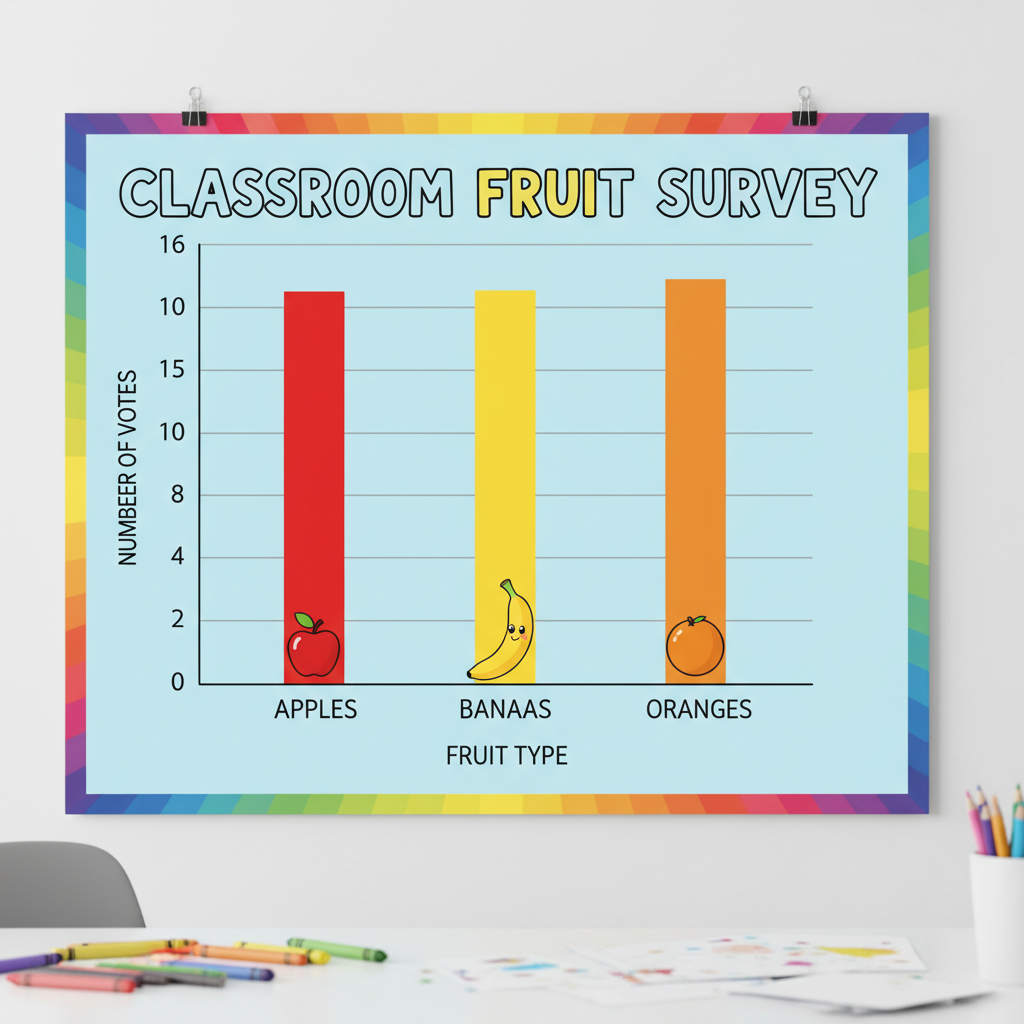 ⚠️ This picture may have spelling mistakes. Trust the words in the lesson.
Let's Recap!
Think about it like this: If you have a bunch of individual LEGO bricks, those are like pieces of data. But when you put all your LEGO bricks into one big container, or even build something specific with them, that whole collection becomes a data set. It's organized information that helps us learn, understand, and answer questions about the world around us!
So next time you see a list of facts or a collection of similar items, you'll know you're looking at a data set!
Keep learning, free
Create a free Syllabax account to unlock practice questions and games for this topic.
Visual Learning Enhanced! 🚀
To help you master this topic, we use Advanced Syllabax AI to generate detailed diagrams and visual models.
Note on Visuals: The AI sometimes makes spelling errors in image labels. Please refer to the lesson text for the correct terminology.