Noise vs music[PHYSICS]
Watch this topic in 60 seconds
Free preview · Lesson 1
Understanding Noise vs music[PHYSICS]
Noise vs. Music: What's the Difference? (Physics Edition)
Have you ever been trying to concentrate, and suddenly a loud, clanging sound interrupts you? Or maybe you’ve enjoyed listening to your favorite song, tapping your foot to the beat. Both sounds, but one might make you wince, and the other might make you smile. Why is that? It all comes down to the physics of sound, and how our ears and brains interpret it.
What is Sound? The Basics
Before we can talk about noise and music, we need to understand what sound is. Imagine you’re dropping a pebble into a still pond. You see ripples spreading outwards, right? Sound travels in a very similar way, but instead of water, it travels through the air (or other materials) as waves. These waves are caused by vibrations.
Vibrations are rapid back-and-forth movements. When something vibrates, it pushes and pulls the air molecules around it. These pushes create areas where the air molecules are squeezed together (called compressions), and the pulls create areas where they are spread apart (called rarefactions). These compressions and rarefactions travel outwards from the source of the vibration as a sound wave. Think of it like a slinky toy being pushed and pulled – the wave travels along the slinky.
Our ears are designed to detect these tiny changes in air pressure. When a sound wave reaches our eardrum, it makes the eardrum vibrate. These vibrations are then sent to our brain, which interprets them as sound.
What Makes Sounds Different? Three Key Properties
All sound waves have a few key properties that determine what we hear. Let’s explore them:
1. Frequency: How High or Low is the Pitch?
Frequency is the number of complete sound waves that pass a certain point in one second. It’s measured in Hertz (Hz). A higher frequency means more waves are passing by each second, and we hear this as a higher pitch. A lower frequency means fewer waves are passing by, and we hear this as a lower pitch.
Analogy: Think about a jump rope. If you shake the rope really fast, you create many waves quickly – that’s like a high frequency and a high pitch (like a whistle). If you shake it slowly, you create fewer waves over time – that’s like a low frequency and a low pitch (like a foghorn).
Most humans can hear sounds with frequencies between 20 Hz and 20,000 Hz. Sounds with frequencies too low for us to hear are called infrasound, and sounds with frequencies too high are called ultrasound.
2. Amplitude: How Loud or Soft is the Sound?
Amplitude is related to how much energy the sound wave carries. It’s the “height” of the sound wave. A larger amplitude means the sound wave has more energy, and we perceive this as a louder sound. A smaller amplitude means less energy, and we hear a softer sound.
Analogy: Imagine throwing a ball. If you throw it gently, it doesn’t go far – that’s a small amplitude and a soft sound. If you throw it with a lot of force, it goes far and is powerful – that’s a large amplitude and a loud sound.
Loudness is measured in decibels (dB). Very loud sounds can damage our hearing.
3. Waveform: What is the “Shape” of the Sound?
This is where things get interesting and directly relate to the difference between noise and music. The waveform describes the complex pattern of compressions and rarefactions in a sound wave. It’s like the unique “fingerprint” of a sound.
Simple sounds, like those made by tuning forks, often have very regular and predictable waveforms. Complex sounds, like those made by musical instruments or our voices, have much more complicated and irregular waveforms.
Analogy: Imagine drawing lines on a piece of paper. A ruler makes a perfectly straight, smooth line – that’s like a pure, simple sound wave. Your own handwriting is wiggly and unique – that’s like a complex sound wave.
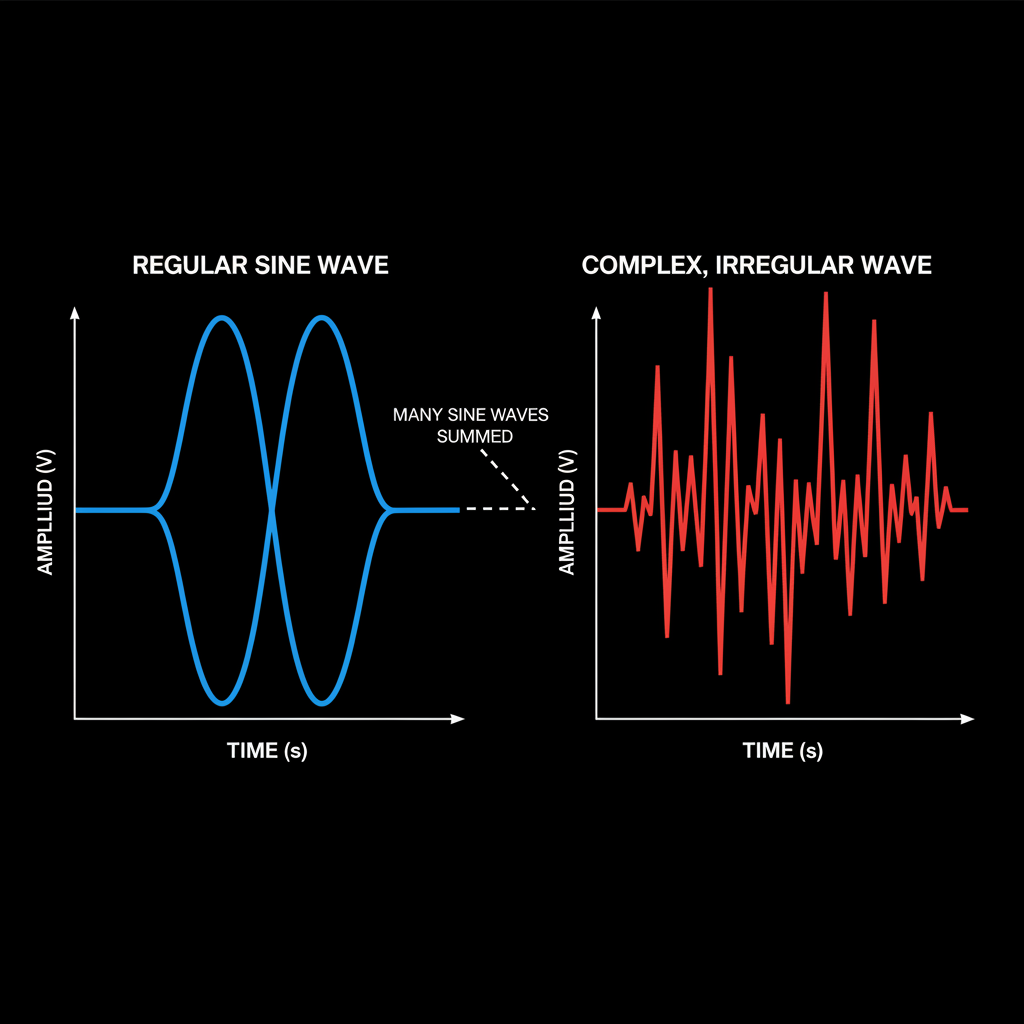 ⚠️ This picture may have spelling mistakes. Trust the words in the lesson.
Noise: The Unpredictable Sound
So, what exactly is noise? In physics terms, noise is generally considered a sound with irregular, random waveforms. There’s no clear pattern or rhythm. Think about:
- A dog barking loudly and randomly.
- Construction work with banging and drilling.
- Static on a radio.
- A crowd of people all talking at once.
These sounds often have a wide range of frequencies mixed together in an unpredictable way. Our brains find it hard to process these random patterns, which is why noise can often feel jarring or unpleasant.
Key Characteristics of Noise:
- Irregular Waveform: No repeating pattern.
- Random Frequencies: Many different pitches mixed chaotically.
- Unpredictable: Hard to guess what will happen next.
- Often Unpleasant: Can be jarring or annoying.
Music: The Organized Sound
Music, on the other hand, is generally a sound with regular, predictable waveforms. While musical sounds can be complex, their waveforms have patterns that our brains can more easily recognize and follow. This organization is what makes music pleasing to our ears.
Think about:
- A single note played on a piano.
- A singer’s voice hitting a clear note.
- A steady drumbeat.
Music often involves specific frequencies (notes) played in a structured way, with a clear rhythm and melody. Even complex music, like an orchestra playing, has underlying patterns that make it sound organized rather than chaotic.
Key Characteristics of Music:
- Regular/Patterned Waveform: Predictable structures.
- Specific Frequencies (Notes): Organized pitches.
- Rhythm and Melody: Organized patterns in time.
- Often Pleasant: Perceived as enjoyable or beautiful.
Is It Always Black and White?
It’s important to remember that the line between noise and music can be blurry! What one person considers music, another might find annoying. For example:
- A baby’s cry is a loud, often irregular sound that most adults would consider noise, but a parent might hear it as a vital signal they need to respond to.
- Some modern music genres use sounds that might seem chaotic to someone who prefers classical music.
- A street musician might sound like noise to someone trying to sleep, but a passerby might enjoy the melody.
Our perception of sound is influenced by our experiences, preferences, and even our emotional state. However, from a physics perspective, the difference boils down to the predictability and organization of the sound waves.
Putting It All Together
So, the next time you hear a sound, think about its properties:
- Is it loud or soft? (Amplitude)
- Is it high or low pitched? (Frequency)
- Does it sound chaotic or organized? (Waveform)
If a sound is random and unpredictable, it’s likely noise. If it has clear patterns and organization, it’s likely music. It’s all about the waves!
Keep learning, free
Create a free Syllabax account to unlock practice questions and games for this topic.
Visual Learning Enhanced! 🚀
To help you master this topic, we use Advanced Syllabax AI to generate detailed diagrams and visual models.
Note on Visuals: The AI sometimes makes spelling errors in image labels. Please refer to the lesson text for the correct terminology.