Introduction to Probability
Watch this topic in 60 seconds
Free preview · Lesson 1
Understanding Introduction to Probability
Introduction to Probability: What are the Chances?
Hello, young mathematicians! Today, we're going on an exciting adventure into the world of 'Probability.' Don't worry, it's not as tricky as it sounds. Probability is all about figuring out the chances of something happening. It helps us guess if an event is very likely to happen, not likely at all, or somewhere in between. Think of it like being a detective, trying to predict the future based on clues!
What Does 'Probability' Mean?
Imagine you're about to play a game, or maybe you're wondering if it will rain tomorrow. Probability is the way we talk about how likely something is to happen. It's like asking: 'What are the chances?'
For example, if you toss a coin, what are the chances it will land on 'heads'? Or if you close your eyes and pick a crayon from a box, what are the chances you'll pick your favorite color?
Words We Use for Probability
We use special words to describe how likely something is. Let's learn them!
1. Certain
If something is certain to happen, it means it WILL happen, no doubt about it! It's 100% going to occur. There's no way it won't happen.
- Analogy: Think about the sun. Is it certain that the sun will rise tomorrow morning? Yes! Unless something really strange happens to the Earth, the sun always rises. It's a certain event.
- Another Example: Is it certain that if you drop a ball, it will fall towards the ground? Yes! Gravity makes it certain.
- Activity: If you have a bag full of only red marbles, and you pick one out, is it certain you will pick a red marble? Absolutely!
2. Impossible
If something is impossible, it means it CANNOT happen, ever! There's no chance at all, zero percent. It simply won't occur.
- Analogy: Can a fish ride a bicycle? No, that's impossible! Fish live in water and don't have legs to pedal.
- Another Example: Is it impossible for a square to have five sides? Yes, a square *always* has four sides. A shape with five sides is a pentagon, not a square.
- Activity: If you have a bag full of only red marbles, is it impossible to pick a blue marble? Yes, because there are no blue marbles in the bag!
3. Likely
If something is likely to happen, it means it probably WILL happen, but it's not 100% sure. It has a good chance of happening.
- Analogy: Imagine it's a very cloudy day, and the weather person says there's an 80% chance of rain. Is it likely to rain? Yes, there's a good chance! It might not, but it's more probable than not.
- Another Example: If you have a bag with 9 red marbles and only 1 blue marble, and you pick one without looking, is it likely you'll pick a red marble? Yes, because there are many more red marbles than blue ones!
- Activity: If your best friend is always on time for school, is it likely they will be on time tomorrow? Yes, based on their past behavior.
4. Unlikely
If something is unlikely to happen, it means it probably WILL NOT happen, but it's not impossible. It has a small chance of happening.
- Analogy: It's a sunny day, with clear blue skies, and the weather person says there's only a 5% chance of rain. Is it unlikely to rain? Yes, it probably won't, but it's not impossible for a surprise shower.
- Another Example: Using that same bag with 9 red marbles and 1 blue marble, is it unlikely you'll pick the blue marble? Yes, because there's only one blue marble out of ten!
- Activity: If you live in a warm place like Florida, is it unlikely to snow in July? Yes, it almost never snows there, especially in summer!
5. Equally Likely
If two (or more) things are equally likely, it means they have the exact same chance of happening. No one event has an advantage over the other.
- Analogy: When you flip a fair coin, there are two sides: heads or tails. Is it equally likely to land on heads as it is to land on tails? Yes! Each side has an equal 50/50 chance.
- Another Example: If you have a spinner with exactly half red and half blue sections, is it equally likely to land on red as it is to land on blue? Yes, because each color takes up the same amount of space.
- Activity: If you have a bag with 5 red marbles and 5 blue marbles, and you pick one without looking, is it equally likely to pick a red or a blue marble? Yes, because there's the same number of each color.
Let's Practice with Examples!
Coin Flip
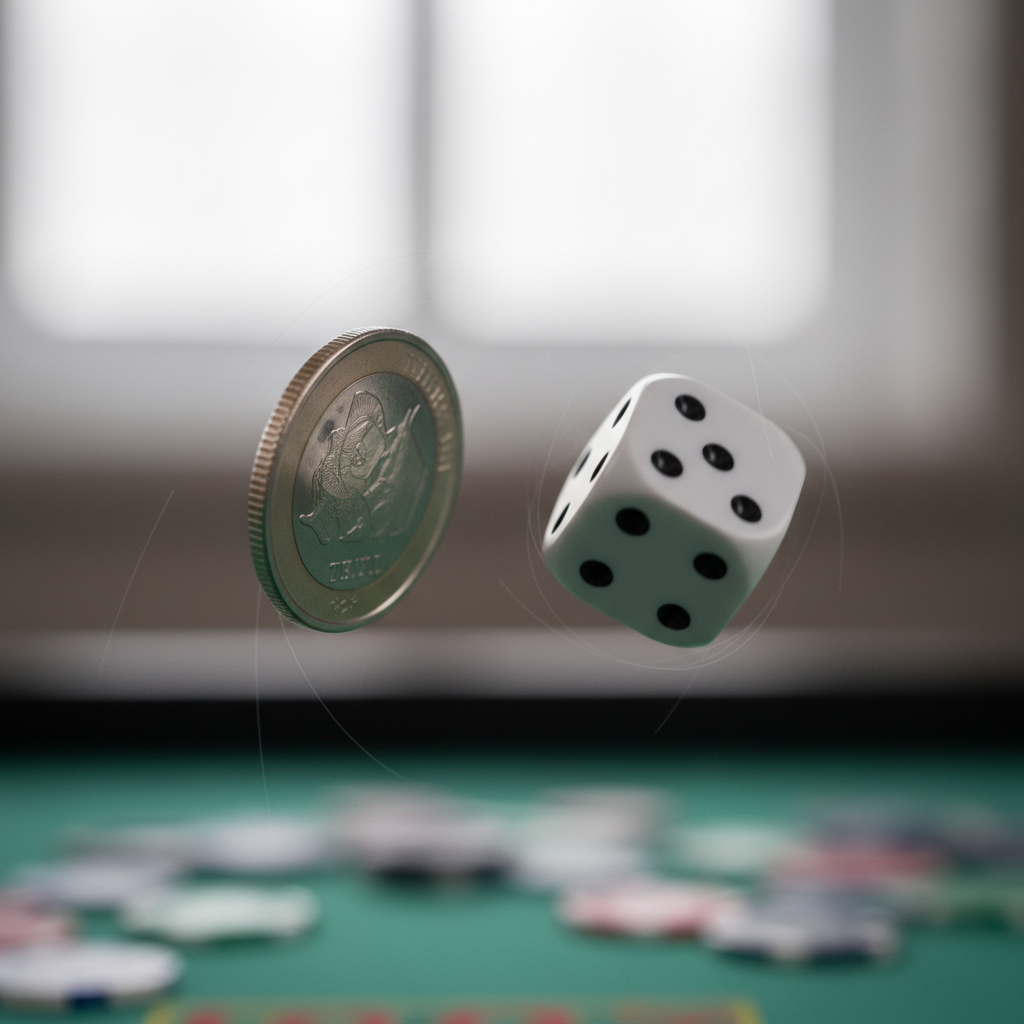
When you flip a coin, there are two possible outcomes: heads or tails. Since a coin is usually fair, each outcome has the same chance. So, landing on heads is equally likely as landing on tails.
Rolling a Die
A standard die has 6 sides, numbered 1 to 6. When you roll it, each number (1, 2, 3, 4, 5, or 6) is equally likely to come up. There's no magic side that comes up more often!
Spinner Games
Imagine a spinner for a board game. If the spinner has a large blue section and a tiny red section, is it equally likely to land on blue as red? No! It's much more likely to land on blue and unlikely to land on red because blue takes up more space.
Why is Probability Important?
Probability isn't just for games! Grown-ups use it all the time:
- Weather forecasts: When you hear there's a 70% chance of rain, that's probability helping you decide if you need an umbrella.
- Doctors: They use probability to understand how likely a medicine is to work.
- Sports: Coaches use it to guess how likely their team is to win a game against another team.
- Games & Lotteries: Probability tells us how hard it is to win!
Time to Review!
So, we've learned that probability helps us understand the chances of things happening. We have special words to describe these chances:
- Certain: Will definitely happen.
- Impossible: Will definitely NOT happen.
- Likely: Probably will happen (good chance).
- Unlikely: Probably will NOT happen (small chance).
- Equally Likely: Each option has the same chance.
Keep your eyes open, and you'll start seeing probability everywhere in your daily life!
Keep learning, free
Create a free Syllabax account to unlock practice questions and games for this topic.
Visual Learning Enhanced! 🚀
To help you master this topic, we use Advanced Syllabax AI to generate detailed diagrams and visual models.
Note on Visuals: The AI sometimes makes spelling errors in image labels. Please refer to the lesson text for the correct terminology.