Learning Journey
Free preview · Lesson 1
Understanding Musical vs noise[PHYSICS]
Musical vs. Noise: What's the Difference? (Physics)
Have you ever wondered why some sounds make you want to tap your feet and sing along, while others just make you want to cover your ears? That's because not all sounds are created equal! In physics, we can explain the difference between pleasant musical sounds and jarring, unpleasant noises based on how the sound waves are produced and how our ears perceive them.
What is Sound?
Before we dive into musical sounds and noise, let's quickly remember what sound is. Sound is created when something vibrates. Think about plucking a guitar string – it vibrates, and that vibration travels through the air as a wave. When this wave reaches your ears, your brain interprets it as sound. These vibrations can travel through solids, liquids, and gases, but we often experience them traveling through the air.
Sound Waves: The Building Blocks
Sound travels in waves, much like ripples on a pond after you throw a stone. These sound waves have different characteristics that affect how we hear them. The two most important characteristics for understanding musical sounds and noise are:
- Frequency: This tells us how fast the sound wave is vibrating. We hear frequency as pitch. High frequency means a high pitch (like a tiny squeaky toy), and low frequency means a low pitch (like a big booming drum).
- Amplitude: This tells us how strong the vibration is. We hear amplitude as loudness or volume. A large amplitude means a loud sound, and a small amplitude means a quiet sound.
Musical Sounds: Organized Vibrations
Musical sounds are usually produced by objects that vibrate in a very regular, predictable way. Think about a musical instrument:
- A Guitar String: When you pluck a guitar string, it vibrates back and forth at a specific, consistent rate. This creates a sound wave with a dominant, clear frequency.
- A Tuning Fork: When you strike a tuning fork, it vibrates uniformly, producing a pure, steady tone.
- A Singer's Voice: A singer's vocal cords vibrate in a controlled manner to produce specific notes.
These regular vibrations create sound waves that are mostly made up of a fundamental frequency (the main note you hear) and several harmonics (which are multiples of the fundamental frequency). Harmonics add richness and complexity to the sound, making it pleasing to our ears. Think of harmonics as the "flavor" that makes a violin sound different from a piano, even when they play the same note at the same loudness.
Analogy: Imagine building with LEGO bricks. Musical sounds are like building something with carefully chosen, uniform bricks that fit together perfectly. The structure is organized and stable.
Key features of musical sounds:
- Regular Vibrations: The source of the sound vibrates consistently.
- Pure Tones or Complex Tones with Harmonics: Often, there's a main pitch and supporting pitches that blend well.
- Pleasing to the Ear: Generally perceived as enjoyable, melodic, or harmonious.
Noise: Disorganized Vibrations
Noise, on the other hand, is typically caused by vibrations that are irregular, random, and unpredictable. Instead of a clear, dominant frequency, noise contains a jumble of many different frequencies at various amplitudes.
- A Rock Dropped in Water: When a rock hits the water, it creates many splashes and ripples of different sizes and speeds, leading to a chaotic sound.
- Static on a Radio: This is random electrical interference, not a structured sound wave.
- A Car Horn in Traffic: The complex interactions of engines, horns, and other sounds create a mixture of frequencies.
- Someone Shouting Randomly: Uncontrolled vocalizations lack the organized pattern of singing.
Noise is essentially a mixture of many frequencies without a clear pattern or dominant pitch. Our brains find it difficult to organize and interpret these jumbled waves, which is why they often sound harsh or unpleasant.
Analogy: Think of noise like trying to build with a pile of broken, mismatched LEGO bricks that don't fit together. The result is chaotic and unstable.
Key features of noise:
- Irregular Vibrations: The source of the sound vibrates randomly.
- Mixture of Frequencies: Many different frequencies are present at once, without a clear pattern.
- Unpleasant to the Ear: Generally perceived as jarring, harsh, or annoying.
The Importance of Waveform
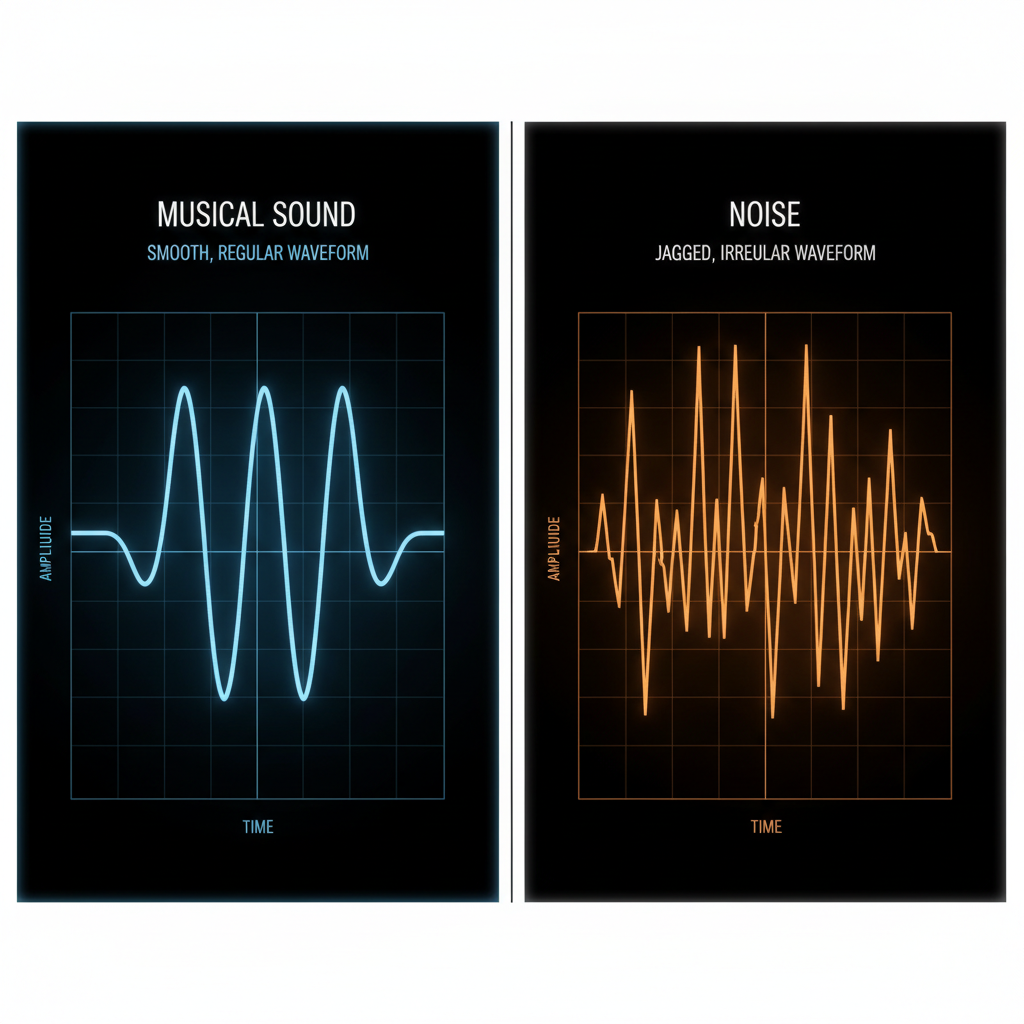
We can visualize these differences using graphs called waveforms. A waveform shows how the amplitude of a sound wave changes over time.
- Musical Sound Waveform: Usually looks smooth and regular, like a gentle wave on the ocean. You can see a clear pattern repeating.
- Noise Waveform: Looks jagged and chaotic, with no repeating pattern. It's like a stormy, choppy sea.
 ⚠️ This picture may have spelling mistakes. Trust the words in the lesson.
Is it Always Black and White?
It's important to remember that the line between music and noise can sometimes be blurry!
- What one person finds musical, another might find noisy. Some people enjoy certain types of rock music or electronic music that have complex sounds. Others might find it too loud or chaotic.
- Context matters. The sound of a rainstorm can be very peaceful (musical) to some, while the same sound might be disruptive (noise) to someone trying to sleep.
- Instruments can make noise. If a guitar string is broken or played very badly, it can sound like noise.
However, in physics, we use the concepts of organized (regular) and disorganized (irregular) vibrations to make a clear distinction between sounds that are typically considered musical and those considered noise.
In Summary
The fundamental difference between musical sound and noise lies in the regularity of the vibrations that produce them. Musical sounds come from organized vibrations and have clear frequencies, while noise comes from disorganized, random vibrations with a jumble of frequencies.
Keep learning, free
Create a free Syllabax account to unlock practice questions and games for this topic.
Visual Learning Enhanced! 🚀
To help you master this topic, we use Advanced Syllabax AI to generate detailed diagrams and visual models.
Note on Visuals: The AI sometimes makes spelling errors in image labels. Please refer to the lesson text for the correct terminology.