Introduction to Robotics
Watch this topic in 60 seconds
Free preview · Lesson 1
Understanding Introduction to Robotics
Introduction to Robotics: Your Robot Friends!
Welcome, young explorers, to the exciting world of robots! Have you ever seen a robot? Maybe on TV, in a movie, or even a toy that moves and talks? Robots are everywhere, helping us in amazing ways, and today, we're going to learn all about them. Don't worry, we'll use simple words and lots of fun analogies to make it super easy to understand!
What Exactly IS a Robot?
Imagine a machine that can do things on its own, almost like it has a mind! That's a robot! More specifically, a robot is a machine designed to carry out a complex series of actions automatically. Think of it like a very clever tool that can see, think (a little bit!), and then do things. It's built by humans to help us with tasks that might be too hard, too dangerous, or just too boring for us to do all the time.
Analogy Time: Think of a robot like a very smart, obedient pet. You tell your dog to 'fetch,' and it goes and gets the ball. You tell a robot to 'clean the floor,' and it vacuums the floor. The big difference is that a robot is a machine, not a living thing, and it follows precise instructions given by humans.
Where Do Robots Live and Work?
Robots are like secret agents; they're in many places you might not even realize! Let's look at some of their common 'hangouts':
- Factories: This is one of the most common places to find robots. Huge robotic arms build cars, electronics, and toys much faster and more precisely than humans ever could.
Analogy: Imagine a giant kitchen where robots are super-efficient chefs, mixing ingredients and putting them together perfectly every single time! - Homes: You might have a robot in your own house! Robotic vacuum cleaners, like a Roomba, clean your floors. Some smart speakers are like simple robots that follow your voice commands.
Analogy: These are your personal, tireless cleaning crew or information helpers, always ready to assist. - Hospitals: Robots help doctors perform surgery with incredible precision, deliver medicines, and even help patients recover.
Analogy: They're like super-focused, careful assistants for doctors and nurses, ensuring everything is done just right. - Space: Robots are our brave explorers in space! Rovers like Perseverance on Mars are robots that travel across alien planets, taking pictures and collecting samples because it's too dangerous for humans.
Analogy: They're like astronauts who don't need oxygen or food, exploring distant worlds for us! - Underwater: Special robots explore the deepest parts of the ocean, where the pressure is immense and it's pitch black. They find shipwrecks and discover new sea creatures.
Analogy: These are like super-tough deep-sea divers with special cameras, exploring mysteries no human can reach.
How Do Robots Work? The 'Robot Body Parts'
Just like you have a body, a brain, and senses, robots have their own versions of these to help them do their jobs. Let's break down the main parts:
The Body (Mechanics/Structure): This is the physical shape and all the moving parts of the robot. It could be wheels, tracks, arms, grippers (like hands), or even legs. It's what allows the robot to move around and interact with the world.
Analogy: Think of it like your skeleton and muscles. Your bones give you shape, and your muscles help you move your arms and legs. A robot's body gives it form and its motors help its parts move.
The Brain (Controller/Computer): Every robot needs a 'brain' to tell it what to do. This is usually a small computer or a special electronic circuit board. It receives information, processes it, and then sends instructions to the robot's moving parts.
Analogy: This is exactly like your brain! Your brain receives information from your eyes and ears, decides what to do, and then tells your muscles to move. A robot's brain does the same, but it follows instructions from a computer program, not its own thoughts.
The Senses (Sensors): How does a robot know what's going on around it? It uses sensors! Sensors are like the robot's eyes, ears, and touch. There are light sensors (like eyes), sound sensors (like ears), touch sensors, distance sensors (to know how far away something is), and many more.
Analogy: Imagine trying to walk around with your eyes closed! It's hard. Sensors give robots the information they need to 'see' and 'feel' their environment. A distance sensor is like a bat's sonar, telling it if a wall is near.
The Action Parts (Actuators): Once the brain decides what to do, it needs a way to actually *do* it! Actuators are the parts that make the robot move or perform actions. The most common actuators are motors, which make wheels turn or arms swing. They can also be lights that blink or speakers that make sounds.
Analogy: These are like your muscles. When your brain tells your arm to pick up a pencil, your arm muscles pull and make it happen. A robot's motors (actuators) get instructions from the brain and then move the robot's arm to pick up an object.
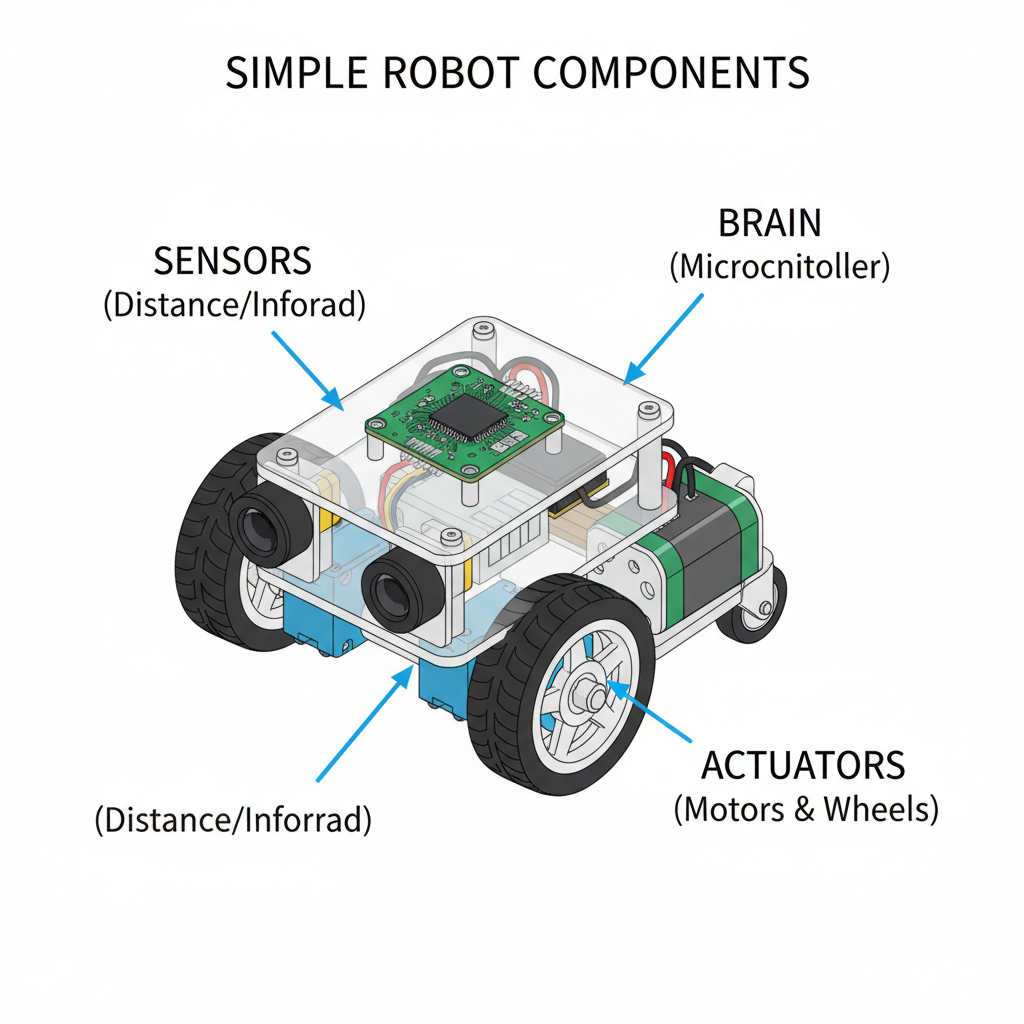 ⚠️ This picture may have spelling mistakes. Trust the words in the lesson.
How Do Robots 'Think'? (Programming)
Robots don't think like humans do. They don't have feelings or their own ideas. Instead, they follow very specific instructions given to them by humans. This set of instructions is called a 'program' or 'code'.
Analogy: Imagine you're following a recipe to bake a cake. The recipe tells you exactly what to do, step-by-step: 'Add flour,' 'Mix thoroughly,' 'Bake for 30 minutes.' A robot's program is just like that recipe. It might say: 'IF obstacle detected, THEN turn right,' or 'MOVE forward for 5 seconds.' The robot simply executes these steps perfectly, every single time.
Why Are Robots So Important?
Robots are more than just cool gadgets; they help us in many important ways:
- Safety: They can do jobs that are too dangerous for humans, like defusing bombs, cleaning up toxic waste, or exploring volcanoes.
- Accuracy & Speed: Robots can perform tasks with incredible precision and much faster than humans, which is great for building things in factories.
- Repetitive Tasks: Some jobs are very boring and repetitive. Robots don't get tired or bored, so they can do these tasks perfectly over and over again.
- Assistance: Robots can help people with disabilities, assist the elderly, or even carry heavy things for us.
- Exploration: They allow us to explore places that are impossible or too risky for humans, like deep space or the bottom of the ocean.
The Future is Robotic!
Robotics is a fast-growing field, and the robots of tomorrow will be even more amazing! They might be even better at understanding our voices, helping us learn, or even creating art. Who knows, maybe one day you'll be designing or building these incredible machines yourself!
For now, remember that robots are our mechanical helpers, designed to make our lives safer, easier, and more exciting!
Keep learning, free
Create a free Syllabax account to unlock practice questions and games for this topic.
Visual Learning Enhanced! 🚀
To help you master this topic, we use Advanced Syllabax AI to generate detailed diagrams and visual models.
Note on Visuals: The AI sometimes makes spelling errors in image labels. Please refer to the lesson text for the correct terminology.