Extraction of metals (basic metallurgy)
Watch this topic in 60 seconds
Free preview · Lesson 1
Understanding Extraction of metals (basic metallurgy)
Unearthing Riches: A Beginner's Guide to Extracting Metals
Have you ever wondered where the metal in your bicycle, the aluminum in your soda can, or the copper in electrical wires comes from? They don't just appear out of thin air! Metals are valuable treasures hidden within the Earth's crust, often mixed with other unwanted materials. The fascinating journey of getting these metals out, purifying them, and making them ready for use is called metallurgy, or more simply, metal extraction.
What is Metallurgy?
Imagine you're trying to find a specific, shiny toy buried in a sandbox full of ordinary sand, pebbles, and dirt. You can't just use the toy as is; you first need to dig it out, clean it, and make sure it's perfect. Metallurgy is very similar! It's the entire scientific and technological process of extracting metals from their natural sources (called ores) and then preparing them for practical use. It’s like finding a hidden treasure and then polishing it to make it useful and beautiful.
Where Do Metals Live? Understanding Ores
Think of metals as being shy. They rarely exist in a pure, free state in nature (only noble metals like gold and platinum are often found 'free'). Most metals prefer to live combined with other elements, forming compounds like oxides, sulfides, carbonates, or silicates. These compounds are found embedded within rocks. A rock from which a metal can be profitably extracted is called an ore.
- Ore Analogy: Imagine an ore as a large apartment building. Inside this building, there's a specific apartment unit (the metal compound) that you're interested in, but it's surrounded by many other unwanted apartments and common areas (the rocky impurities).
- Gangue (pronounced 'gang'): This is a fancy name for the unwanted rocky material and impurities found along with the metal compound in the ore. It's like the dirt, pebbles, and useless bits of rock that are mixed in with your valuable metal compound. You definitely don't want these impurities in your final product!
The Grand Journey: Steps of Metal Extraction
Extracting a metal is usually a multi-step process, much like preparing a complex meal. You can't just throw all ingredients together; you need to clean, chop, cook, and then present! Here are the main stages:
Step 1: Crushing, Grinding, and Concentration of the Ore (Making it Ready)
Before you can even think about getting the metal out, you need to prepare the ore. Imagine mining a huge chunk of rock from the Earth. It's too big to work with! So, the first sub-steps involve:
- Crushing and Grinding: The large chunks of ore are first crushed into smaller pieces using powerful machinery, then ground into a fine powder (like flour) in ball mills or stamp mills. This increases the surface area, which helps in the next steps.
- Concentration (or Enrichment) of the Ore: This is where we get rid of as much of the unwanted gangue as possible. It's like sifting flour to remove lumps or washing vegetables before cooking. The goal is to increase the percentage of the valuable metal compound in the ore. Different methods are used depending on the physical properties of the ore and the gangue:
- Hand Picking: For ores where the metal-containing part and gangue are visibly different and large enough, workers simply pick out the unwanted material by hand. (Analogy: Picking out rotten apples from a basket).
- Hydraulic Washing (Gravity Separation): This method uses water to separate particles based on their density. The powdered ore is washed with a stream of water; the heavier metal particles settle down, while the lighter gangue particles are washed away. (Analogy: Panning for gold – the heavy gold stays, the lighter sand washes away).
- Froth Flotation Method: This is brilliant for sulfide ores (like copper sulfide). The powdered ore is mixed with water and a special oil (like pine oil) to form a slurry. Air is then blown through the mixture. The oil sticks to the metal sulfide particles, making them lighter and causing them to float to the surface as a 'froth' (foam), while the heavier gangue sinks to the bottom. (Analogy: Imagine mixing tiny wood chips and tiny stones in water; if you add something that makes the wood chips float, you can scoop them off, leaving the stones behind).
- Magnetic Separation: If either the ore or the gangue is magnetic, this method is used. The powdered ore is passed over a magnetic roller. The magnetic particles stick to the roller and are carried further before falling off, while the non-magnetic particles fall directly. (Analogy: Using a magnet to pick up iron filings from sand).
After concentration, we have an 'enriched' ore with a much higher percentage of the desired metal compound.
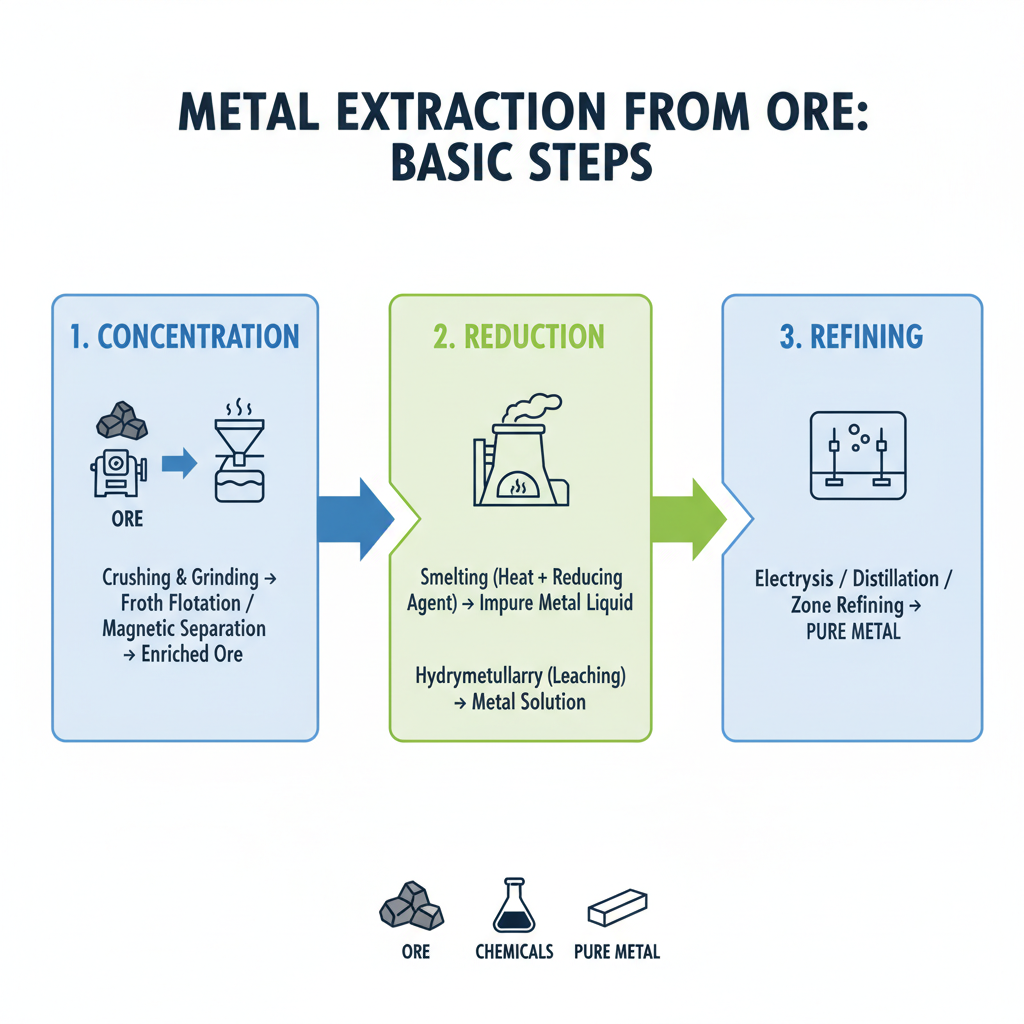 ⚠️ This picture may have spelling mistakes. Trust the words in the lesson.
Step 2: Conversion of Concentrated Ore to Crude Metal (Getting the Metal Out)
Now that we have a concentrated ore, our next big challenge is to actually separate the metal from its compound form. This often involves two main sub-steps:
-
Converting the Ore into Metal Oxide (If it's not already an oxide): Many reduction processes work best with metal oxides. So, if our ore is a carbonate or a sulfide, we first convert it into an oxide.
- Calcination: This process involves heating a carbonate ore (e.g., zinc carbonate) strongly in the absence of air (or with very limited air). It removes volatile impurities and breaks down carbonates into oxides, releasing carbon dioxide. (Analogy: Baking a cake in a sealed oven to remove moisture or other gases without letting them react with outside air).
Example: Zinc carbonate (ZnCO3) → Zinc oxide (ZnO) + Carbon dioxide (CO2) - Roasting: This process involves heating a sulfide ore (e.g., zinc sulfide) strongly in the presence of excess air. The sulfur reacts with oxygen to form sulfur dioxide, and the metal sulfide converts into a metal oxide. (Analogy: Toasting bread – you need air to burn the surface and change it, but you're not trying to completely burn it to ash).
Example: Zinc sulfide (ZnS) + Oxygen (O2) → Zinc oxide (ZnO) + Sulfur dioxide (SO2)
- Calcination: This process involves heating a carbonate ore (e.g., zinc carbonate) strongly in the absence of air (or with very limited air). It removes volatile impurities and breaks down carbonates into oxides, releasing carbon dioxide. (Analogy: Baking a cake in a sealed oven to remove moisture or other gases without letting them react with outside air).
-
Reduction of the Metal Oxide to Crude Metal: This is the crucial step where we get the pure metal atom out of its oxide compound. 'Reduction' in chemistry means gaining electrons, often by removing oxygen. We use a 'reducing agent' to do this, which is a substance that takes away the oxygen from the metal oxide.
- Reduction by Carbon (Smelting): For moderately reactive metals (like iron, zinc, lead), carbon (usually in the form of coke) is a common and cheap reducing agent. The metal oxide is heated with coke, and the carbon 'steals' the oxygen, leaving the metal behind. This process is often done in a large furnace, like a blast furnace for iron. (Analogy: Imagine a tug-of-war where oxygen is tied to the metal, and carbon is a strong friend who pulls the oxygen away).
Example: Iron oxide (Fe2O3) + Carbon (C) → Iron (Fe) + Carbon dioxide (CO2) - Reduction by More Reactive Metals: For some metals, carbon isn't strong enough. In these cases, a more reactive metal (like aluminum) can be used as a reducing agent to extract a less reactive metal from its oxide. (Analogy: A bigger, stronger kid takes a toy from a smaller kid). This is used in the thermite reaction to extract iron from iron oxide using aluminum powder.
- Electrolytic Reduction (Electrolysis): For highly reactive metals (like sodium, potassium, calcium, magnesium, and aluminum), which form very stable oxides, neither carbon nor more reactive metals can easily reduce them. Instead, we use electricity! The molten metal oxide or chloride is passed through an electric current. The electric current breaks the strong bonds, depositing the pure metal at the cathode (negative electrode). (Analogy: Using a powerful electrical 'magnet' to pull the metal atoms apart from their partners). This is an energy-intensive but very effective method.
- Reduction by Carbon (Smelting): For moderately reactive metals (like iron, zinc, lead), carbon (usually in the form of coke) is a common and cheap reducing agent. The metal oxide is heated with coke, and the carbon 'steals' the oxygen, leaving the metal behind. This process is often done in a large furnace, like a blast furnace for iron. (Analogy: Imagine a tug-of-war where oxygen is tied to the metal, and carbon is a strong friend who pulls the oxygen away).
After this step, we have 'crude' or 'impure' metal. It's metal, but it still contains some unwanted impurities that need to be removed.
Step 3: Refining (Purification) of Crude Metal (Making it Sparkling Pure)
The crude metal obtained from the reduction process is rarely 100% pure. It usually contains small amounts of other metals or non-metals. For most applications, we need metals to be very pure, so a final purification step, called refining, is essential. It's like polishing a raw gemstone to make it sparkle.
There are several refining methods, but the most common and important one for many metals (like copper, zinc, nickel) is:
- Electrolytic Refining: This is a very effective method for getting highly pure metals. It uses electricity to move pure metal from an impure block to a pure sheet.
- The impure metal is made the anode (positive electrode).
- A thin strip of pure metal is made the cathode (negative electrode).
- Both are placed in an electrolytic solution containing a salt of the same metal.
- When electricity is passed, metal ions from the impure anode dissolve into the solution, and then pure metal ions from the solution deposit onto the pure cathode. The impurities either sink below the anode (as 'anode mud') or dissolve into the electrolyte. (Analogy: Imagine a dirty sponge (impure metal) losing its clean water (metal ions) into a basin, and then a clean, thirsty sponge (pure metal) soaking up only the clean water from the basin, leaving the dirt behind).
Other methods like distillation (for low-boiling metals like zinc, mercury) and zone refining (for ultra-pure metals used in semiconductors) also exist, but electrolytic refining is key for many common metals.
The Cycle of Metals
So, from a simple rock in the ground to the shiny, useful objects all around us, metals undergo an incredible transformation. This journey from ore to pure metal is a testament to human ingenuity and our understanding of chemistry. Next time you see a metal object, remember the amazing process it went through to get to you!
Keep learning, free
Create a free Syllabax account to unlock practice questions and games for this topic.
Visual Learning Enhanced! 🚀
To help you master this topic, we use Advanced Syllabax AI to generate detailed diagrams and visual models.
Note on Visuals: The AI sometimes makes spelling errors in image labels. Please refer to the lesson text for the correct terminology.