Area of triangle (basic) [Area]
Watch this topic in 60 seconds
Free preview · Lesson 1
Understanding Area of triangle (basic) [Area]
Understanding the Area of a Triangle: A Gentle Introduction
Hello, future mathematicians! Today, we're going on an exciting adventure to discover the secret behind the area of a triangle. Don't worry, it's not as complicated as it sounds! We'll use simple words and fun examples to make sure you understand it completely.
What is Area?
Before we talk about triangles, let's understand what 'area' means. Imagine you have a piece of paper. The area is like the amount of space that piece of paper covers. It's the total surface inside its edges. Think of it like painting a wall. The area is how much paint you'll need to cover the entire wall. Or, if you're laying carpet in a room, the area tells you how much carpet you need to buy to cover the floor. Area is always measured in square units, like square inches (in²) or square centimeters (cm²).
What is a Triangle?
Now, let's talk about triangles! You've probably seen them everywhere. A triangle is a shape with three straight sides and three corners (called vertices). Think of a slice of pizza, a slice of watermelon, a roof of a house, or even the pointy part of an arrow – these are all shapes that are similar to triangles!
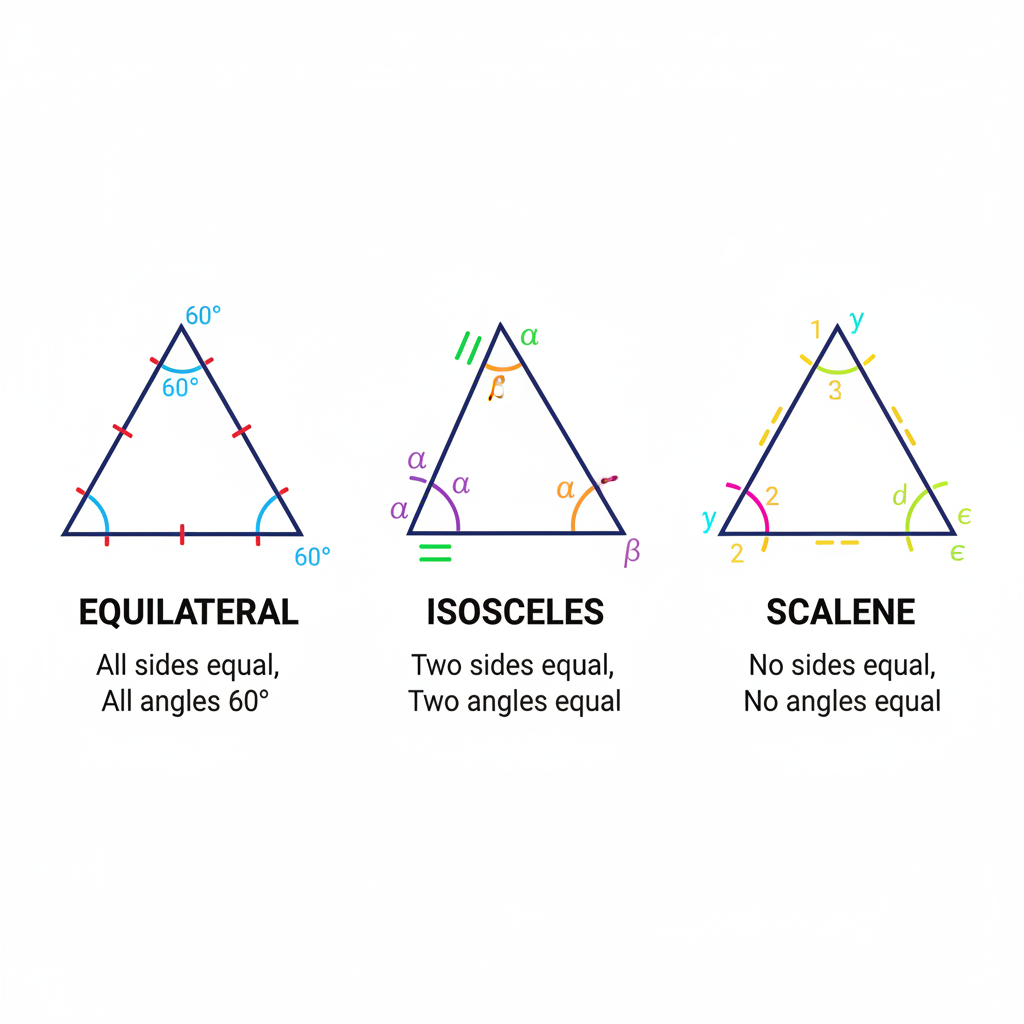
There are different kinds of triangles, but for now, we'll focus on finding the area of any triangle.
Triangles and Rectangles: A Special Friendship
Here's a super cool secret: every triangle is like half of a rectangle or a parallelogram! Imagine you have a rectangle. If you draw a line from one corner to the opposite corner (this line is called a diagonal), you cut the rectangle into two identical triangles. See?
Let's say you have a rectangular garden. If you wanted to divide it in half by making a diagonal path, you would create two triangular sections. The area of each triangle would be exactly half the area of the original rectangular garden!
How to Find the Area of a Triangle: The Magic Formula!
Because a triangle is half of a rectangle (or a parallelogram), its area is also related to the rectangle's area. Remember how to find the area of a rectangle? It's length times width.
For a triangle, we need two special measurements:
- Base (b): This is one of the sides of the triangle. You can usually pick any side to be the base, but often it's the side that sits at the bottom. Think of it as the 'foot' of the triangle.
- Height (h): This is the distance from the base straight up to the opposite corner (vertex). It's like measuring how tall the triangle is. The height must make a perfect right angle (like the corner of a square) with the base. Sometimes, especially in triangles that are wide or slanted, the height might be outside the triangle, but it still measures straight up from the base line. Think of it as an imaginary ladder reaching from the base to the very top point.
The formula for the area of a triangle is:
Area = ½ × base × height
Or you can write it like this:
Area = (base × height) / 2
This formula works for ALL types of triangles!
Let's Use an Analogy!
Imagine you have a delicious rectangular cake that is 10 inches long and 4 inches wide. The area of the whole cake is 10 inches × 4 inches = 40 square inches.
Now, imagine you cut this cake diagonally into two perfect triangles. Each triangle will have a base of 10 inches and a height of 4 inches (the original length and width of the rectangle).
Using our triangle formula:
Area of one triangle = ½ × base × height
Area of one triangle = ½ × 10 inches × 4 inches
Area of one triangle = ½ × 40 square inches
Area of one triangle = 20 square inches.
This makes sense because each triangle is exactly half of the rectangular cake, and half of 40 square inches is indeed 20 square inches!
Putting it into Practice: Examples
Example 1: A Simple Triangle
Let's say a triangle has a base of 6 cm and a height of 4 cm. What is its area?
- Base (b) = 6 cm
- Height (h) = 4 cm
- Area = ½ × b × h
- Area = ½ × 6 cm × 4 cm
- Area = ½ × 24 cm²
- Area = 12 cm²
So, the area of this triangle is 12 square centimeters.
Example 2: A Slightly Different Triangle
Consider a triangle with a base of 10 inches and a height of 7 inches. Let's find its area.
- Base (b) = 10 inches
- Height (h) = 7 inches
- Area = (b × h) / 2
- Area = (10 inches × 7 inches) / 2
- Area = 70 square inches / 2
- Area = 35 square inches
The area of this triangle is 35 square inches.
Example 3: What if the Height Looks Different?
Sometimes, the height might not look like it's *inside* the triangle. This happens with wide or slanted triangles. Imagine a triangle shaped like a slice of Swiss cheese with a hole. If you want to measure its height, you might have to draw a line straight up from the base, and that line might go outside the cheesy part. But it's still the correct height!
Let's say a triangle has a base of 8 meters and its perpendicular height (the height that makes a right angle with the base) is 5 meters.
- Base (b) = 8 m
- Height (h) = 5 m
- Area = ½ × b × h
- Area = ½ × 8 m × 5 m
- Area = ½ × 40 m²
- Area = 20 m²
The area is 20 square meters. The formula remains the same!
Key Takeaways
Remember these important points:
- Area is the amount of space a 2D shape covers.
- A triangle has three sides and three corners.
- A triangle is like half of a rectangle or parallelogram.
- The area of a triangle is calculated using the formula: Area = ½ × base × height.
- The height must be perpendicular (make a right angle) to the base.
Keep practicing, and you'll become a triangle area expert in no time!
Keep learning, free
Create a free Syllabax account to unlock practice questions and games for this topic.
Visual Learning Enhanced! 🚀
To help you master this topic, we use Advanced Syllabax AI to generate detailed diagrams and visual models.
Note on Visuals: The AI sometimes makes spelling errors in image labels. Please refer to the lesson text for the correct terminology.