Learning Journey
Watch this topic in 60 seconds
Free preview · Lesson 1
Understanding Random Sampling Techniques
Exploring the World of Random Sampling: Your Guide to Fair Choices!
Welcome, 7th graders! Have you ever wondered how scientists, pollsters, or even game designers make fair decisions or learn about large groups of people without talking to *everyone*? It's all about something super important called random sampling! Think of it like being a detective trying to figure out what a huge party is like, but you only have time to talk to a few people. How do you choose those few people so your findings are accurate and fair?
1. The Big Picture vs. The Sneak Peek: Population and Sample
Imagine you have a giant bowl of delicious soup. You want to know if it needs more salt, but you don't want to eat the whole bowl! What do you do? You take a small spoonful, right? That spoonful tells you a lot about the taste of the entire bowl.
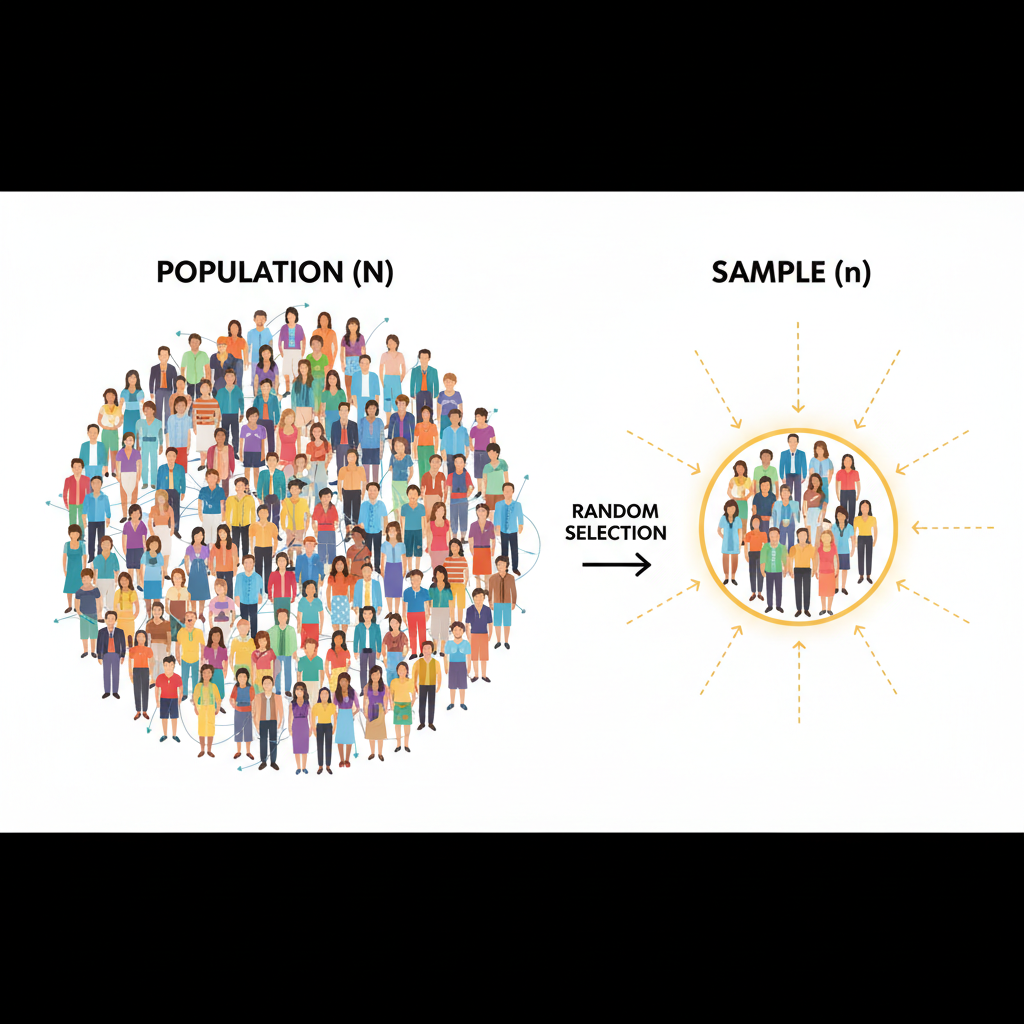
- Population: The Whole Bowl! In statistics, the population is the entire group you're interested in. It could be all the 7th graders in your school, all the trees in a forest, or every single video game ever made. It's the BIG group you want to learn about.
- Sample: The Spoonful! A sample is a smaller, carefully chosen part of the population. It's the spoonful of soup, a few 7th graders from your school, or some trees from the forest. We study the sample because studying the entire population is often too hard, too expensive, or just impossible!
The goal is for our "spoonful" (sample) to taste exactly like the "whole bowl" (population) so we can make good guesses or conclusions about the entire group.
2. Why "Random" Matters: Avoiding Bias (The Unfair Spoonful)
Now, what if, when you tasted your soup, you only took a spoonful from the very top, and all the good spices had sunk to the bottom? Your spoonful wouldn't represent the whole bowl, would it? This is what we call bias.
Bias means that your sample isn't fair or representative of the whole population. It's like asking only people who love chocolate if chocolate is the best flavor of ice cream – their answer would be biased because you didn't ask people who prefer vanilla or strawberry!
To avoid bias and get a fair, accurate "sneak peek" at the population, we use random sampling. "Random" means that every single person or item in the population has an equal chance of being chosen for the sample. It's like stirring the soup really well before you take your spoonful!
When you choose a sample randomly, you're giving everyone a fair shot, and that helps ensure your sample truly reflects the larger population.
3. Types of Random Sampling: Fair Ways to Pick!
There are different ways to be "random." Here are a few foundational methods:
a) Simple Random Sampling: The Classic "Names-in-a-Hat" Method
This is the most basic and often the best way to get a random sample! Imagine you want to pick 5 students from your class of 30 to win a prize. How would you do it fairly?
You'd write every student's name on a separate slip of paper, put all the slips into a hat, mix them up really well, and then draw 5 names without looking! Every student has an equal chance of being chosen.
- How it works: Every member of the population has an equal and independent chance of being selected. It's like a lottery!
- Analogy: Drawing names from a hat, using a random number generator on a computer to pick numbers from a list, or shuffling a deck of cards and picking the top few.
This method is great when your population isn't too large and you have a list of everyone in it.
b) Systematic Random Sampling: The "Every Nth One" Method
Sometimes, writing every name on a slip of paper is too much work, especially if you have a very large population, like all the customers walking into a store. Systematic random sampling offers a clever way to be random!
Imagine you're standing at the entrance of a theme park and want to survey 100 visitors about their favorite rides. Instead of randomly pointing at people, you decide to survey every 10th person who walks through the gate. You'd first pick a random starting point (e.g., the 3rd person), and then count every 10th person from there (3rd, 13th, 23rd, 33rd, and so on).
- How it works: You choose a random starting point and then select every Nth (e.g., every 5th, every 10th) member from a list or sequence.
- Analogy: Picking every 3rd book from a shelf, selecting every 5th student in a line during morning assembly, or inspecting every 20th item coming off an assembly line.
This method is easy to implement and can be very efficient, especially for large populations that are naturally ordered.
c) Stratified Random Sampling: The "Group First" Method (A Quick Look!)
What if your population has very different groups within it, and you want to make sure each group is fairly represented in your sample? For example, if your school has an equal number of 7th, 8th, and 9th graders, but you only pick 7th graders for your sample, it wouldn't be fair, would it?
Stratified random sampling is when you first divide your population into different groups (called "strata") based on a shared characteristic (like grade level, gender, or favorite color). Then, you take a simple random sample from *each* of those groups. This ensures that each important subgroup is represented proportionally in your overall sample.
- How it works: Divide the population into distinct subgroups (strata), then perform simple random sampling within each stratum.
- Analogy: Imagine a buffet with different food stations (Italian, Mexican, American). To taste the "whole buffet" fairly, you wouldn't just take all your food from the Italian station. Instead, you'd take a small, random sample from each station.
This method helps ensure that important variations within the population aren't missed.
4. The Power of Random Sampling: Getting the Real Picture
Using random sampling techniques is like taking a tiny, but perfectly clear, photograph of a huge scene. If your photograph is taken randomly (not just focusing on one corner), you can learn a lot about the whole scene from that small picture. It helps us make informed decisions, understand trends, and draw conclusions with confidence, knowing we've been as fair and unbiased as possible!
So, the next time you hear about a survey or a study, think about how they picked their sample. Was it random? If so, you can trust their results a lot more!
Keep learning, free
Create a free Syllabax account to unlock practice questions and games for this topic.
Visual Learning Enhanced! 🚀
To help you master this topic, we use Advanced Syllabax AI to generate detailed diagrams and visual models.
Note on Visuals: The AI sometimes makes spelling errors in image labels. Please refer to the lesson text for the correct terminology.