Sequencing: Step-by-Step Commands
Watch this topic in 60 seconds
Free preview · Lesson 1
Understanding Sequencing: Step-by-Step Commands
Learning About Sequencing: Step-by-Step Commands
Hello, young learners! Today, we're going on an exciting adventure to understand something super important called sequencing. It might sound like a big word, but it just means putting things in the right order. Think of it like a puzzle where each piece has to go in a special spot!
What is a Sequence?
A sequence is simply the order in which things happen or are done. Imagine telling a story – you start at the beginning, then go to the middle, and finally end the story. You wouldn't tell the ending first, would you? That's a sequence!
Analogy Time!
Think about a train! Each car of the train follows the one in front of it, in a perfect line. If the cars were all mixed up, the train wouldn't be able to move forward! That straight line is like a sequence.
What are Step-by-Step Commands?
When we talk about step-by-step commands, we're talking about instructions that tell you exactly what to do, one thing after another, in a specific order. Each 'step' is a small action, and a 'command' is like a friendly instruction telling you what that action is.
Why do we need step-by-step commands? Because sometimes, if you don't follow the instructions in the correct order, things can get a little messy, or even not work at all!
Analogy Time!
Imagine you want to build a tower with LEGOs. If you put the top piece on first, before you've even built the bottom, your tower would fall right over! You need to follow the steps: first the base, then the next layer, then the next, and so on. Each LEGO piece is a step, and the instructions are the commands.
Why is Following the Order So Important?
Following a sequence or step-by-step commands is super important for many reasons:
- Things Work Properly: If you mix up the steps, your plan might not work.
- Clear and Easy to Understand: When things are in order, everyone can understand them better.
- Achieve Your Goal: Whether it's making a yummy snack or getting ready for school, following the steps helps you get it done right.
Remember: The right order makes things happen the right way!
Everyday Examples of Sequencing!
1. Getting Ready for School
Think about your morning routine. You don't put your shoes on before your socks, do you? And you probably don't eat breakfast after you've already left for school! Here's a common sequence:
- Wake up
- Get out of bed
- Brush your teeth
- Wash your face
- Get dressed (socks first, then shoes!)
- Eat breakfast
- Pack your bag
- Go to school!
2. Making a Delicious Sandwich
Let's make a peanut butter and jelly sandwich! If you just put everything on the table at once, it wouldn't be a sandwich, would it? You need steps!
- Get two slices of bread.
- Spread peanut butter on one slice.
- Spread jelly on the other slice.
- Put the two slices of bread together.
- Enjoy your sandwich!
If you put the bread together before spreading the peanut butter and jelly, it would be much harder, wouldn't it? The order matters!
after you've mixed everything and put it in the pan.Analogy Time!
Imagine a superhero's instructions for saving the day! First, they need to put on their super suit. Second, they need to fly to the city. Third, they need to stop the bad guy. If they tried to stop the bad guy without their super suit, or before flying to the city, it probably wouldn't go very well!
4. Playing a Game
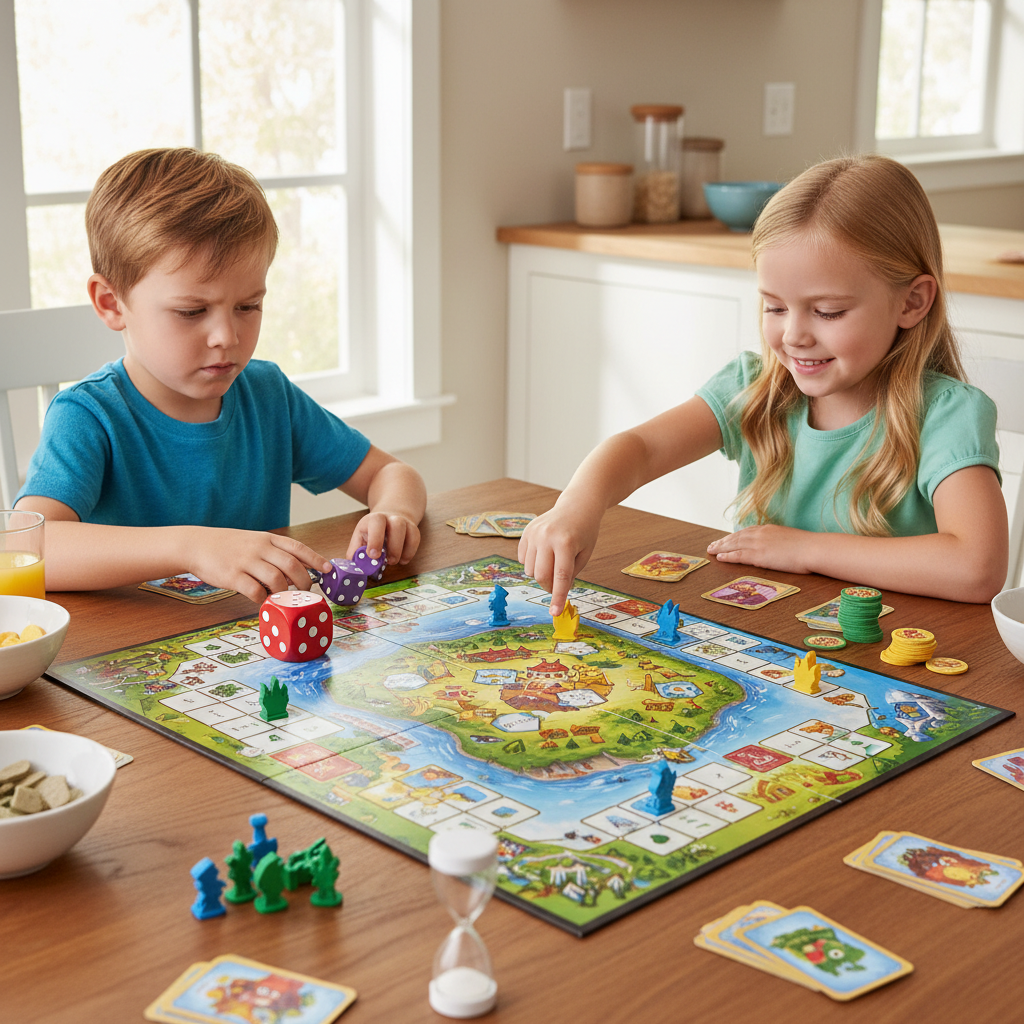
Think about a board game like 'Snakes and Ladders' or 'Candy Land.' There are rules and a specific order to play:
- Roll the dice.
- Move your game piece.
- Follow the instructions on the square you land on (like going up a ladder or down a snake!).
- Wait for the next player's turn.
You can't move your piece before you roll the dice! The game wouldn't make sense.
 ⚠️ This picture may have spelling mistakes. Trust the words in the lesson.
Thinking Like a Computer!
Even computers follow sequences! When you click on an app on a tablet, the tablet follows a sequence of commands: 'detect touch,' 'open app,' 'show app screen.' If those commands got mixed up, the tablet wouldn't know what to do!
Challenge: Look around your house today! Can you find 3 more things that need to be done in a specific sequence? Maybe folding laundry, watering a plant, or helping to set the table!
Let's Review!
Sequencing and step-by-step commands are all about doing things in the right order. From brushing your teeth to building a fort, following the steps makes sure everything works smoothly and correctly. Keep practicing your sequencing skills every day!
Keep learning, free
Create a free Syllabax account to unlock practice questions and games for this topic.
Visual Learning Enhanced! 🚀
To help you master this topic, we use Advanced Syllabax AI to generate detailed diagrams and visual models.
Note on Visuals: The AI sometimes makes spelling errors in image labels. Please refer to the lesson text for the correct terminology.