Learning Journey
Watch this topic in 60 seconds
Free preview · Lesson 1
Understanding Identifying & comparing fractions (Fractions)
Understanding Fractions: The Building Blocks of Parts!
Welcome to the wonderful world of fractions! You've already learned about whole numbers, like 1 apple or 5 cookies. Now, we're going to explore what happens when we have parts of things. Think of it like sharing a pizza or a cake – you don't always eat the whole thing, right? Fractions help us talk about those delicious slices!
What is a Fraction?
A fraction is simply a way to represent a part of a whole. Imagine you have a whole chocolate bar. If you break it into equal pieces, each piece is a fraction of the whole chocolate bar.
Fractions have two main parts:
- The Numerator: This is the top number in a fraction. It tells us how many parts we have or are talking about. Think of it as the 'number of pieces you took'.
- The Denominator: This is the bottom number in a fraction. It tells us how many equal parts the whole thing is divided into. Think of it as the 'total number of slices in the whole pie'.
We write fractions with a line in between the numerator and the denominator. For example, if a pizza is cut into 8 equal slices, and you eat 3 of them, the fraction representing the pizza you ate is 3/8. Here, 3 is the numerator (how many slices you ate) and 8 is the denominator (the total number of slices the pizza was cut into).
Visualizing Fractions: Pictures Help!
Sometimes, the best way to understand fractions is to see them! Let's imagine some scenarios:
Scenario 1: The Sharing Cookie
Imagine a giant chocolate chip cookie. If you cut it into 4 equal pieces, the whole cookie is divided into 4 parts. Each piece is 1/4 of the cookie. If you eat 1 piece, you ate 1/4. If you ate 2 pieces, you ate 2/4. If you ate all 4 pieces, you ate 4/4, which is the whole cookie!
Scenario 2: The Birthday Cake
Your birthday cake is cut into 6 equal slices. The whole cake is divided into 6 parts. Each slice is 1/6 of the cake. If your friends eat 3 slices, they ate 3/6 of the cake. If they eat 5 slices, they ate 5/6 of the cake.
Here’s a visual representation:
In this picture, the pizza is divided into 8 equal parts (the denominator is 8). We can see that 3 of those parts have been taken or are being considered (the numerator is 3). So, the fraction of the pizza shown as eaten is 3/8.
Comparing Fractions: Which Slice is Bigger?
Comparing fractions is like asking, "Which is a bigger slice of pie?" or "Who ate more pizza?" We need to compare the amounts represented by the fractions.
Case 1: Same Denominators (Same Size Slices)
If the fractions have the same denominator, it means the whole was divided into the same number of equal parts. Think of it like comparing two pizzas that were both cut into 8 slices.
- Pizza A: You ate 3 slices (3/8).
- Pizza B: Your friend ate 5 slices (5/8).
Since both pizzas were cut into 8 slices, the slices are the same size. To compare 3/8 and 5/8, we just look at the numerators. The person who ate 5 slices ate more pizza than the person who ate 3 slices. So, 5/8 is greater than 3/8.
Rule: When denominators are the same, the fraction with the larger numerator is the larger fraction.
Case 2: Same Numerators (Same Number of Slices Taken)
Now, let's think about a different situation. Imagine two pies, both cut into different numbers of slices, but you and a friend both take the same number of slices.
- Pie A: Cut into 4 slices. You took 1 slice (1/4).
- Pie B: Cut into 6 slices. Your friend took 1 slice (1/6).
Here, the numerators are the same (1), but the denominators are different (4 and 6). Which slice is bigger? Think about it: if Pie A is cut into fewer slices (4), each slice has to be bigger to make up the whole pie. If Pie B is cut into more slices (6), each slice will be smaller.
So, 1/4 is greater than 1/6 because the slice from the pie cut into 4 parts is larger than the slice from the pie cut into 6 parts.
Rule: When numerators are the same, the fraction with the smaller denominator is the larger fraction.
Visualizing Comparisons
Let's use our pizza example again. Imagine two pizzas, both round and the same size:
Pizza 1 is cut into 4 equal slices. If you eat 1 slice, you eat 1/4. This is a pretty big slice!
Pizza 2 is cut into 8 equal slices. If you eat 1 slice, you eat 1/8. This is a much smaller slice.
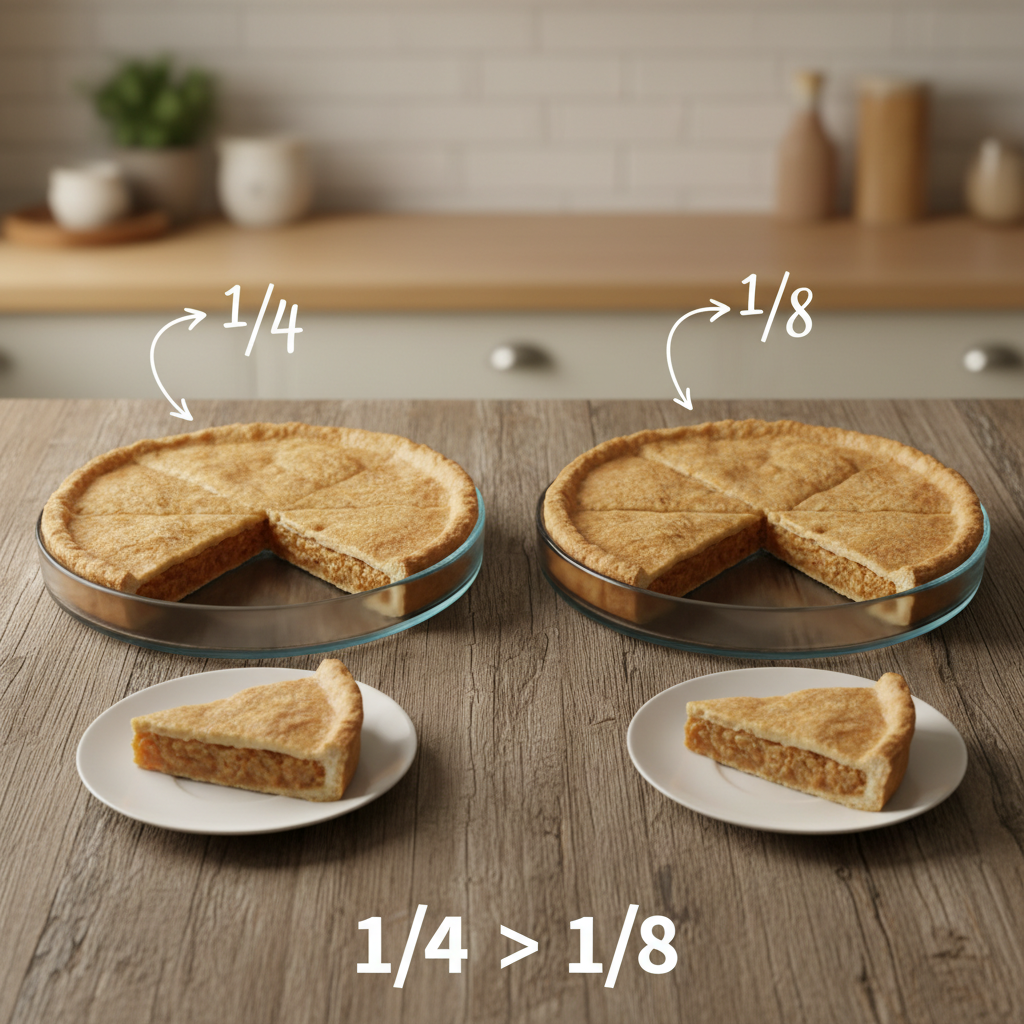
This picture clearly shows that the 1/4 slice is larger than the 1/8 slice.
Key Ideas to Remember!
- A fraction represents a part of a whole.
- The numerator is the top number (how many parts you have).
- The denominator is the bottom number (total equal parts in the whole).
- When comparing fractions with the same denominator, the one with the bigger numerator is bigger.
- When comparing fractions with the same numerator, the one with the smaller denominator is bigger.
Keep learning, free
Create a free Syllabax account to unlock practice questions and games for this topic.
Visual Learning Enhanced! 🚀
To help you master this topic, we use Advanced Syllabax AI to generate detailed diagrams and visual models.
Note on Visuals: The AI sometimes makes spelling errors in image labels. Please refer to the lesson text for the correct terminology.