Learning Journey
Watch this topic in 60 seconds
Free preview · Lesson 1
Understanding Basic motion problems (Time, Speed & Distance)
Understanding Motion: Time, Speed, and Distance for Grade 9
Welcome, future physicists and problem-solvers! Today, we're going to embark on an exciting journey to understand one of the most fundamental concepts in our world: motion. From the moment you wake up and walk to school, to a cheetah chasing its prey, or even a rocket soaring into space, everything involves motion. But what exactly is motion, and how do we describe it?
What is Motion?
Simply put, motion is the act of changing position. If you're sitting still, you're not in motion. If you stand up and walk across the room, you are in motion! To describe motion, we usually need to answer a few key questions: How far did something go? How long did it take? And how fast was it moving?
The Three Musketeers of Motion: Distance, Time, and Speed
Think of these three concepts as best friends that always go together when talking about how things move. You can't really talk about one without the others eventually popping up!
1. Distance: How Far Did You Go?
Distance is the total length of the path traveled by an object. Imagine you're walking from your home to a friend's house. The distance is the entire length of the path you walked. It doesn't care if you took a straight line or wiggled your way through a park; it's the total ground covered.
- Analogy: Think of a measuring tape. If you unroll it from your starting point to your ending point, the number you read is the distance. Or, if you run a lap around a track, the distance is the length of that track, say 400 meters. If you run two laps, the distance is 800 meters.
- Common Units: Meters (m), kilometers (km), miles (mi), feet (ft).
2. Time: How Long Did It Take?
Time is the duration over which the motion occurred. It's how long you were moving for. If you walked to your friend's house and it took you 15 minutes, then 15 minutes is the time.
- Analogy: Your clock or stopwatch measures time. If you start a stopwatch when you begin a task and stop it when you finish, the reading is the time elapsed. It's like baking a cake – the recipe tells you how long it needs to be in the oven!
- Common Units: Seconds (s), minutes (min), hours (h).
3. Speed: How Fast Were You Going?
Speed tells us how quickly an object is moving. It's a measure of how much distance is covered in a certain amount of time. If you walk 10 meters in 5 seconds, you're moving faster than if you walk 10 meters in 10 seconds. Speed is all about efficiency – how much ground you cover per unit of time.
- Analogy: Imagine two cars on a highway. One car covers 100 kilometers in 1 hour, while another car covers only 50 kilometers in 1 hour. The first car is moving faster, meaning it has a higher speed. Speed is what your car's speedometer shows you!
- Common Units: Meters per second (m/s), kilometers per hour (km/h), miles per hour (mph). Notice these units are always a distance unit divided by a time unit.
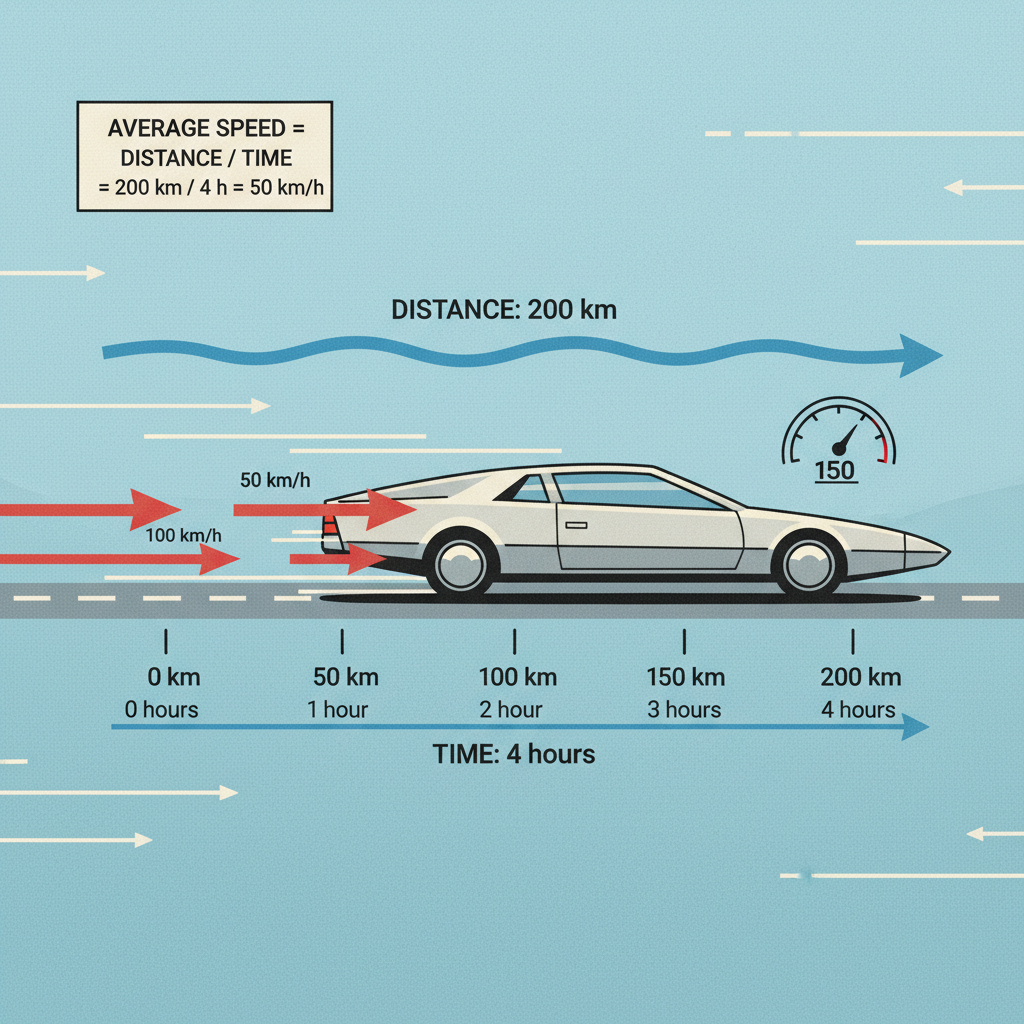
The Magic Formula: Connecting D, T, and S
Now for the exciting part! These three concepts are not just related; they are mathematically connected by a simple, yet powerful, formula. This is the cornerstone of basic motion problems:
Speed (S) = Distance (D) / Time (T)
Let's break this down:
- If you know how far something went and how long it took, you can calculate its speed.
- Example: A runner covers a distance of 100 meters in a time of 10 seconds. What is their speed?
- S = D / T
- S = 100 meters / 10 seconds
- S = 10 m/s
Rearranging the Formula: Finding Distance or Time
What if you know the speed and time, but want to find the distance? Or what if you know the distance and speed, but want to find the time? We can rearrange our original formula to solve for any of the three variables!
To find Distance:
If Speed = Distance / Time, then to get Distance by itself, we can multiply both sides by Time:
Distance (D) = Speed (S) × Time (T)
- Analogy: If you drive your car at a constant speed of 60 km/h for 2 hours, how far have you traveled? You've covered 60 km in the first hour and another 60 km in the second hour, for a total of 120 km. That's 60 km/h × 2 h = 120 km.
To find Time:
If Speed = Distance / Time, and we want Time by itself, we can swap Speed and Time (or multiply by Time and then divide by Speed):
Time (T) = Distance (D) / Speed (S)
- Analogy: If you need to travel a distance of 300 kilometers and you know your car can maintain an average speed of 100 km/h, how long will the trip take? You need to cover 300 km, and you cover 100 km every hour, so it will take 300 km / 100 km/h = 3 hours.
Units, Units, Units! – A Crucial Detail
When you're solving problems, it's super important to make sure your units are consistent! If your speed is in km/h, and your time is in minutes, you'll need to convert minutes to hours before you can use the formula. Always aim to have your distance in meters (or kilometers), your time in seconds (or hours), and your speed in meters/second (or kilometers/hour).
- Common conversions:
- 1 minute = 60 seconds
- 1 hour = 60 minutes = 3600 seconds
- 1 kilometer = 1000 meters
Putting It All Together – The Triangle Trick
Many students find the 'Distance, Speed, Time triangle' a helpful way to remember the formulas:
    D
   / \
  S -- T
To use it, cover the variable you want to find:
- Cover D: You see S x T (Distance = Speed x Time)
- Cover S: You see D / T (Speed = Distance / Time)
- Cover T: You see D / S (Time = Distance / Speed)
Mastering these basic concepts and the single formula (and its rearrangements) will set you up for success in understanding more complex physics problems. Keep practicing, and remember that motion is all around us!
Keep learning, free
Create a free Syllabax account to unlock practice questions and games for this topic.
Visual Learning Enhanced! 🚀
To help you master this topic, we use Advanced Syllabax AI to generate detailed diagrams and visual models.
Note on Visuals: The AI sometimes makes spelling errors in image labels. Please refer to the lesson text for the correct terminology.