Outcomes & events (Probability)
Watch this topic in 60 seconds
Free preview · Lesson 1
Understanding Outcomes & events (Probability)
Unlocking the Secrets of Chance: Outcomes & Events in Probability (Grade 7)
Have you ever played a game where you didn't know what would happen next? Maybe you flipped a coin to decide who goes first, or rolled a die in a board game. Life is full of these moments where we're not entirely sure what the future holds. That's where probability comes in! Probability is all about understanding the likelihood of things happening.
In this lesson, we're going to dive into two very important words in probability: Outcomes and Events. Think of them as the building blocks for understanding chance.
What is Probability? (A Quick Refresher)
Imagine you have a jar full of red and blue marbles. If you reach in without looking, what color marble do you think you'll pull out? If there are way more red marbles, you'd probably guess red, right? Probability is just a fancy way of talking about how likely something is to happen. It helps us make educated guesses or predictions about uncertain situations.
Think of it like predicting the weather. Meteorologists use probability to say there's a "70% chance of rain." They're telling us how likely it is to rain, based on all the information they have.
Part 1: Understanding "Outcomes" – All the Possibilities!
Let's start with Outcomes. An outcome is simply ANY possible result of an experiment or situation. It's like listing every single thing that could happen. When you do something where the result isn't certain, like flipping a coin, every possible result is an outcome.
Analogy Time: The Menu of Possibilities
Imagine you go to a restaurant and they hand you a menu. The menu lists ALL the different dishes you could possibly order. Each dish on that menu is an "outcome." You haven't chosen yet, but you know all your options.
Examples of Outcomes:
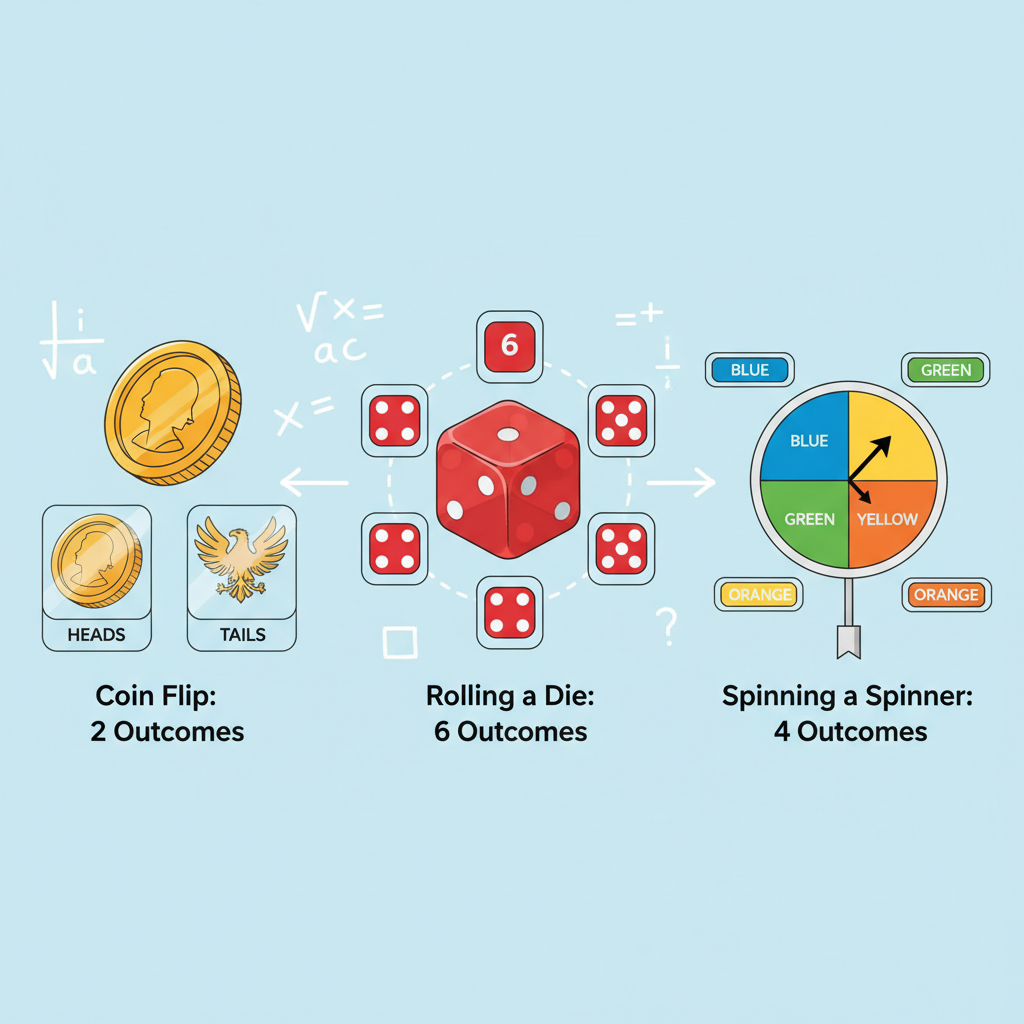
- Flipping a Coin: When you flip a standard coin, what are all the things that could possibly happen?
- You could get Heads.
- You could get Tails.
- Rolling a Six-Sided Die: If you roll a standard die (the kind with dots from 1 to 6), what are all the possible numbers you could land on?
- You could roll a 1.
- You could roll a 2.
- You could roll a 3.
- You could roll a 4.
- You could roll a 5.
- You could roll a 6.
- Spinning a Spinner: Let's say you have a spinner divided into four equal parts: Red, Blue, Green, Yellow. What are the outcomes when you spin it once?
- You could land on Red.
- You could land on Blue.
- You could land on Green.
- You could land on Yellow.
- Choosing a Marble: A bag contains a red, a blue, and a green marble. If you pick one marble without looking, what are the outcomes?
- You could pick a Red marble.
- You could pick a Blue marble.
- You could pick a Green marble.
See? Outcomes are just a list of *everything* that could possibly come out of your experiment. They are the "what ifs."
Part 2: Understanding "Events" – What We're Interested In!
Now let's talk about Events. An event is one specific outcome, or a collection of specific outcomes, that we are interested in. It's like picking something *off* that menu of possibilities. An event is what you're actually hoping for, or what you're asked to consider.
Analogy Time: Your Order at the Restaurant
Remember the restaurant menu? That was the list of all outcomes. An "event" is what you *choose* to order. You might say, "I want the spaghetti." Or, "I want something vegetarian." In the first case, "spaghetti" is a single outcome that is your event. In the second case, "something vegetarian" might include pasta, salad, or a veggie burger – so it's a collection of outcomes that make up your event.
Examples of Events:
Let's use our previous examples and define some events:
- Flipping a Coin: Outcomes were {Heads, Tails}.
- Event A: Getting Heads. This event has just one outcome: {Heads}.
- Event B: Getting Tails. This event also has just one outcome: {Tails}.
- Rolling a Six-Sided Die: Outcomes were {1, 2, 3, 4, 5, 6}.
- Event C: Rolling a 4. This event has one outcome: {4}.
- Event D: Rolling an even number. Which outcomes are even? {2, 4, 6}. This event has three outcomes: {2, 4, 6}.
- Event E: Rolling a number greater than 5. Which outcomes are greater than 5? {6}. This event has one outcome: {6}.
- Event F: Rolling an odd number. Which outcomes are odd? {1, 3, 5}. This event has three outcomes: {1, 3, 5}.
- Spinning a Spinner: Outcomes were {Red, Blue, Green, Yellow}.
- Event G: Landing on Blue. This event has one outcome: {Blue}.
- Event H: Landing on a primary color. Which outcomes are primary colors? {Red, Blue, Yellow} (often considered primary, sometimes Green is too, but for simplicity let's stick to Red, Blue, Yellow). This event has three outcomes: {Red, Blue, Yellow}.
An event can be a single outcome (like rolling a 4) or a group of outcomes (like rolling an even number).
The Big Difference: Outcomes vs. Events
It's super important to know the difference between an outcome and an event. Here's a simple way to remember:
Outcomes are everything that *could* happen. It's the full list of possibilities.
Events are what you *want* to happen, or what you're specifically looking for, from that list of possibilities.
Think of it like this:
- If you're buying a lottery ticket, the "outcomes" are every single possible combination of numbers that could be drawn. There are millions!
- The "event" you're interested in is *your specific ticket numbers* being drawn.
Let's use a quick table to solidify the idea:
| Concept | What it is | Example (Rolling a Die) |
|---|---|---|
| Outcome | Any single possible result of an experiment. | Rolling a 1, Rolling a 2, Rolling a 3, etc. ({1}, {2}, {3}, {4}, {5}, {6}) |
| Event | One specific outcome, or a collection of specific outcomes, that you are interested in. | Rolling an even number ({2, 4, 6}), Rolling a 5 ({5}), Rolling a number less than 3 ({1, 2}) |
Listing Outcomes and Events: Putting It All Together
When you're asked to identify outcomes and events, always start by listing all the possible outcomes first. This creates your "universe" of possibilities.
Practice Scenario 1: Drawing Cards
Imagine you have a deck of cards with only the suits Ace, King, Queen, Jack of Hearts and Ace, King, Queen, Jack of Clubs. You draw one card.
- All Possible Outcomes: {Ace of Hearts, King of Hearts, Queen of Hearts, Jack of Hearts, Ace of Clubs, King of Clubs, Queen of Clubs, Jack of Clubs}. There are 8 outcomes.
- Event 1: Drawing a King. The outcomes for this event are: {King of Hearts, King of Clubs}.
- Event 2: Drawing a Heart. The outcomes for this event are: {Ace of Hearts, King of Hearts, Queen of Hearts, Jack of Hearts}.
- Event 3: Drawing the Ace of Clubs. The outcomes for this event are: {Ace of Clubs}.
Practice Scenario 2: Picking a Letter
You have a bag with letter tiles that spell out the word "MATH". You pick one letter without looking.
- All Possible Outcomes: {M, A, T, H}. There are 4 outcomes.
- Event 1: Picking a vowel. The outcomes for this event are: {A}.
- Event 2: Picking a consonant. The outcomes for this event are: {M, T, H}.
Why is this important?
Understanding outcomes and events is the very first step to calculating probabilities! Once you know all the possible outcomes, and you know which outcomes make up your specific event, you can then figure out how likely that event is to happen. For example, if you know there are 6 outcomes when rolling a die, and 3 of them are even numbers, you can easily see that rolling an even number is pretty common!
Conclusion
So, there you have it! Outcomes are all the results that *could* possibly happen in an experiment, like every dish on a restaurant menu. Events are the specific results or groups of results that you're interested in, like the meal you choose to order. Mastering these two concepts is your ticket to understanding the exciting world of probability and making sense of chance!
Keep learning, free
Create a free Syllabax account to unlock practice questions and games for this topic.
Visual Learning Enhanced! 🚀
To help you master this topic, we use Advanced Syllabax AI to generate detailed diagrams and visual models.
Note on Visuals: The AI sometimes makes spelling errors in image labels. Please refer to the lesson text for the correct terminology.