Learning Journey
Watch this topic in 60 seconds
Free preview · Lesson 1
Understanding Defects of vision (intro for ICSE depth) [PHYSICS]
Understanding Defects of Vision: A Beginner's Guide (for ICSE Physics)
Welcome to our fascinating journey into the world of vision! Our eyes are incredible organs that allow us to see the beauty around us. But sometimes, just like any other part of our body, they don't work exactly as they should. These imperfections are called 'defects of vision'. In this lesson, we'll explore some of the most common defects of vision in simple terms, using lots of analogies to make things clear.
How Do Our Eyes Work Normally? The Perfect Picture!
Before we talk about what goes wrong, let's quickly review how a healthy eye works. Imagine your eye is like a sophisticated camera.
1. Cornea: This is the transparent outer layer at the front of your eye. Think of it as the camera's lens cover, protecting the inside. It also does most of the work of bending (refracting) light that enters your eye.
2. Pupil and Iris: The pupil is the dark opening in the center of your eye. The iris is the colored part that surrounds it. The iris acts like the aperture of a camera, controlling how much light enters by making the pupil bigger (in dim light) or smaller (in bright light).
3. Lens: Behind the pupil is the eye's lens. This is like the adjustable lens in your camera. It fine-tunes the bending of light so that a sharp, clear image is formed.
4. Retina: This is the light-sensitive screen at the back of your eye. It's like the film or sensor in your camera. When light focuses perfectly on the retina, it sends signals to your brain, which then interprets them as an image.
In a normal eye, light rays from an object pass through the cornea and lens, and they are bent (refracted) just right so that they meet at a single point precisely on the retina. This creates a sharp, clear image.
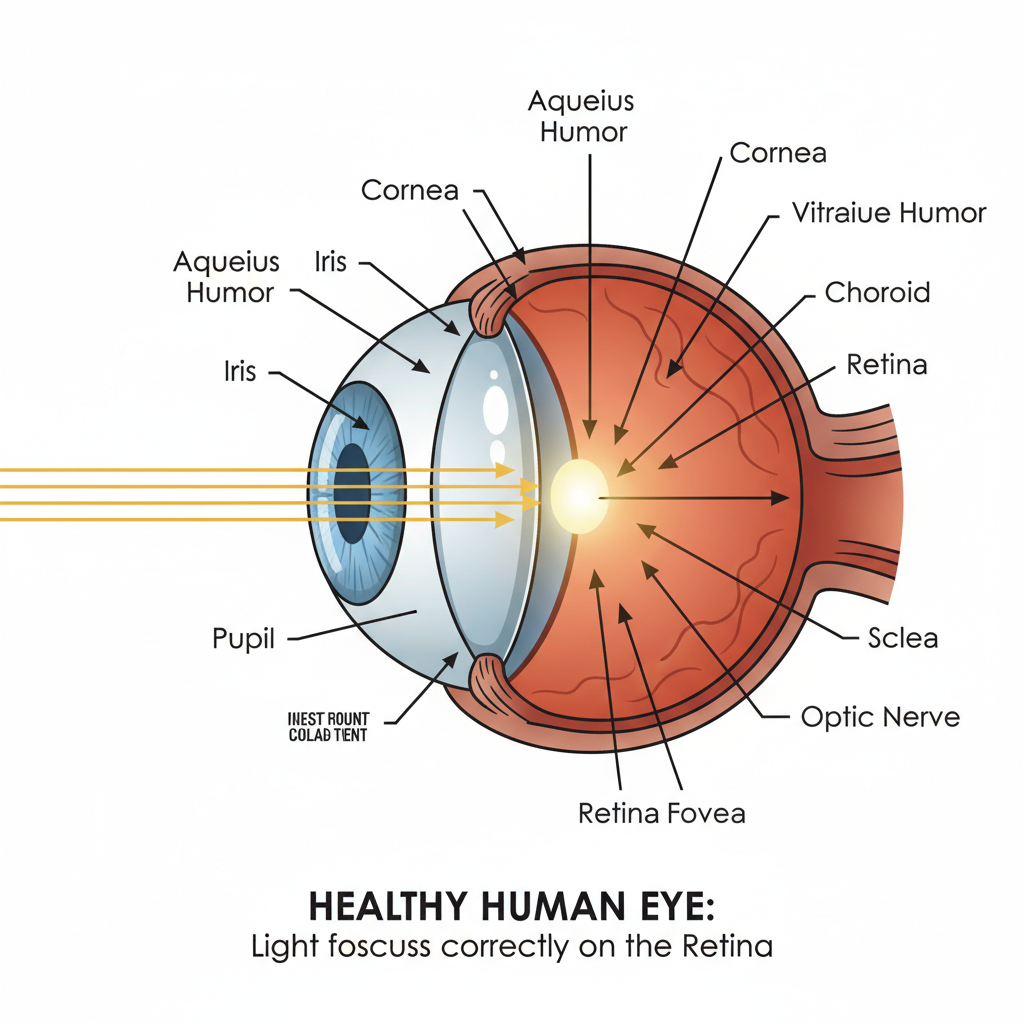 ⚠️ This picture may have spelling mistakes. Trust the words in the lesson.
What Happens When Things Go Wrong? Defects of Vision
Sometimes, the eye's lens system doesn't bend light correctly, or the eyeball might be too long or too short. This means the light doesn't focus perfectly on the retina. Instead, it might focus in front of the retina or behind it. This causes a blurry or distorted image. Let's look at the most common defects:
1. Myopia (Nearsightedness): Seeing Close Things Clearly, Far Things Blurry
What is it? Myopia, commonly known as nearsightedness, is a condition where you can see nearby objects clearly, but distant objects appear blurry.
Analogy: Imagine you have a projector that's set up to project a clear image onto a wall. Now, imagine the wall is suddenly moved closer to the projector. The image that was sharp on the original wall will now be blurry because it's focused before the new, closer wall. In myopia, the 'wall' (retina) is effectively too far away, or the 'projector' (eye's lens system) is too powerful, causing light to focus *in front* of the retina.
Why it happens: This usually happens for two main reasons:
- The eyeball is too long: If the distance from the front of the eye to the retina is too great, the light rays meet before they reach the retina.
- The eye lens is too powerful (too much power): If the cornea or lens bends light too much, it will focus the light too soon, in front of the retina.
Effect: Distant objects look out of focus. Think of trying to read a sign from far away – with myopia, the letters would be smudged.
2. Hypermetropia (Farsightedness): Seeing Far Things Clearly, Close Things Blurry
What is it? Hypermetropia, often called farsightedness, is the opposite of myopia. In this condition, you can see distant objects clearly, but nearby objects appear blurry.
Analogy: Let's go back to our projector. This time, imagine the wall is moved *further away* from the projector. The light rays from the projector might not have reached the wall yet when they hit it; they would still be converging behind the wall. In hypermetropia, the 'wall' (retina) is effectively too close, or the 'projector' (eye's lens system) is too weak, causing light to focus *behind* the retina.
Why it happens: This is usually due to:
- The eyeball is too short: If the distance from the front of the eye to the retina is too small, the light rays don't meet by the time they reach the retina.
- The eye lens is too weak (too little power): If the cornea or lens doesn't bend light enough, it will focus the light behind the retina.
Effect: Nearby objects look blurry. It's like trying to read a book up close, but the letters are fuzzy and indistinct.
3. Presbyopia (Aging Eyes): Difficulty Focusing Up Close
What is it? Presbyopia is a natural part of aging. As we get older, usually after the age of 40, the lens in our eye becomes less flexible.
Analogy: Think of the lens in your eye like a flexible jelly. When you're young, this jelly is very soft and can easily change shape to focus on things near and far. As you age, this jelly becomes harder and less flexible. It's like trying to squeeze a firm rubber ball instead of a soft jelly – it's much harder to change its shape. Because the lens can't become rounded enough to focus on close objects, they appear blurry.
Why it happens: The eye lens loses its elasticity and ability to change its shape (accommodate) to focus on nearby objects. It’s primarily a loss of flexibility in the lens, not a change in the length of the eyeball (though it can occur alongside other refractive errors).
Effect: Difficulty reading small print or doing close-up work. You might find yourself holding things further away to see them clearly.
Summary: Key Differences
Let's recap the main differences:
- Myopia: Blurry vision for distant objects. Light focuses *in front* of the retina.
- Hypermetropia: Blurry vision for near objects. Light focuses *behind* the retina.
- Presbyopia: Difficulty focusing on near objects due to aging lens. Affects near vision.
Understanding these basic defects is the first step towards knowing how our amazing eyes work and how we can help them function at their best!
Keep learning, free
Create a free Syllabax account to unlock practice questions and games for this topic.
Visual Learning Enhanced! 🚀
To help you master this topic, we use Advanced Syllabax AI to generate detailed diagrams and visual models.
Note on Visuals: The AI sometimes makes spelling errors in image labels. Please refer to the lesson text for the correct terminology.