Simplifying ratios (Ratio & Proportion)
Watch this topic in 60 seconds
Free preview · Lesson 1
Understanding Simplifying ratios (Ratio & Proportion)
Unlocking the Power of Ratios: Simplifying for Clarity! (Grade 7)
Welcome, young mathematicians! Today, we're going on an exciting adventure into the world of ratios. Think of ratios as super-smart tools that help us compare quantities. They're everywhere, from your favorite recipes to understanding sports scores, and even when building amazing structures!
What Exactly IS a Ratio? The Basics!
Imagine you're at a party, and there are some bowls of fruit. In one bowl, you see 3 apples and 6 bananas. A ratio is simply a way to compare the number of apples to the number of bananas. It tells us 'how much' of one thing there is compared to 'how much' of another.
We can write ratios in a few different ways:
- Using a colon (most common in math!): 3 : 6 (read as "3 to 6")
- Using the word "to": 3 to 6
- As a fraction: 3/6
No matter how you write it, the meaning is the same: for every 3 apples, there are 6 bananas.
Analogy Time: The Fruit Salad Mix-Up!
Let's stick with our fruit salad. If someone asks you, "What's the ratio of apples to bananas?" and you say "3 to 6," that's perfectly correct. But what if you wanted to make a much bigger (or smaller) fruit salad, but keep the taste exactly the same? You'd want to know the simplest relationship between the fruits.
Why Do We SIMPLIFY Ratios? Making Things Crystal Clear!
Think about fractions. If you have the fraction 2/4, you know it's the same as 1/2, right? We simplify fractions to make them easier to understand and work with. Simplifying ratios is exactly the same idea!
When we simplify a ratio, we're trying to find the most basic, irreducible form of that comparison. It's like finding the 'core' relationship, without making the numbers unnecessarily large.
Another Analogy: The Lego Master Builder!
Imagine you have a box of Lego bricks. You have 12 red bricks and 18 blue bricks. The ratio of red to blue is 12:18. Now, you want to create small, identical groups of bricks, with the same red-to-blue relationship in each group. You wouldn't just grab 12 red and 18 blue every time; you'd want to know the smallest possible group you can make to represent that relationship.
Simplifying the ratio 12:18 would tell you that fundamental building block.
How to Simplify Ratios: The Secret Weapon - GCF!
Just like simplifying fractions, simplifying ratios involves finding a special number called the Greatest Common Factor (GCF). The GCF is the largest number that divides evenly into both parts of your ratio.
Step-by-Step Guide: Let's Simplify!
Let's take our fruit salad example: 3 apples to 6 bananas (3:6).
-
Find the factors of each number:
- Factors of 3: 1, 3
- Factors of 6: 1, 2, 3, 6
-
Identify the Greatest Common Factor (GCF):
Look at the factors for both numbers. The largest number they both share is 3. So, our GCF is 3.
-
Divide both parts of the ratio by the GCF:
- Divide the first number (apples) by 3: 3 ÷ 3 = 1
- Divide the second number (bananas) by 3: 6 ÷ 3 = 2
-
Write the simplified ratio:
The simplified ratio is 1 : 2.
This means for every 1 apple, there are 2 bananas. This is much clearer and easier to work with than 3:6, even though both ratios represent the exact same relationship!
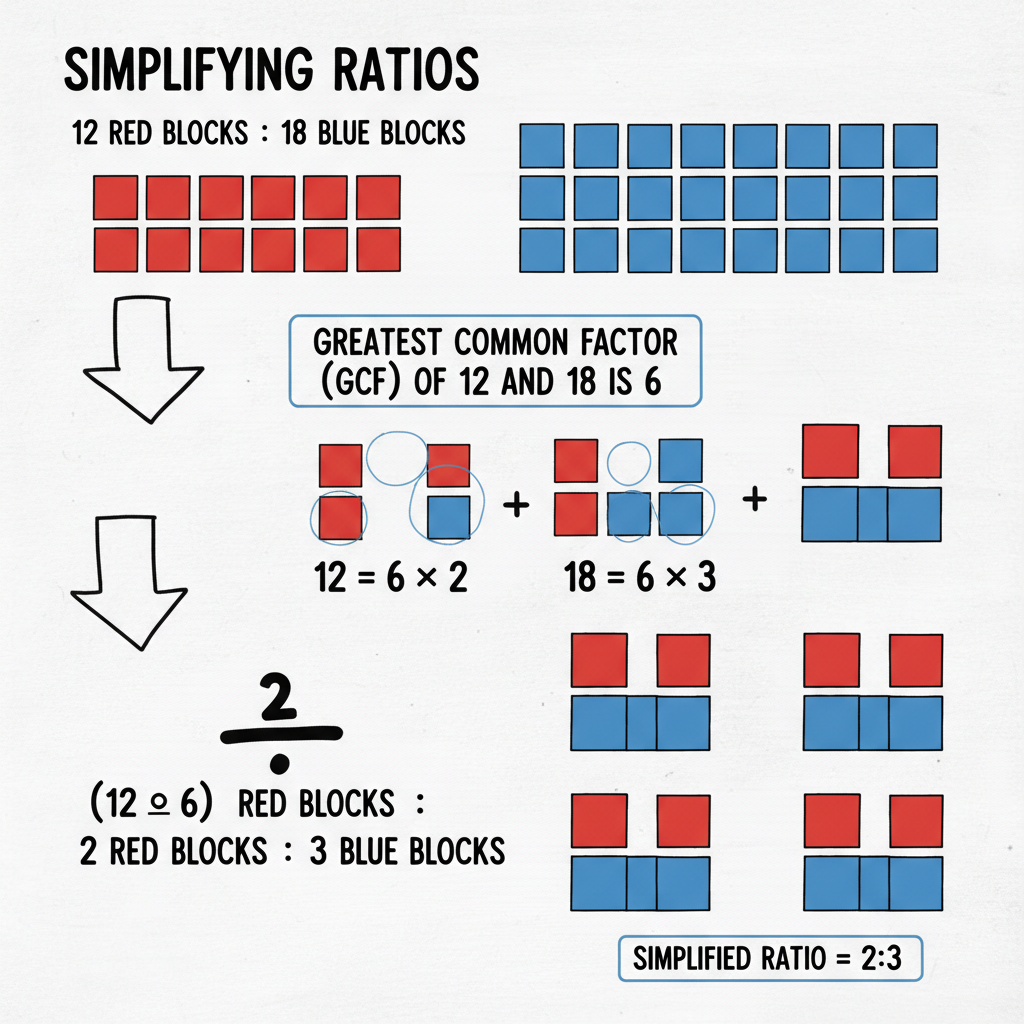 ⚠️ This picture may have spelling mistakes. Trust the words in the lesson.
Let's Try Another Example: The Classroom Ratio!
In a classroom, there are 10 girls and 15 boys. What is the simplified ratio of girls to boys?
- The ratio is: 10 : 15
- Find factors of 10: 1, 2, 5, 10
- Find factors of 15: 1, 3, 5, 15
- The GCF is: 5 (It's the largest number found in both lists!)
-
Divide both sides by 5:
- 10 ÷ 5 = 2
- 15 ÷ 5 = 3
- The simplified ratio is: 2 : 3
This means for every 2 girls, there are 3 boys in the classroom. This simplified ratio is much more intuitive!
Important Things to Remember When Simplifying Ratios:
- Keep the Order: The order of the numbers in a ratio matters! A ratio of "apples to bananas" (1:2) is different from "bananas to apples" (2:1).
- Do to One, Do to the Other: Whatever you do to one number in the ratio (like dividing by the GCF), you MUST do to the other number. This keeps the relationship the same.
- Simplest Form: A ratio is fully simplified when the only common factor between its numbers is 1. You can't divide them any further by a whole number.
- No Units in Simplified Form (Usually): When you simplify, the units (like "apples" or "girls") usually disappear, leaving just the numbers that represent the pure comparison.
Real-World Connections!
- Recipes: If a recipe calls for 2 cups of flour to 1 cup of sugar, the ratio is 2:1. If you double the recipe, you use 4 cups of flour to 2 cups of sugar (4:2), which simplifies back to 2:1. The relationship stays the same!
- Maps and Models: Scale models often use ratios, like 1:100. This means 1 unit on the model represents 100 units in real life. These ratios are always given in their simplest form.
- Sports Scores: If a basketball team scores 60 points and their opponent scores 40 points, the ratio of their scores is 60:40. Simplifying this gives 3:2 (GCF is 20). This tells you for every 3 points the first team scored, the opponent scored 2.
Simplifying ratios is a fundamental skill that will help you understand and work with comparisons in all sorts of situations. Keep practicing, and you'll become a ratio master in no time!
Keep learning, free
Create a free Syllabax account to unlock practice questions and games for this topic.
Visual Learning Enhanced! 🚀
To help you master this topic, we use Advanced Syllabax AI to generate detailed diagrams and visual models.
Note on Visuals: The AI sometimes makes spelling errors in image labels. Please refer to the lesson text for the correct terminology.