Free fall, weight, mass[PHYSICS]
Watch this topic in 60 seconds
Free preview · Lesson 1
Understanding Free fall, weight, mass[PHYSICS]
Exploring Free Fall, Weight, and Mass: The Basics
Welcome to our journey into the fascinating world of how things fall! We're going to explore three fundamental concepts in physics: free fall, weight, and mass. Don't worry if these sound a bit complicated; we'll break them down using simple terms and plenty of everyday examples.
What is Free Fall?
Imagine you drop a ball. What happens? It falls towards the ground, right? This falling motion is what we call free fall. In physics, free fall is defined as the motion of an object where gravity is the only force acting upon it. This means we ignore other forces like air resistance, which can slow things down.
Think about an astronaut dropping a hammer and a feather on the Moon. Since the Moon has no atmosphere (and therefore no air resistance), both the hammer and the feather fall at the same rate and hit the surface at the same time! This is a perfect example of free fall in action.
On Earth, if you drop a feather and a hammer at the same time, the hammer will hit the ground much faster. This is because air resistance pushes up on the feather more than it pushes on the hammer, slowing the feather down. However, if you were to put both the hammer and the feather in a vacuum (a place with no air) on Earth and drop them, they would fall at the same speed and hit the ground together!
Analogy: The Elevator Ride
Think about being in an elevator. When the elevator starts moving downwards really fast, you might feel a sensation of being lighter, almost like you're floating. This is similar to what happens during free fall. If you were in a box that was falling freely, you wouldn't feel your own weight pushing you down anymore, because you and the box would be falling together.
Mass: How Much Stuff is There?
Mass is a fundamental property of matter. It tells us how much 'stuff' is in an object. Think of it as the amount of material that makes up an object. A rock has more 'stuff' in it than a small pebble, so the rock has more mass.
Mass is also a measure of an object's inertia. Inertia is the resistance of an object to changes in its state of motion. In simpler terms, the more mass an object has, the harder it is to get it moving, and the harder it is to stop it once it's moving.
Analogy: The Shopping Cart
Imagine pushing an empty shopping cart. It's pretty easy to get it moving and easy to stop. Now, imagine pushing a shopping cart filled to the brim with groceries. It's much harder to get it moving, and much harder to stop. The full shopping cart has more mass, and therefore more inertia, making it more resistant to changes in its motion.
A key thing to remember about mass is that it is constant. Whether you are on Earth, on the Moon, or floating in space, the amount of 'stuff' in your body (your mass) doesn't change.
Weight: The Force of Gravity
Weight, on the other hand, is a force. Specifically, it's the force of gravity pulling on an object's mass. Everything with mass has gravity, and gravity pulls on everything with mass. The Earth has a huge amount of mass, so its gravity is strong and pulls everything towards its center.
Your weight depends on two things: your mass and the strength of the gravitational field you are in. Because the Earth's gravity is much stronger than the Moon's gravity, you would weigh less on the Moon than you do on Earth, even though your mass (the amount of 'stuff' in you) remains the same.
Analogy: The Magnet and the Paperclips
Think of mass as a bunch of paperclips. Weight is like a magnet pulling on those paperclips. A bigger magnet (like Earth) will pull harder on the paperclips (your mass) than a smaller magnet (like the Moon). The number of paperclips (your mass) stays the same, but how hard the magnet pulls (your weight) can change depending on the magnet's strength.
On Earth, we are used to our weight because Earth's gravity is constantly pulling us down. This is why we feel 'grounded'. In space, far away from any large celestial bodies, you would experience 'weightlessness'. This doesn't mean you have no mass; it means there is very little gravitational force acting on your mass.
Weight vs. Mass: A Crucial Difference
It's really important to understand that mass and weight are not the same thing:
- Mass is the amount of matter in an object. It's measured in kilograms (kg). It doesn't change based on location.
- Weight is the force of gravity on an object's mass. It's measured in Newtons (N). It changes depending on the strength of gravity.
Think of it this way: Your mass is your personal 'stuff' content. Your weight is how strongly gravity is pulling on your 'stuff'.
Putting It All Together: Free Fall, Mass, and Weight
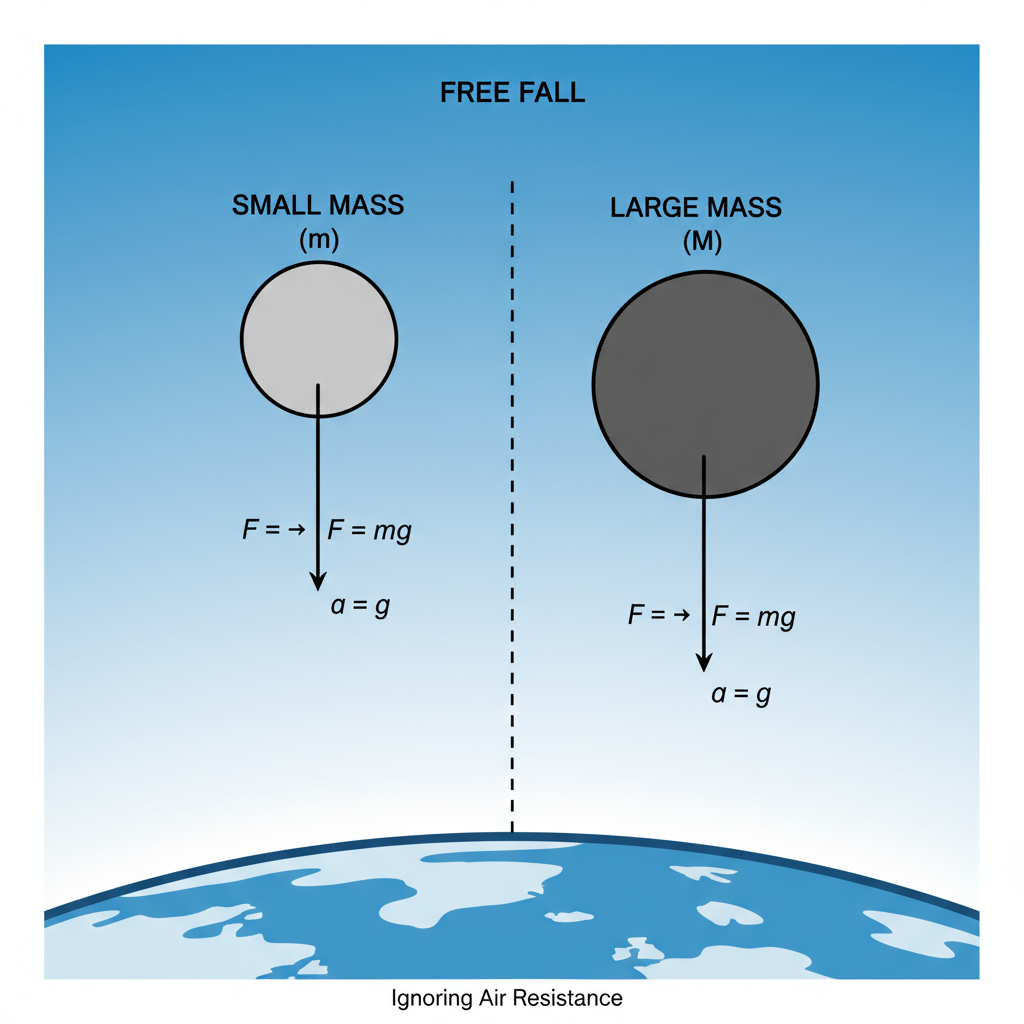
When an object is in free fall, gravity is the only force acting on it. This means that the acceleration due to gravity is constant for all objects in free fall, regardless of their mass (if we ignore air resistance). However, the force of gravity acting on the object, which is its weight, is proportional to its mass. So, a more massive object will experience a greater gravitational force (it will weigh more), but it also has more inertia (resistance to acceleration). These two effects perfectly cancel out, resulting in the same acceleration for all objects in free fall.
This is why a bowling ball and a feather, if dropped together in a vacuum, will accelerate downwards at the same rate and hit the ground at the same time. The bowling ball has more mass, so gravity pulls on it harder (it weighs more), but it's also harder to get moving. The feather has less mass, so gravity pulls on it less strongly (it weighs less), but it's also easier to get moving. The result is the same speed-up for both!
Let's visualize this with a simple scenario:
 ⚠️ This picture may have spelling mistakes. Trust the words in the lesson.
In this image, we see two objects falling. Imagine the larger object has more mass. The arrow representing the force of gravity (its weight) is longer for the larger object, showing it's being pulled down with more force. However, the arrow representing its acceleration is the same size as the smaller object's acceleration. This is the essence of free fall!
Summary
We've learned about three key concepts:
- Free Fall: When gravity is the only force acting on an object.
- Mass: The amount of 'stuff' or matter in an object, which also determines its inertia.
- Weight: The force of gravity acting on an object's mass, which changes with location.
Understanding these concepts is crucial for grasping many other ideas in physics. Keep observing the world around you – you'll see examples of free fall, mass, and weight everywhere!
Keep learning, free
Create a free Syllabax account to unlock practice questions and games for this topic.
Visual Learning Enhanced! 🚀
To help you master this topic, we use Advanced Syllabax AI to generate detailed diagrams and visual models.
Note on Visuals: The AI sometimes makes spelling errors in image labels. Please refer to the lesson text for the correct terminology.