Estimation (Mental Maths)
Watch this topic in 60 seconds
Free preview · Lesson 1
Understanding Estimation (Mental Maths)
Estimation: Guessing Smart!
Hello young mathematicians! Today, we're going to talk about a super fun skill called estimation. Estimation is like being a detective for numbers! It means making a smart guess about a number without counting every single thing. It's like guessing how many jellybeans are in a jar – you don't count them all, but you can look at the jar and make a good guess!
Why is Estimation Important?
Estimation is important because it helps us in many ways, even when we're not doing math homework!
- Quick Answers: Sometimes, you just need a quick idea of how many. For example, if you're packing your lunchbox, you can estimate if you have enough snacks without counting each cracker.
- Checking Your Work: If you add up a list of numbers and get a really big, surprising answer, estimation can help you check if you made a mistake. If you estimate the answer should be around 10 and you got 100, you know something's wrong!
- Real-Life Decisions: When you go to the store with your parents, you might estimate if you have enough money to buy a toy.
What Does "Estimate" Mean?
When we estimate, we are finding a number that is close to the actual number. It doesn't have to be exactly right, but it should be pretty close! Think about guessing the number of students in your class. If there are 22 students, guessing 20 or 25 is a good estimate. Guessing 5 or 100 would not be a good estimate.
How Do We Estimate?
There are a few ways to make a smart guess:
1. Looking and Comparing:
Sometimes, you can estimate by just looking at a group of things and comparing it to something you know.
Imagine you have a bag of apples. If you know that 5 apples fill up half the bag, you can estimate that the whole bag has about 10 apples. You're using what you know (5 apples) to guess the total.
2. Rounding Numbers:
A super helpful way to estimate is by rounding. Rounding means making a number simpler by changing it to the nearest 10 or 100. For numbers ending in 0, 1, 2, 3, or 4, we round down. For numbers ending in 5, 6, 7, 8, or 9, we round up.
Let's try rounding to the nearest 10:
- 12 is close to 10. (The '2' tells us to round down).
- 17 is close to 20. (The '7' tells us to round up).
- 25 is close to 30. (The '5' always tells us to round up!).
- 34 is close to 30. (The '4' tells us to round down).
When we round numbers before adding or subtracting, it makes the math much easier in our heads!
For example, if you want to estimate 12 + 17:
- Round 12 to the nearest 10, which is 10.
- Round 17 to the nearest 10, which is 20.
- Now, add the rounded numbers: 10 + 20 = 30.
So, an estimate for 12 + 17 is 30. The actual answer is 29, which is very close to 30! See? Estimation works!
3. Using Benchmark Numbers:
A benchmark number is a number that is easy to work with, like 10, 20, 50, or 100. We can compare the number we're trying to estimate to these benchmark numbers.
Imagine you have a pile of 18 LEGO bricks. You can think, "18 is close to 20. 20 is a benchmark number, and it's easy to count by 20s." You've just estimated the number of LEGO bricks using a benchmark!
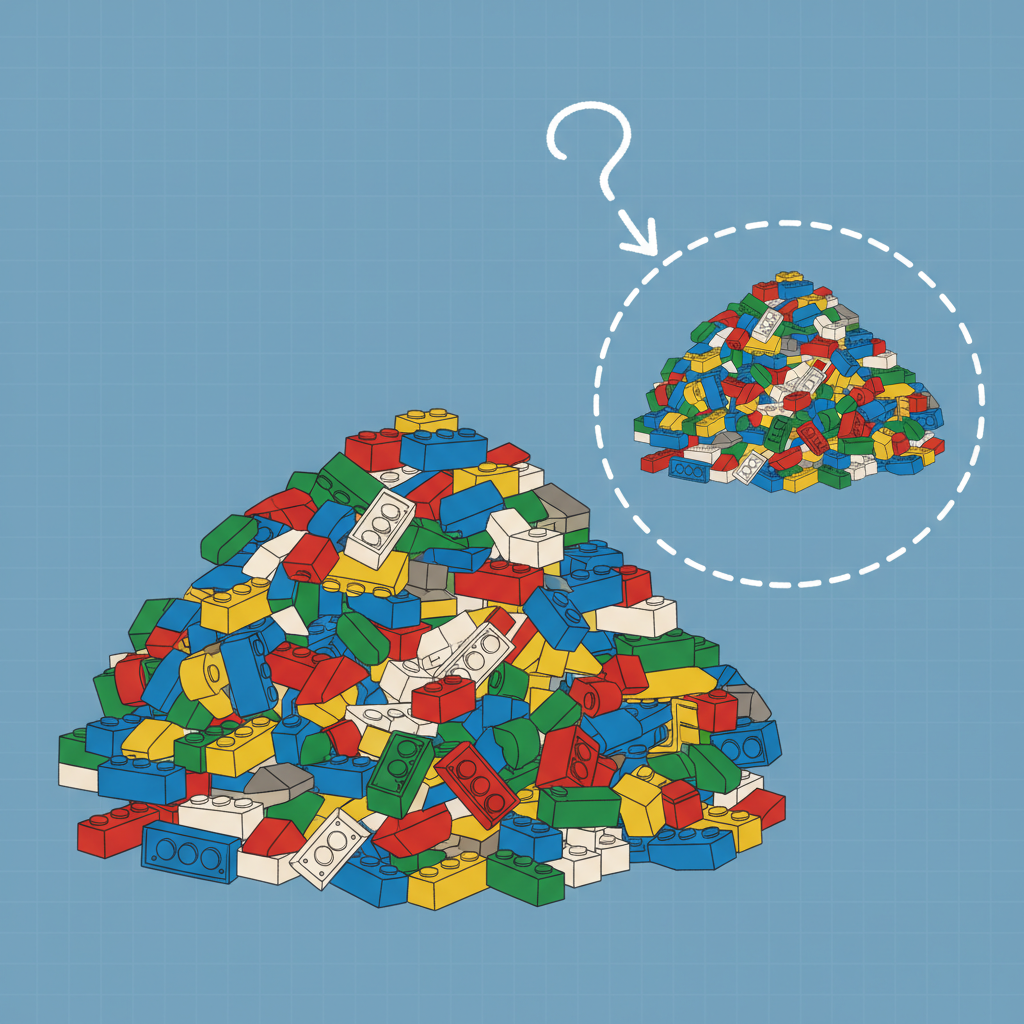 ⚠️ This picture may have spelling mistakes. Trust the words in the lesson.
Estimation in Action!
Let's think about some everyday situations:
- How many books on the shelf? You don't need to count every single one. You can look at how many fit on one row and estimate how many rows there are.
- How long will it take to walk to the park? You might estimate it takes about 10 minutes because you know other short walks take about that long.
- How many cookies are in the jar? If you see a full jar, you can estimate it has more cookies than a half-full jar.
Estimation is all about making a smart, educated guess. The more you practice, the better you'll become at it!
Keep learning, free
Create a free Syllabax account to unlock practice questions and games for this topic.
Visual Learning Enhanced! 🚀
To help you master this topic, we use Advanced Syllabax AI to generate detailed diagrams and visual models.
Note on Visuals: The AI sometimes makes spelling errors in image labels. Please refer to the lesson text for the correct terminology.