Properties & reactions[CHEMISTRY]
Watch this topic in 60 seconds
Free preview · Lesson 1
Understanding Properties & reactions[CHEMISTRY]
Understanding the World of Matter: Properties and Reactions (Grade 10, Foundational Chemistry)
Welcome, future scientists! In this foundational chemistry lesson, we're going to embark on an exciting journey to understand the fundamental characteristics of everything around us – matter. From the air we breathe to the devices we use, everything is made of matter, and matter has fascinating 'personalities' called properties, and it loves to 'interact' in events we call reactions. Think of it like learning about different people: some are tall (a property), some are good at sports (another property), and sometimes they interact by talking or playing games (reactions)!
Part 1: The 'Personality Traits' of Matter – What are Properties?
Just like you have unique traits that describe you (like your height, hair color, or how easily you get along with others), matter also has unique traits that describe it. These are called properties. We can divide these properties into two main categories: physical properties and chemical properties.
1. Physical Properties: What You See and Measure Without Changing Its Identity
Imagine you have a block of cheese. You can describe its color (yellow), its smell, its texture (soft), its shape (cubed), and how much it weighs. If you melt the cheese, it's still cheese, just in a different form. These are all physical properties – characteristics of a substance that can be observed or measured without changing the substance's fundamental identity or composition.
Think of it like this: If you describe your friend's hair color, height, or the sound of their voice, you're not changing who they are; you're just describing their existing characteristics. Similarly, observing physical properties doesn't turn one substance into another.
Common Examples of Physical Properties:
- Color: The visual appearance of a substance (e.g., gold is yellow, copper is reddish-brown).
- Odor: The smell of a substance (e.g., vinegar has a pungent smell, flowers have a sweet scent).
- Density: How much 'stuff' is packed into a given space. It's mass divided by volume. (Imagine two boxes of the same size; one filled with feathers, one with rocks. The box of rocks is denser.)
- Melting Point: The temperature at which a solid turns into a liquid (e.g., ice melts at 0°C).
- Boiling Point: The temperature at which a liquid turns into a gas (e.g., water boils at 100°C).
- Solubility: The ability of a substance to dissolve in another substance (e.g., sugar dissolves in water).
- Malleability: The ability of a substance to be hammered or pressed into thin sheets without breaking (e.g., aluminum foil).
- Ductility: The ability of a substance to be drawn out into a thin wire (e.g., copper wires).
- Conductivity: The ability of a substance to conduct heat or electricity (e.g., metals are good conductors).
- State of Matter: Whether it's a solid, liquid, or gas at a given temperature.
2. Chemical Properties: How Matter Behaves When It Tries to Change!
Now, let's think about your friend again. If you describe how easily they get angry, or how they react under pressure, you're describing something that might lead to a change in their behavior or even a new situation (like an argument or a solution!). Similarly, chemical properties describe a substance's ability to undergo a change that alters its identity and forms new substances.
This is about how a substance interacts with other substances or conditions to transform into something else. You can only observe chemical properties when a chemical change (a reaction!) is happening or is capable of happening.
Common Examples of Chemical Properties:
- Flammability: The ability of a substance to burn or ignite, causing fire or combustion (e.g., wood is flammable). When wood burns, it turns into ash, smoke, and gases – totally new substances!
- Reactivity: How easily a substance reacts with other substances. For example, some metals react strongly with acids, producing hydrogen gas.
- Combustibility: Similar to flammability, the ability to burn in the presence of oxygen.
- Oxidation: The tendency of a substance to combine with oxygen (e.g., iron rusts when it oxidizes). Rust (iron oxide) is a new substance, different from pure iron.
- Toxicity: The ability of a substance to cause harm to living organisms.
Part 2: The 'Interactions' of Matter – What are Changes and Reactions?
Matter is never static! It's always undergoing some kind of change or interaction. These changes can also be categorized into two main types: physical changes and chemical changes (which we also call chemical reactions).
1. Physical Changes: Rearranging, Not Transforming
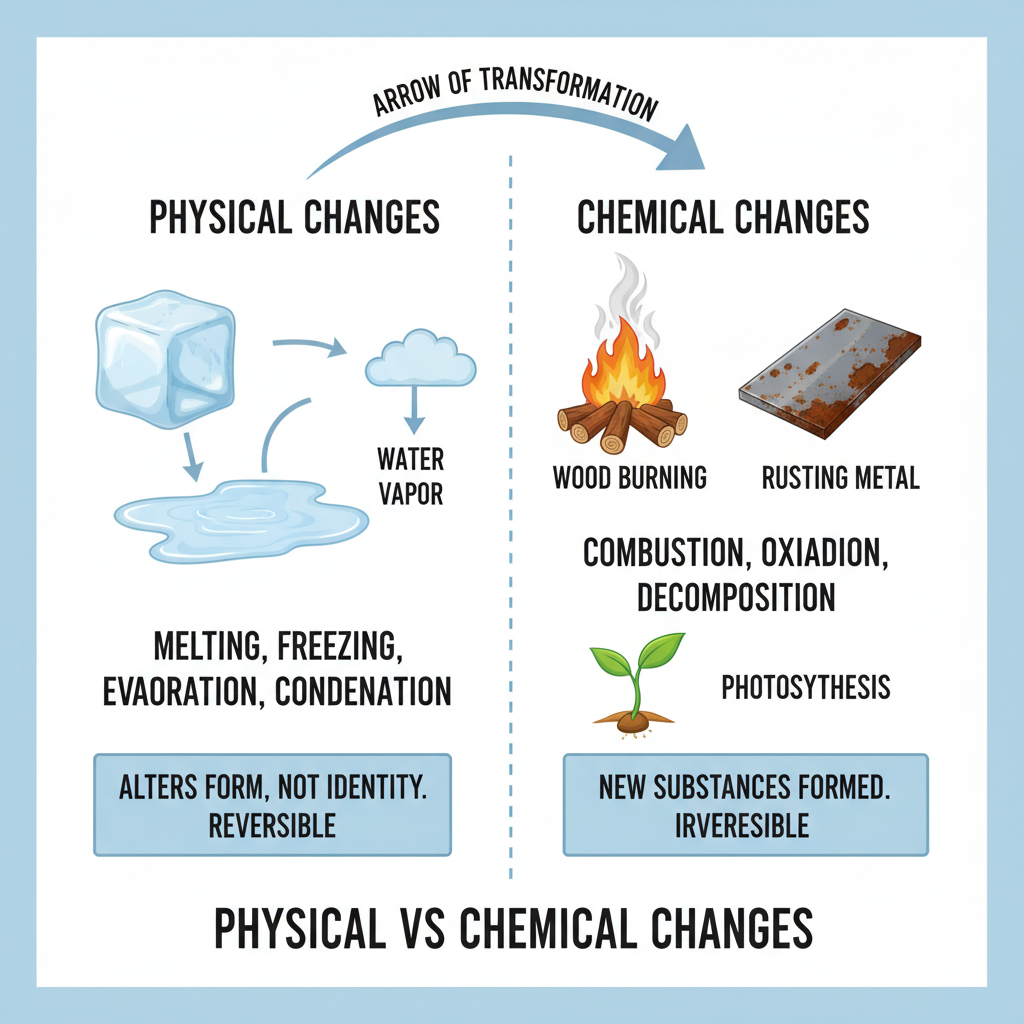
A physical change is a change in the form or appearance of a substance, but not in its chemical composition. The substance remains the same kind of matter.
Imagine you're playing with LEGO bricks. If you take a large tower of LEGOs and break it into smaller pieces, or rearrange them into a different shape, they are still LEGO bricks. You haven't turned them into plasticine or metal. This is a physical change.
Examples of Physical Changes:
- Melting ice: Ice (solid water) turns into liquid water. It's still H2O.
- Boiling water: Liquid water turns into steam (gaseous water). It's still H2O.
- Dissolving sugar in water: The sugar crystals disappear, but they are still sugar molecules mixed with water molecules. You can evaporate the water and get the sugar back.
- Tearing paper: The paper is in smaller pieces, but it's still paper.
- Crushing a can: The can changes shape, but the aluminum is still aluminum.
Most physical changes are easily reversible. You can freeze water back into ice, or evaporate water to get dissolved sugar back.
2. Chemical Changes (Chemical Reactions): Forming Something Entirely New!
A chemical change, also known as a chemical reaction, is a process that involves the rearrangement of the molecular or ionic structure of a substance, as opposed to a change in physical form. In simpler terms, one or more substances are transformed into entirely new substances with different properties.
Going back to our LEGO analogy: A chemical change is like taking individual LEGO bricks (your initial substances, called reactants) and using them to build a completely new, fused, and different toy (your new substances, called products). You can't just easily break it back down into the original bricks without serious effort, and the new toy has its own unique characteristics.
Think about baking a cake. You start with flour, eggs, sugar, butter (your reactants). You mix them and apply heat. What do you get? A cake! You can't just pick out the raw eggs or raw flour from the finished cake. The ingredients have chemically transformed into new substances that make up the cake. This is a chemical reaction!
Signs That a Chemical Reaction (Chemical Change) Has Occurred:
These are like clues that tell us new substances have been formed:
- Formation of a Gas: Bubbles appearing without heating to boiling point (e.g., mixing baking soda and vinegar produces CO2 gas).
- Formation of a Precipitate: A solid forming and settling out of a liquid solution (e.g., when two clear liquids are mixed and a cloudy solid appears).
- Color Change: A noticeable and often irreversible change in the color of the substance (e.g., fruit browning, leaves changing color in autumn, rusting iron).
- Temperature Change: The reaction mixture gets noticeably hotter (exothermic reaction, releasing heat) or noticeably colder (endothermic reaction, absorbing heat).
- Emission of Light or Sound: Light is given off (e.g., glow sticks, burning wood) or sound is produced (e.g., an explosion).
 ⚠️ This picture may have spelling mistakes. Trust the words in the lesson.
Examples of Chemical Reactions (Chemical Changes):
- Burning wood: Wood reacts with oxygen to produce ash, carbon dioxide, water vapor, and heat/light.
- Rusting of iron: Iron reacts with oxygen and water to form iron oxide (rust).
- Digesting food: Food molecules are broken down and reassembled into new molecules that the body can use.
- Baking a cake: Ingredients combine and transform under heat to form new substances.
- Mixing an acid and a base: Often produces a salt and water, with a change in pH.
The Law of Conservation of Mass (A Quick Important Note!)
In all physical and chemical changes, a crucial principle holds true: the Law of Conservation of Mass. This law states that matter cannot be created or destroyed in an isolated system. This means that during any change or reaction, the total mass of the reactants must equal the total mass of the products. You're just reorganizing the atoms, not losing or gaining any! It's like our LEGOs: no matter how you rearrange or combine them, the total number of LEGO studs remains the same.
Conclusion
By understanding physical and chemical properties, and the differences between physical and chemical changes, you've gained fundamental tools for describing and predicting how matter behaves. Remember, physical properties are what you observe without changing the substance's identity, while chemical properties describe its potential to change into something new. Physical changes alter form, but chemical changes create entirely new substances. Keep an eye out for these changes in your daily life – chemistry is all around you!
Keep learning, free
Create a free Syllabax account to unlock practice questions and games for this topic.
Visual Learning Enhanced! 🚀
To help you master this topic, we use Advanced Syllabax AI to generate detailed diagrams and visual models.
Note on Visuals: The AI sometimes makes spelling errors in image labels. Please refer to the lesson text for the correct terminology.