Expanded form (Intro) (Place Value )
Watch this topic in 60 seconds
Free preview · Lesson 1
Understanding Expanded form (Intro) (Place Value )
Understanding Expanded Form: Building Numbers with Place Value!
Hello young mathematicians! Today, we're going on an exciting adventure to learn about something super important called Expanded Form. Think of it like building with LEGOs! Just like you put different colored and shaped LEGO bricks together to build a cool castle or a speedy car, we use numbers to build bigger numbers. Expanded form is a way to show how a number is made up of its different parts.
What is Place Value?
Before we build with expanded form, let's talk about Place Value. Imagine you have a special box with different compartments. Each compartment holds a certain number of items. In math, we have similar compartments for our numbers! These compartments are called places. The most common places we learn about are:
- The Ones Place: This is the very first compartment on the right. It holds single items, from 0 to 9. Think of it as a small bag where you put individual candies.
- The Tens Place: This compartment is to the left of the ones place. It holds groups of ten. Imagine a box that can hold 10 candies. If you have 10 candies, you put them in this box!
- The Hundreds Place: This is to the left of the tens place. It holds groups of one hundred. Think of a big basket that can hold 10 boxes of 10 candies!
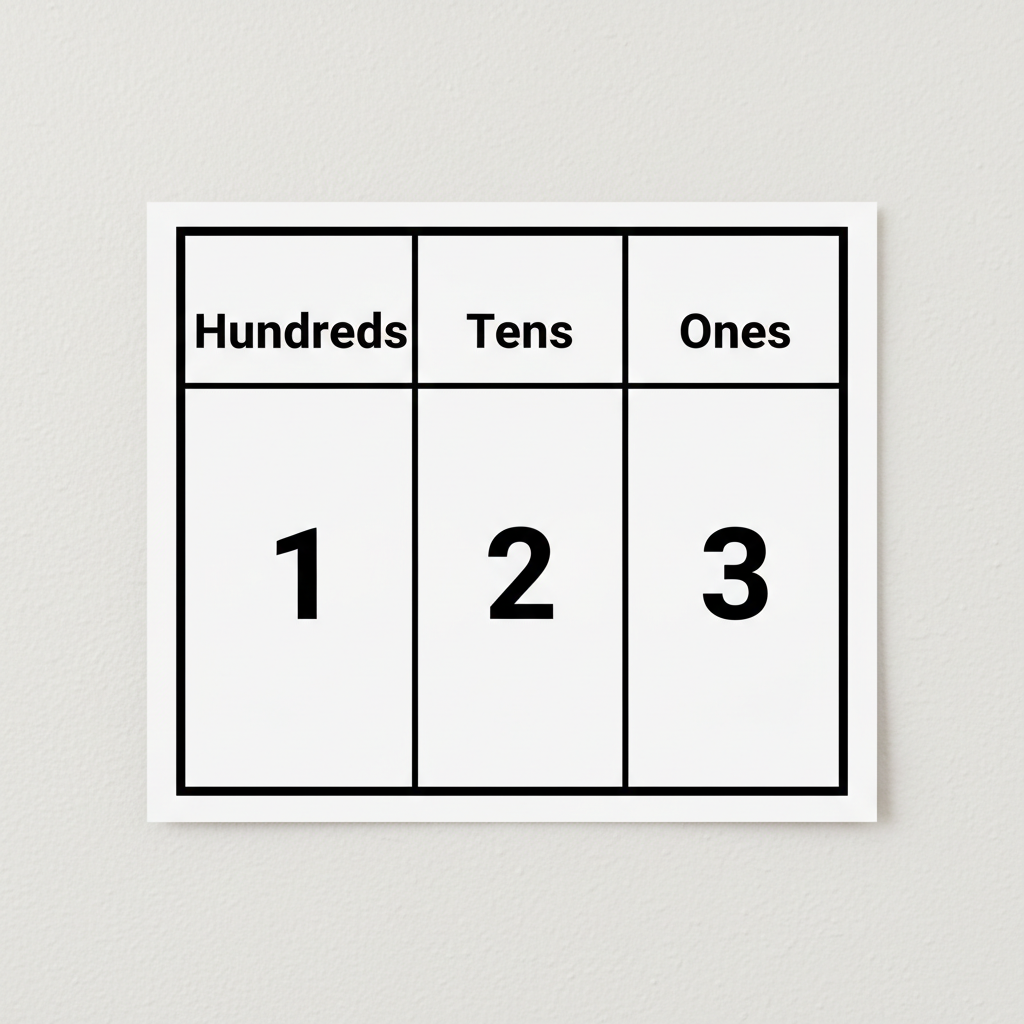
The position of a digit in a number tells us its value. For example, in the number 123:
- The digit '3' is in the ones place, so it means 3 ones.
- The digit '2' is in the tens place, so it means 2 tens, which is like having 2 groups of 10, or 20!
- The digit '1' is in the hundreds place, so it means 1 hundred, which is like having 1 group of 100, or 100!
What is Expanded Form?
Now that we know about place value, let's learn about Expanded Form! Expanded form is like taking apart a LEGO creation and showing all the individual bricks that were used to build it. It means writing a number as the sum of the value of each of its digits.
Let's take our number 123 again.
In expanded form, we show what each digit is worth:
- The '1' in the hundreds place is worth 100.
- The '2' in the tens place is worth 20.
- The '3' in the ones place is worth 3.
So, we write 123 in expanded form like this:
100 + 20 + 3
See? We've taken the number 123 and "expanded" it by showing all the parts that add up to it! It's like opening up a gift box and showing all the wonderful presents inside, instead of just looking at the wrapped box.
More Examples!
Example 1: The number 45
Let's break down the number 45.
- The digit '4' is in the tens place. So, it's worth 4 tens, which is 40.
- The digit '5' is in the ones place. So, it's worth 5 ones, which is 5.
In expanded form, 45 is:
40 + 5
Example 2: The number 207
Let's look at the number 207.
- The digit '2' is in the hundreds place. So, it's worth 2 hundreds, which is 200.
- The digit '0' is in the tens place. So, it's worth 0 tens, which is 0.
- The digit '7' is in the ones place. So, it's worth 7 ones, which is 7.
In expanded form, 207 is:
200 + 0 + 7
(Sometimes, when a digit is 0, we can leave it out, but it's good to know it's there! So, 200 + 7 is also correct for 207.)
Example 3: The number 9
What about a single-digit number like 9?
- The digit '9' is in the ones place. So, it's worth 9 ones, which is 9.
In expanded form, 9 is just:
9
For single-digit numbers, the number itself is its expanded form because it only has a value in the ones place.
Why is Expanded Form Useful?
Expanded form helps us really understand how numbers are built. It's like learning the alphabet before you can read books. By seeing the parts of a number, we can:
- Understand Place Value Better: It reinforces that the '2' in 23 means 20, not just 2.
- Add and Subtract Easier: When we get older, expanded form helps us do bigger addition and subtraction problems by breaking them down.
- See the Value of Each Digit: It highlights that digits in different places have different amounts of value.
Let's Practice!
Now it's your turn to try building numbers with expanded form!
Keep learning, free
Create a free Syllabax account to unlock practice questions and games for this topic.
Visual Learning Enhanced! 🚀
To help you master this topic, we use Advanced Syllabax AI to generate detailed diagrams and visual models.
Note on Visuals: The AI sometimes makes spelling errors in image labels. Please refer to the lesson text for the correct terminology.