What is Artificial Intelligence (AI)?
Watch this topic in 60 seconds
Free preview · Lesson 1
Understanding What is Artificial Intelligence (AI)?
What is Artificial Intelligence (AI)? Your Smart Assistant!
Imagine you have a super-smart friend who can learn incredibly fast, help you solve tricky problems, and even understand what you say and show you pictures. That, in a nutshell, is a bit like Artificial Intelligence, or AI for short! At its core, AI is about making computers, robots, and other machines think, learn, and act in ways that usually require human intelligence.
AI: More Than Just Robots – It's Like a Super Brain!
When you hear 'AI,' you might picture a talking robot from a movie, and while robots can use AI, AI itself isn't just about physical machines. Think of AI as the 'brain' or 'smart part' inside many devices we use every day. It's the clever programming that allows a computer to do things we consider 'smart.'
Analogy 1: Your Pet Detective
Imagine you lose your favorite toy. A human friend would help you by remembering where you last saw it, looking for clues, and maybe even guessing where it might have rolled. An AI works in a similar way! If you tell an AI what your toy looks like and show it many pictures of your room, the AI could 'learn' to identify your toy and help you find it by scanning images of your room, much like a super-fast pet detective!
How Does AI 'Learn'? It's Like Going to School!
Humans learn by going to school, reading books, listening to teachers, and practicing. AI 'learns' in a similar, but much faster, way! Instead of textbooks, AI learns from huge amounts of information called 'data.' This data can be pictures, words, numbers, sounds, or videos. The AI looks for patterns in this data.
Analogy 2: Learning to Identify Animals
Think about how you learned to tell the difference between a cat and a dog. Someone showed you many pictures of cats, saying 'cat,' and many pictures of dogs, saying 'dog.' After seeing enough examples, you learned the patterns: cats usually have pointy ears and whiskers, while dogs often have floppy ears and different noses. AI learns like this too! You feed it thousands of pictures labeled 'cat' and 'dog,' and it figures out the patterns to tell them apart on its own.
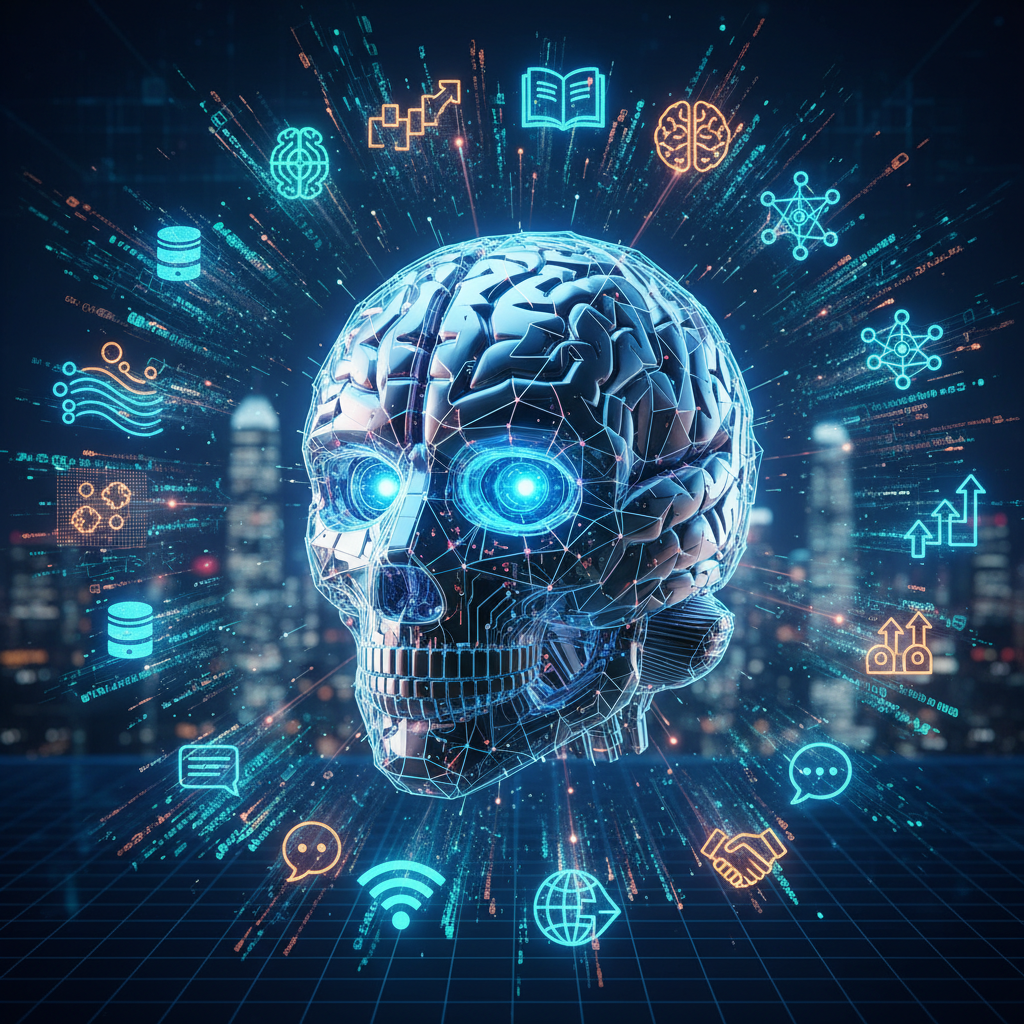 ⚠️ This picture may have spelling mistakes. Trust the words in the lesson.
Where Do We See AI Every Day? Everywhere!
You might be surprised how much AI is already a part of your life!
- Voice Assistants: When you ask Siri, Alexa, or Google Assistant a question, AI is working to understand your words and find an answer.
- Recommendation Systems: When YouTube suggests a new video you might like, or a streaming service recommends a movie, AI is predicting what you'd enjoy based on what you've watched before.
- Smart Games: Many video games use AI for computer-controlled characters to make them seem intelligent and challenging.
- Spam Filters: Your email uses AI to figure out which emails are junk (spam) and move them out of your main inbox.
- Self-Driving Cars: These cars use AI to 'see' the road, understand traffic signs, and make decisions about when to speed up, slow down, or turn.
- Facial Recognition: When your phone unlocks just by looking at your face, AI is at work.
The Main 'Superpowers' of AI: Simplified!
AI isn't just one big thing; it has different 'superpowers' or branches. Here are a few important ones:
1. Machine Learning (ML): The Super Learner
This is the most common way AI learns. Instead of programmers writing every single instruction, they create programs that can 'learn' from data. It's like teaching a puppy a trick – you don't program every muscle movement, you show it what to do repeatedly until it learns.
Analogy 3: Teaching a Robot to Sort Toys
Imagine you have a robot and you want it to sort your toys into different bins: cars in one, blocks in another, and stuffed animals in a third. With Machine Learning, you wouldn't tell the robot exactly how to recognize every car or block. Instead, you'd show it hundreds of examples of cars, blocks, and stuffed animals, each time telling it which bin it belongs in. The robot would then 'learn' the characteristics of each toy type and be able to sort new, unseen toys all by itself!
2. Natural Language Processing (NLP): The Super Communicator
NLP is what allows computers to understand, interpret, and generate human language. It's how your voice assistant understands your questions and how translation apps can turn one language into another.
Analogy 4: A Super Translator
Think of NLP as a super-fast, super-accurate translator. When you speak to your phone, NLP helps the phone translate your messy, human words into commands the computer can understand. And when it talks back, it translates computer answers into understandable human speech.
3. Computer Vision: The Super Seer
Computer Vision gives computers the ability to 'see' and interpret the world through images and videos. This is crucial for things like self-driving cars recognizing traffic lights and pedestrians, or security cameras identifying faces.
Analogy 5: An Expert Art Critic
Imagine an art critic who can look at a painting and not just describe what's in it, but also tell you about the style, the emotions, and perhaps even who painted it. Computer Vision lets computers do something similar. It helps them 'see' a picture, identify objects (like a cat, a tree, or a car), understand scenes (is this a park or a street?), and even recognize faces.
Why is AI Important? Helping Us Do More!
AI is being developed to help us in countless ways:
- Solving Complex Problems: AI can analyze huge amounts of data much faster than humans, helping scientists find new medicines or understand climate change.
- Making Life Easier: From smart home devices to personalized learning tools, AI can make daily tasks simpler and more efficient.
- Improving Safety: AI in cars, drones, and security systems can help prevent accidents and keep us safe.
A Glimpse into the Future: AI and You
AI is still a young field, and it's growing incredibly fast! As you grow up, AI will become even more integrated into your world, changing how we work, play, and learn. Understanding what AI is and how it works is like having a secret key to unlock many exciting possibilities for the future. It's a tool that can amplify human intelligence and help us tackle some of the world's biggest challenges.
Keep learning, free
Create a free Syllabax account to unlock practice questions and games for this topic.
Visual Learning Enhanced! 🚀
To help you master this topic, we use Advanced Syllabax AI to generate detailed diagrams and visual models.
Note on Visuals: The AI sometimes makes spelling errors in image labels. Please refer to the lesson text for the correct terminology.