Push and pull (Force & Motion)
Watch this topic in 60 seconds
Free preview · Lesson 1
Understanding Push and pull (Force & Motion)
All About Pushes and Pulls: The Amazing Forces Around Us!
Hello, young scientists! Have you ever wondered how things move? How does your toy car roll across the floor? How do you open a door? The answer is simple: it's all thanks to something called force! A force is like an invisible helper that makes things happen. It's what makes objects start moving, stop moving, change direction, or even change their shape!
In our world, the two most common and important types of forces we use every single day are pushes and pulls. Let's dive in and discover how these amazing forces work!
What is a Push?
Imagine you have a big box, and you want to move it across the room. What do you do? You put your hands on it and move it away from you, right? That's a push! A push is a force that moves an object away from you or away from the point where the force is applied.
Think of it like this:
- When you push a swing: You make it go forward, away from your body.
- When you push a shopping cart: You apply force to its back to move it forward, away from where you are standing.
- When you push a door open: You often apply force to make the door swing away from you.
- When you push a button on a remote control: Your finger presses down, moving the button away from the surface.
Pushes are all about making things go! You push a skateboard to make it roll, you push a toy car to get it moving, and you push the pedals on your bike to make it speed up.

Look at the picture above! The child is using a push to make the red toy car move. See how their hand is making the car go forward, away from them? That's a perfect example of a push in action!
What is a Pull?
Now, imagine you have a heavy toy wagon, and you want to bring it closer to you. What do you do? You grab the handle and move it towards you, right? That's a pull! A pull is a force that moves an object towards you or towards the point where the force is applied.
Let's think about some examples of pulls:
- When you pull a rope in a game of tug-of-war: You are trying to bring the other team, and the rope, closer to your side.
- When you pull a drawer open: You grab the handle and bring the drawer out, closer to you.
- When you pull a pet's leash: You guide your pet by bringing them closer or changing their direction towards you.
- When you pull a chair to the table: You move the chair closer to where you want to sit.
Pulls are just as common as pushes! You pull a zipper up on your jacket, you pull a string to open blinds, and you pull a book off a shelf.
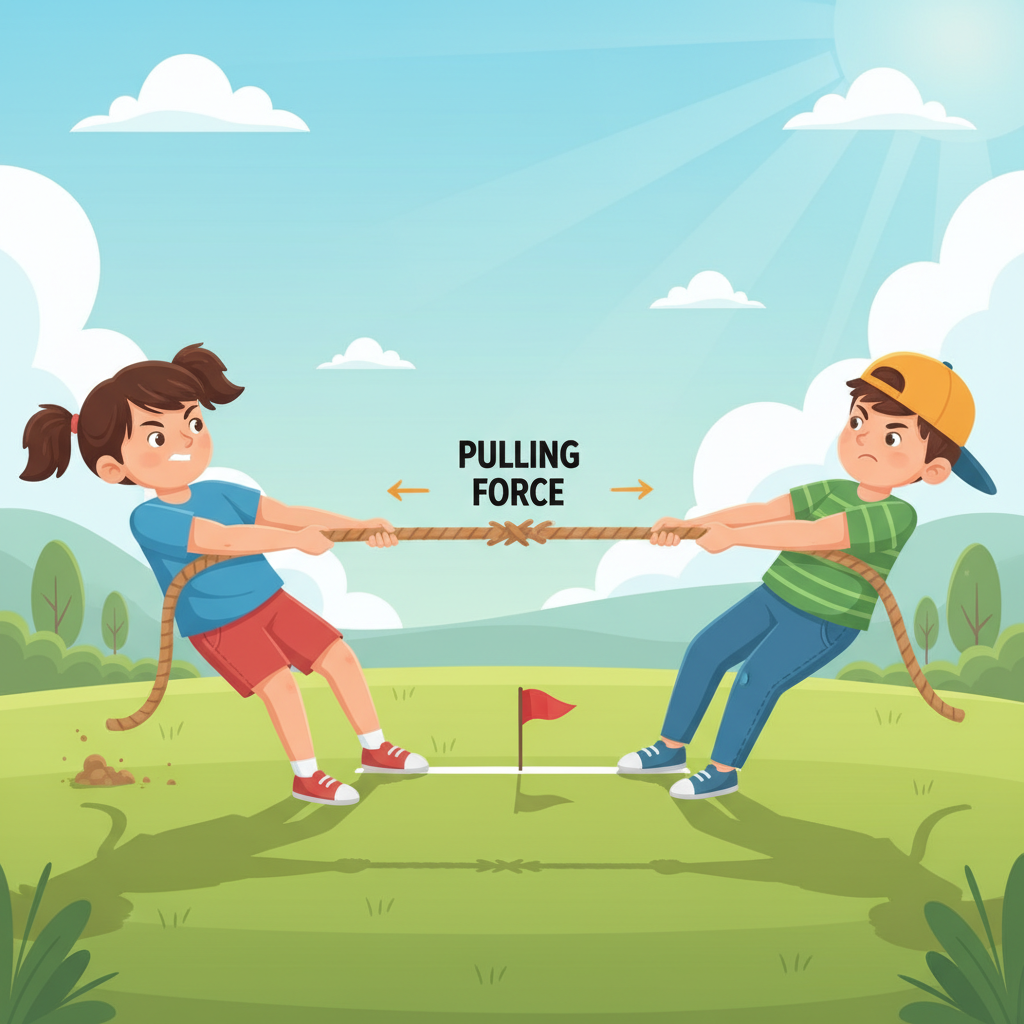 ⚠️ This picture may have spelling mistakes. Trust the words in the lesson.
In this image, two children are showing a great example of pulling force. Each child is pulling the rope towards themselves, trying to win the game! This is a fantastic way to understand what a pull looks and feels like.
How Pushes and Pulls Make Things Change!
Pushes and pulls aren't just for moving things; they can do so much more! These forces can change how objects move in many ways:
1. Starting Movement:
Imagine a soccer ball sitting perfectly still on the grass. It won't move by itself! You need to push it with your foot to make it start rolling. Or, if you have a toy train on a track, you might pull it with a string to get it going.
2. Stopping Movement:
What if that soccer ball is rolling really fast, and you want it to stop? You can put your foot in front of it and push against it to make it slow down and stop. When you ride your bicycle, you pull the brake levers, and the brake pads push against the wheels to make you stop.
3. Changing Direction:
Let's say you're playing catch with a friend. When the ball comes to you, you might push it back to your friend in a different direction. If you're steering a wagon, you might pull the handle to the left or right to change the wagon's direction.
4. Changing Speed:
If you give your friend a gentle push on a swing, they will move slowly. But if you give a big, strong push, they will go much faster! The same with pulling a sled: a soft pull makes it go slow, but a strong pull makes it zoom!
5. Changing Shape (Sometimes!):
While we usually think of pushes and pulls moving things, they can also change shapes! If you push down on a lump of play-doh, it flattens and changes shape. If you pull on a rubber band, it stretches and changes its shape. This shows how forces can truly transform objects!
Pushes and Pulls are Everywhere in Your Day!
It's amazing how many times a day you use pushes and pulls without even thinking about it! Think about your morning:
- You push the covers off your bed.
- You pull your shirt over your head.
- You push the toothpaste out of the tube and pull your toothbrush across your teeth.
- You pull a chair out from the table to sit down for breakfast.
- You push your cereal bowl away when you're finished.
And when you're playing:
- You push a ball to your friend.
- You pull a toy with a string.
- You push a button on a video game controller.
- You might pull a kite string to make it fly higher.
Even simple things like eating an apple involve forces! You pull the apple from a fruit bowl, and then you push your teeth through it to take a bite!
The Big Difference: Push vs. Pull
The easiest way to remember the difference is:
- Push: Moves something AWAY from you. Think: "Pusshhh it away!"
- Pull: Moves something TOWARDS you. Think: "Pull it here!"
Sometimes, we even use both forces together! When you open a heavy sliding door, you might have to push one side and pull the other. Or, imagine trying to open a stubborn jar lid – you might push down and twist, or pull and twist!
Conclusion
So, the next time you see something move, stop, change direction, or speed up, remember the amazing forces of pushes and pulls! They are the invisible engines that make our world go 'round, allowing us to interact with everything around us. From kicking a ball to opening a book, pushes and pulls are fundamental to how we live and play. Keep an eye out for them – you'll see them everywhere!
Keep learning, free
Create a free Syllabax account to unlock practice questions and games for this topic.
Visual Learning Enhanced! 🚀
To help you master this topic, we use Advanced Syllabax AI to generate detailed diagrams and visual models.
Note on Visuals: The AI sometimes makes spelling errors in image labels. Please refer to the lesson text for the correct terminology.