Sounds around us (Sound)
Watch this topic in 60 seconds
Free preview · Lesson 1
Understanding Sounds around us (Sound)
Welcome to the Wonderful World of Sounds!
Hello, young learners! Have you ever closed your eyes and just listened? What do you hear? Maybe a bird singing, a car driving by, or even your own tummy rumbling! All these things are sounds. Sounds are all around us, all the time!
What is Sound?
Sound is a type of energy that we can hear with our ears. It helps us understand what's happening around us. Think about it like a secret message that travels through the air to reach your ears!
How Do We Make Sound? It's All About Vibrations!
This is the most important secret about sound: all sounds are made by vibrations! What are vibrations? Imagine you have a rubber band. If you pull it tight and then pluck it, what happens? It wiggles very, very fast! That fast wiggling is a vibration.
- Analogy 1: The Guitar String. When someone plays a guitar, they pluck a string. The string vibrates back and forth really fast. You can even see it if you look closely! This vibration makes the sound.
- Analogy 2: The Drum. When you hit a drum, the skin on top of the drum vibrates. This makes the booming sound.
- Analogy 3: Your Voice. Even your own voice is made by vibrations! Inside your throat, you have something called vocal cords. When you talk or sing, they vibrate super fast to make different sounds.
So, whenever you hear a sound, something somewhere is vibrating!
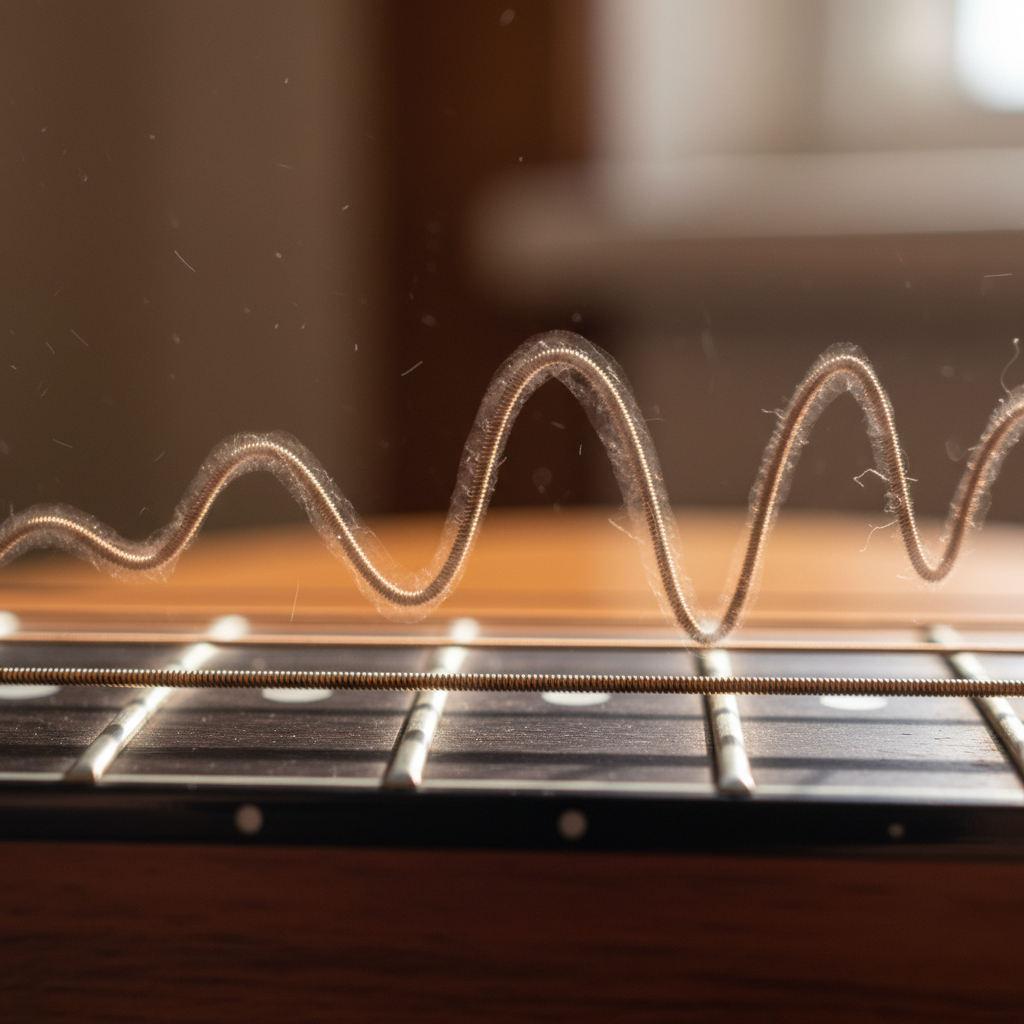 ⚠️ This picture may have spelling mistakes. Trust the words in the lesson.
How Does Sound Travel?
Once a sound is made by vibrations, it needs to travel to your ears so you can hear it. Sound travels through many things, like air, water, and even solid objects!
- Analogy 4: Ripples in a Pond. Imagine dropping a stone into a still pond. You'll see little waves, or ripples, spread out from where the stone hit. Sound travels a bit like these ripples, but through the air (or water or other things) instead of water.
- Analogy 5: The Cup-and-String Telephone. Have you ever made a telephone with two paper cups and a string? When you talk into one cup, the sound vibrations travel along the tight string to the other cup, and your friend can hear you! The string helps the sound travel.
So, sound travels in waves, carrying the message of the vibration to your ears.
Loud Sounds and Soft Sounds
Some sounds are very loud, like a big fire truck siren, and some are very soft, like a whisper. What makes a sound loud or soft?
- Analogy 6: Pushing a Swing. If you give a swing a big, strong push, it swings out very far. That's like a loud sound – it has a lot of energy!
- Analogy 7: Gentle Push. If you give the swing a tiny, gentle push, it barely moves. That's like a soft sound – it has less energy.
Loud sounds are made by strong vibrations that move a lot, and soft sounds are made by gentle vibrations that move just a little.
High Sounds and Low Sounds (Pitch)
Sounds can also be high or low. We call this pitch.
- Analogy 8: Bird Chirping vs. Dog Barking. A tiny bird usually makes a high-pitched sound, like a 'tweet-tweet!' A big dog, like a golden retriever, usually makes a lower-pitched sound, like a 'woof-woof!'
- Analogy 9: Thin String vs. Thick String. On a guitar, the thin strings make high-pitched sounds when you pluck them. The thick strings make low-pitched sounds.
High-pitched sounds are made by very fast vibrations, and low-pitched sounds are made by slower vibrations.

Sounds All Around Us!
Let's think about all the different sounds you hear every day:
- At Home: The doorbell ringing (loud), your microwave beeping (high), your parents talking (medium), a clock ticking (soft), the washing machine humming (low).
- At School: The school bell ringing (loud), children laughing (high), a pencil scratching (soft), the teacher's voice (medium).
- Outside: Birds singing (high), a car horn beeping (loud), leaves rustling in the wind (soft), thunder rumbling (low and loud).
Each sound tells us something about the world around us!
Why Are Sounds Important?
Sounds are super important! They help us:
- Communicate: We use our voices to talk and listen to each other.
- Stay Safe: A fire alarm warns us of danger. A car horn tells us to be careful.
- Enjoy Music: Music is made of beautiful sounds that make us feel happy or excited.
- Understand Our World: Sounds tell us if it's raining, if someone is at the door, or if an animal is nearby.
Protecting Our Ears
Our ears are amazing tools for hearing! It's very important to take good care of them. Loud noises for a long time can hurt your ears. So, try to keep the volume down on your headphones or TV, and if a sound is too loud, move away from it. Our ears help us explore the wonderful world of sound, so let's keep them safe!
Let's Review!
You've learned so much about sounds today! Remember, sounds are made by vibrations, they travel in waves, and they can be loud or soft, and high or low. Keep listening and exploring the sounds all around you!
Keep learning, free
Create a free Syllabax account to unlock practice questions and games for this topic.
Visual Learning Enhanced! 🚀
To help you master this topic, we use Advanced Syllabax AI to generate detailed diagrams and visual models.
Note on Visuals: The AI sometimes makes spelling errors in image labels. Please refer to the lesson text for the correct terminology.