Atmospheric pressure[PHYSICS]
Watch this topic in 60 seconds
Free preview · Lesson 1
Understanding Atmospheric pressure[PHYSICS]
Understanding Atmospheric Pressure: Earth's Invisible Blanket
Imagine you're at the beach, enjoying the sunshine. You feel the gentle breeze, but you can't see it, can you? Yet, it pushes against your skin. Now, imagine something even more powerful, something that's all around you, all the time, but completely invisible. That's atmospheric pressure!
What is the Atmosphere?
Our Earth is wrapped in a giant, invisible blanket called the atmosphere. This blanket isn't made of wool or cotton; it's made of gases – mostly nitrogen and oxygen, with a little bit of other gases like argon, carbon dioxide, and water vapor. Think of it like a huge ocean of air surrounding our planet.
What is Pressure?
Before we talk about atmospheric pressure, let's understand what pressure is in general. Pressure is basically the force applied over a certain area. Think about it this way:
- If you press your finger against a wall, you feel a little bit of pressure.
- If you use the tip of a sharp needle to press against the same wall with the same force, it feels much more painful and digs in more! Why? Because the force is concentrated over a much smaller area.
So, pressure = force / area.
What is Atmospheric Pressure?
Now, let's put it all together. The atmosphere, that big ocean of air, is made of tiny gas particles. These particles are constantly moving and bumping into everything. Because they are moving and have mass (even though it's tiny), they exert a force. Since the air is all around us, this force is spread out over an area. Therefore, we have atmospheric pressure!
Atmospheric pressure is the weight of the air in the atmosphere pressing down on the Earth's surface.
Think of it like a stack of books. The book at the bottom has to hold up the weight of all the books above it. Similarly, the air at the bottom of the atmosphere (near the Earth's surface) has to hold up the weight of all the air above it. This makes the pressure greatest at sea level.
Why Can't We Feel It?
This is a great question! If the air is so heavy, why don't we feel squashed like a pancake? The reason is that pressure always acts in all directions. The air above you is pushing down, but the air all around you is pushing in, and the air below you (if you're standing) is pushing up!
Your body is also pushing outwards with its own internal pressure. These forces balance each other out, so you don't feel the immense pressure of the atmosphere. It's like being underwater. When you're deep underwater, you feel the water pressure pushing on you. But at the surface, you can't really feel the weight of the water above you because the pressure is balanced.
Another analogy: Imagine a giant marshmallow man standing on a tiny ant. The ant feels the immense weight of the marshmallow man pressing down. But if the ant were part of the marshmallow man, it wouldn't feel that pressure because it's surrounded by other parts of the marshmallow man pushing equally in all directions.
How Does Altitude Affect Atmospheric Pressure?
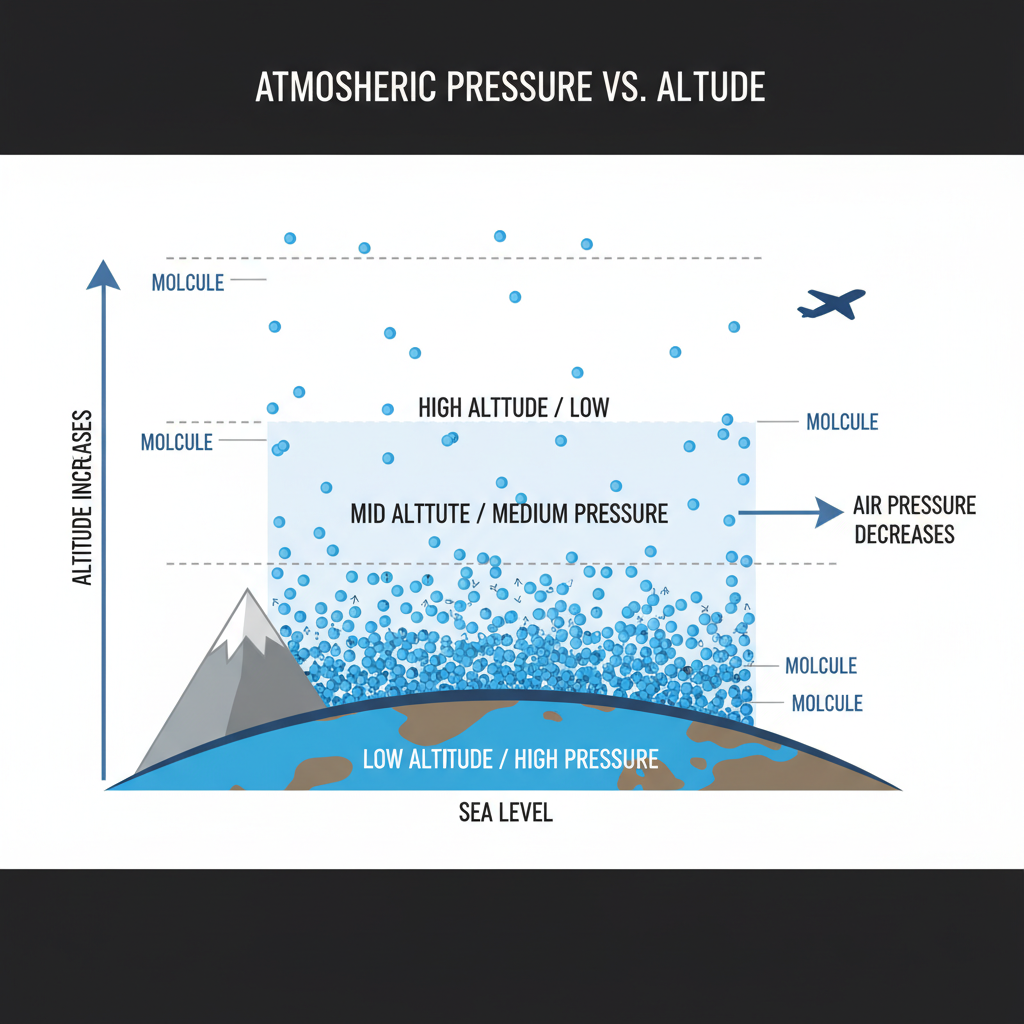
As you go higher up in the atmosphere, there is less air above you. Think back to the stack of books analogy. If you're on the top book, there are no books above you, so the pressure is much less. The same happens with altitude:
- At sea level (low altitude): There is a lot of air above, so the atmospheric pressure is high.
- On a mountain (high altitude): There is less air above, so the atmospheric pressure is lower.
This is why mountain climbers often need oxygen tanks. The air is thinner (less dense) at higher altitudes, meaning there are fewer oxygen molecules to breathe in. It's not just about the lack of oxygen; it's also about the lower air pressure making it harder for your body to absorb the oxygen that is there.
 ⚠️ This picture may have spelling mistakes. Trust the words in the lesson.
Changes in Weather
Atmospheric pressure isn't constant. It changes from day to day and even from hour to hour. These changes in pressure are a major factor in our weather:
- High-pressure systems are generally associated with clear, fair weather. Think of it as a "heavy" blanket of air pressing down, which tends to keep clouds from forming easily.
- Low-pressure systems are often associated with clouds, rain, and storms. Think of it as a "lighter" area where the air is rising, creating space for clouds to form and grow.
Wind itself is caused by differences in atmospheric pressure. Air always moves from areas of high pressure to areas of low pressure, trying to even things out.
Measuring Atmospheric Pressure
We use a tool called a barometer to measure atmospheric pressure. You might have seen one in a weather station. A simple barometer works by using mercury or water in a tube. The weight of the air pushes on the liquid, and the height the liquid rises in the tube tells us how much pressure there is.
The standard atmospheric pressure at sea level is often defined as 1 atmosphere (atm). This is equivalent to about 101,325 Pascals (Pa) or 14.7 pounds per square inch (psi).
Key Concepts Recap
- The atmosphere is the blanket of gases around the Earth.
- Pressure is force per unit area.
- Atmospheric pressure is the weight of the air pressing down.
- Pressure acts in all directions, which is why we don't feel squashed.
- Pressure decreases as altitude increases.
- Changes in atmospheric pressure influence weather patterns.
So, the next time you step outside, remember that invisible, powerful blanket of air all around you – the atmosphere – and the pressure it exerts!
Keep learning, free
Create a free Syllabax account to unlock practice questions and games for this topic.
Visual Learning Enhanced! 🚀
To help you master this topic, we use Advanced Syllabax AI to generate detailed diagrams and visual models.
Note on Visuals: The AI sometimes makes spelling errors in image labels. Please refer to the lesson text for the correct terminology.