Learning Journey
Watch this topic in 60 seconds
Free preview · Lesson 1
Understanding Simple Probability Games
Simple Probability Games: What Are Your Chances?
Hello, young mathematicians! Have you ever played a game where you wondered what might happen next? Maybe you flipped a coin to see who goes first, or spun a spinner in a board game? If so, you've already started exploring the exciting world of probability! Probability is just a fancy word for the chance or likelihood that something will happen.
What is Probability? Understanding 'Chance'
Imagine you're asking your friend, "Will it rain today?" They might say, "Maybe!" or "Probably not!" or "Definitely!" They are talking about the probability of rain. Probability helps us understand how likely or unlikely an event is. It's like having a special superpower that helps you guess what might happen next in a fair way.
Thinking About Chances:
- Impossible: This means something CANNOT happen. Like a fish riding a bicycle!
- Unlikely: This means something probably WON'T happen, but it could. Like picking a purple crayon from a box of 100 red crayons and only one purple one.
- Equally Likely: This means two things have the EXACT SAME chance of happening. Like flipping a coin – it's equally likely to land on Heads as it is on Tails.
- Likely: This means something probably WILL happen. Like picking a red crayon from a box of 100 red crayons and only one purple one.
- Certain: This means something WILL definitely happen. Like the sun rising tomorrow morning!
All the Possibilities: What Are the Outcomes?
When we play a game, there are different things that *can* happen. We call these the outcomes. Think of it like a menu at your favorite restaurant. The outcomes are all the different foods you can choose from.
Let's look at some examples:
- Flipping a Coin: What can happen? It can land on HEADS or TAILS. So, there are 2 possible outcomes.
- Rolling a Number Cube (Die): What numbers can you get? You can get a 1, 2, 3, 4, 5, or 6. So, there are 6 possible outcomes.
- Spinning a Spinner: Look at this spinner below. What are the possible outcomes? It can land on Red, Blue, Yellow, or Green. So, there are 4 possible outcomes.
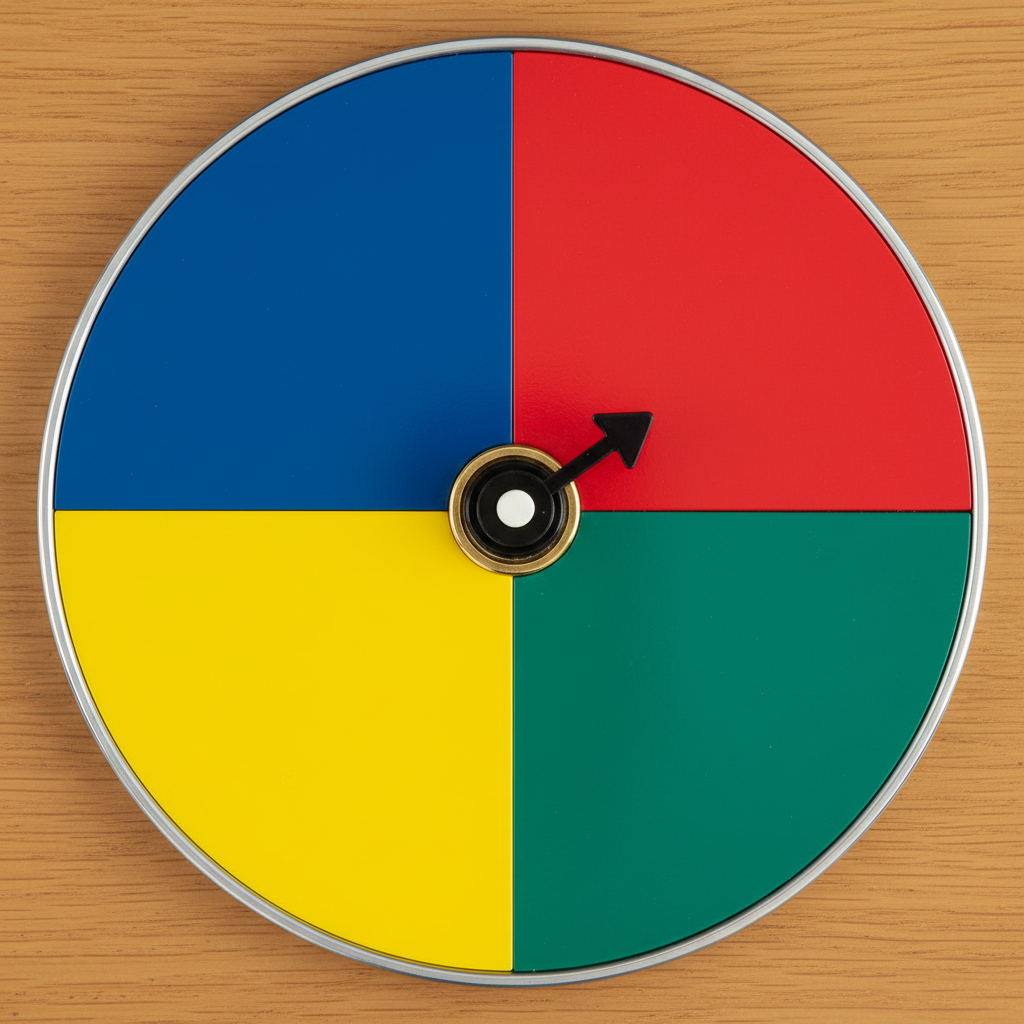
Each time you play a game or do an experiment, knowing all the possible outcomes helps you understand the chances of different things happening.
Fair Games vs. Unfair Games
When you play a game, do you want everyone to have an equal chance to win? If so, you want a fair game!
- Fair Game: In a fair game, every outcome has an equally likely chance of happening. Imagine a seesaw that is perfectly balanced – neither side is heavier than the other. If you flip a coin, heads and tails are equally likely, so it's a fair way to decide who goes first. If you use a regular number cube, each number (1-6) has an equally likely chance of being rolled.
- Unfair Game: In an unfair game, some outcomes are more likely than others. It's like a seesaw that's stuck on one side, giving one person an advantage. What if you had a coin with two 'Heads' sides? Then getting 'Tails' would be impossible, and it wouldn't be a fair way to play! Or what if a spinner had a very tiny section for one color and a giant section for another? The giant section would be much more likely.
Simple Probability Games in Action!
Let's look at some games and talk about their chances:
1. The Coin Toss
You have a coin with Heads on one side and Tails on the other. You flip it. What are the outcomes? Heads or Tails. Are they equally likely? Yes! So, a coin toss is a fair game. The probability of getting Heads is the same as the probability of getting Tails.
2. The Dice Roll
You have a standard number cube (die) with numbers 1 through 6. You roll it. What are the outcomes? 1, 2, 3, 4, 5, 6. Is it equally likely to roll a '1' as it is to roll a '6'? Yes! Each number has the same chance. So, rolling a die is usually part of a fair game.
3. The Marble Grab
Imagine you have a bag with different colored marbles. If you reach in without looking, what color marble will you pull out? Let's say you have a bag with 8 red marbles and 2 blue marbles.
- What is the chance of pulling out a red marble? It's very likely because there are many more red marbles.
- What is the chance of pulling out a blue marble? It's unlikely because there are only a few blue marbles.
- What is the chance of pulling out a green marble? It's impossible because there are no green marbles in the bag!
This is an example where the chances are not equal for all colors, so picking a marble from this bag would not be a fair way to decide something based on color.
Why Do We Learn About Probability?
Understanding probability helps you make smart guesses! It helps you:
- Know if a game is fair or unfair.
- Understand the chances of winning a game.
- Think about everyday events, like the chance of needing a jacket today or the chance of picking your favorite snack from a mixed bag.
So next time you play a game, think about the outcomes and the chances! You're already becoming a probability expert!
Keep learning, free
Create a free Syllabax account to unlock practice questions and games for this topic.
Visual Learning Enhanced! 🚀
To help you master this topic, we use Advanced Syllabax AI to generate detailed diagrams and visual models.
Note on Visuals: The AI sometimes makes spelling errors in image labels. Please refer to the lesson text for the correct terminology.