Artificial Intelligence Explained
Watch this topic in 60 seconds
Free preview · Lesson 1
Understanding Artificial Intelligence Explained
Artificial Intelligence Explained: Your Smart Digital Helper
Imagine having a super-smart friend who can learn new things incredibly fast, help you solve tricky problems, and even understand what you say and show you pictures of things you like. Sounds like something out of a science fiction movie, right? Well, that's pretty close to what Artificial Intelligence, or AI, is all about!
Think of AI as a computer program that can think and learn almost like a human brain, but in its own digital way. It's not alive, and it doesn't have feelings, but it's designed to mimic some of the amazing abilities our brains have, such as understanding, reasoning, and learning from experience.
How Does AI Learn? (It's Like Being a Super Student!)
Just like you learn math by doing practice problems, or learn to play a sport by practicing moves, AI learns by looking at tons and tons of information. This information is called data. The more data an AI sees, the smarter it gets at a specific task. It's like a baby learning to identify a cat – the more different cats it sees, the better it becomes at recognizing a cat versus a dog.
What Can AI Actually Do?
AI isn't just one thing; it's a bunch of different smart tricks computers can do. Let's look at some examples:
- Learning & Prediction: Imagine an AI that helps you pick your next favorite song. How does it know what you like? It learns from all the songs you've listened to, liked, and skipped. It then *predicts* what you might enjoy next. It's like a chef learning your favorite ingredients to cook a meal you'll love, or a weather forecaster using past data to predict tomorrow's weather.
- Understanding Language (Natural Language Processing or NLP): When you ask Siri or Alexa a question, and they understand what you mean, that's AI at work. It's like having a super-translator inside your device that can understand human languages, no matter how you phrase them.
- Seeing & Recognizing (Computer Vision): Your phone can unlock with your face, or recognize your friend in a photo. That's AI "seeing" and understanding images. Think of it like a detective who can spot patterns and identify faces or objects in a crowd with incredible speed and accuracy.
- Problem-Solving & Decision Making: AI can play chess better than any human, navigate a robot through a messy room, or even help doctors suggest treatments by analyzing patient data. It makes decisions based on rules and patterns it has learned, much like a seasoned detective piecing together clues to solve a mystery.
- Creating: Believe it or not, AI can even help create art, write stories, or compose music! It learns different styles and patterns from existing works and then uses those patterns to generate something new and original. It's like a student who learns all the painting techniques and then creates their own masterpiece, but at a lightning-fast pace.
Here's a visual of how AI helps us in daily life, often working in the background to make things smarter and more convenient:
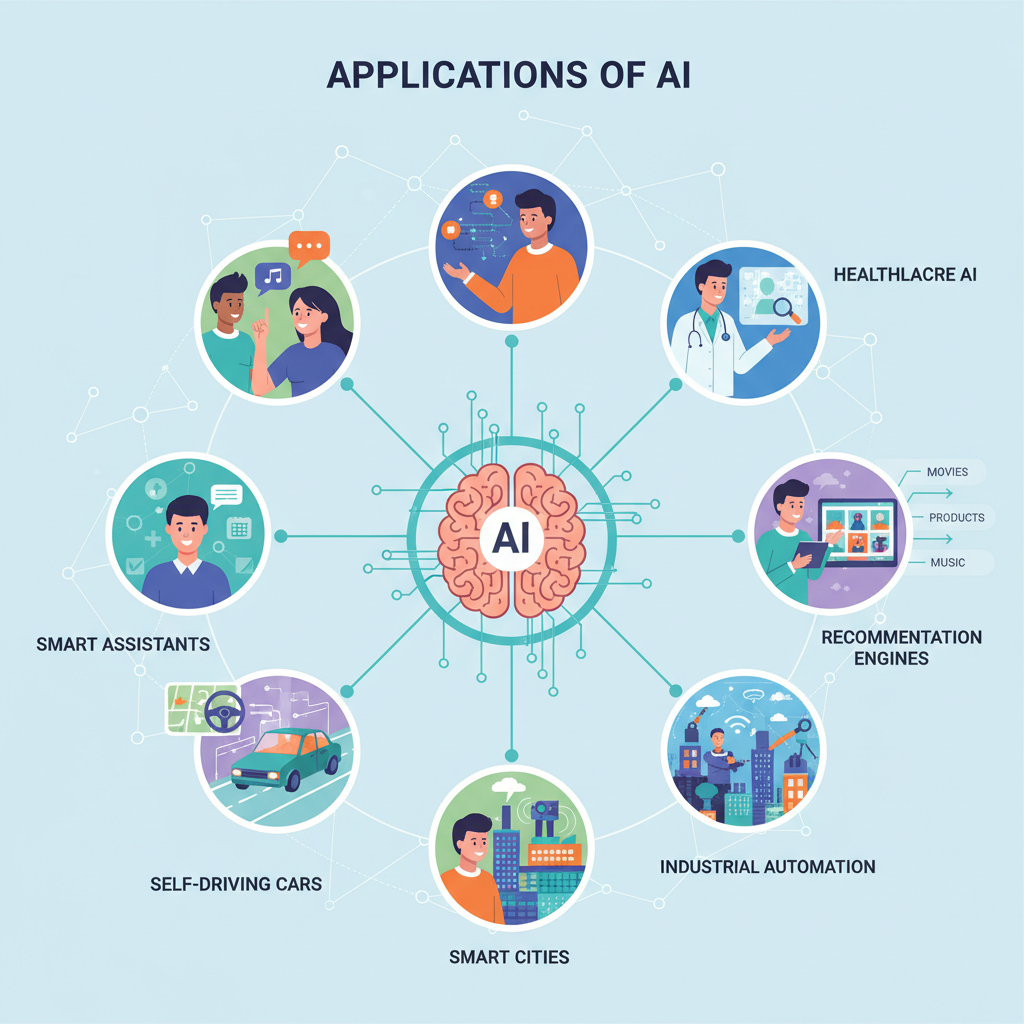 ⚠️ This picture may have spelling mistakes. Trust the words in the lesson.
Where Do We See AI in Our Daily Lives? (It's Everywhere!)
AI is already integrated into so many things we use every day, even if you don't always notice it!
- Your Smartphone: When your phone corrects your spelling, suggests the next word you want to type, or lets you talk to a virtual assistant like Siri or Google Assistant – that's AI helping you out.
- Online Shopping: Ever notice how websites like Amazon suggest products "you might also like" based on what you've viewed or bought before? That's AI studying your past purchases and browsing habits. It’s like a super helpful store clerk who knows your taste better than you do sometimes!
- Streaming Services: Netflix, Spotify, and YouTube use AI to recommend movies, TV shows, or music based on what you’ve watched or listened to before. It’s like having a personal DJ or movie critic just for you, constantly learning your preferences.
- Video Games: Many game characters have AI that makes them act like real opponents or teammates, responding to your moves and challenges in a realistic way.
- Self-Driving Cars: These incredible vehicles use AI to "see" the road, understand traffic signs, detect pedestrians, and make real-time decisions about when to turn or stop. It's like having a super-focused, constantly learning driver at the wheel.
- Social Media: AI helps filter spam, suggests friends you might know, and even customizes what posts you see in your feed.
How Does AI Get Smart? The Basics of Machine Learning
At its heart, AI learns from two main things, working together:
- Data: This is like the 'food' or 'ingredients' for AI. It's all the information – pictures, words, numbers, sounds, videos – that the AI gets to 'look' at and process. For an AI to recognize a cat, it needs to see millions of pictures of cats (and also millions of pictures of not-cats!) to understand what makes a cat a cat. The more good data, the better and more accurate it learns.
- Algorithms: These are like the 'recipes' or 'instructions' the AI follows to learn from the data. An algorithm tells the computer *how* to process the data, *how* to look for patterns, and *how* to make decisions based on those patterns. It's the step-by-step guide that turns raw ingredients into a delicious meal, or raw data into intelligent insights!
When an AI uses these ingredients (data) and recipes (algorithms) to learn from experience without being specifically told every single step for every possible situation, we often call this process Machine Learning (ML). Think of it like teaching a dog to fetch – you don't program every single muscle movement, you show it examples, give commands, and reward it, and it learns the pattern over time.
Types of AI: From Smart Tools to Science Fiction
Not all AI is the same. For now, most of the AI we interact with is called Narrow AI or Weak AI.
- Narrow AI: This is AI that is really, really good at *one specific task*. For example, an AI that plays chess brilliantly can't write a poem or drive a car. An AI that can recognize faces can't hold a conversation about your day. It's like a specialized tool, such as a calculator which is amazing at math but can't bake a cake. Most of the AI you see today – Siri, recommendation systems, facial recognition, spam filters – are examples of Narrow AI.
- General AI (AGI) & Super AI (ASI): These are types of AI that don't exist yet, except in science fiction movies and books!
- General AI (AGI): This would be an AI that can understand, learn, and apply intelligence to *any* intellectual task that a human being can. It would be able to learn new skills, solve problems creatively, understand complex ideas across many different subjects, and adapt to new situations just like a human.
- Super AI (ASI): This would be an AI that is even smarter than the smartest human in virtually every field, including scientific creativity, general wisdom, and social skills. It would surpass human intelligence significantly.
AI and the Future: Opportunities and Challenges
AI is an incredibly exciting and rapidly changing field. It has the potential to help us solve some of the world's biggest problems, like finding cures for diseases, making travel safer and more efficient, helping us understand climate change, and even exploring space.
However, AI also comes with important questions and challenges that we need to think about:
- How do we make sure AI is fair and doesn't have biases (meaning it treats everyone equally, regardless of background)?
- How will AI change jobs in the future, and how can we prepare for those changes?
- How do we ensure AI is used responsibly and ethically, protecting privacy and preventing misuse?
These are big questions, and people like you, the next generation of thinkers, innovators, and citizens, will play a crucial role in shaping the future of AI. Remember, AI is a powerful tool, and like any tool, it's how we choose to use it that truly matters.
So, the next time you ask your phone a question, get a movie recommendation, or see a car driving itself, remember that a bit of 'artificial intelligence' is hard at work, making your digital world a little smarter and a lot more helpful!
Keep learning, free
Create a free Syllabax account to unlock practice questions and games for this topic.
Visual Learning Enhanced! 🚀
To help you master this topic, we use Advanced Syllabax AI to generate detailed diagrams and visual models.
Note on Visuals: The AI sometimes makes spelling errors in image labels. Please refer to the lesson text for the correct terminology.