Intersecting & parallel lines [Basic Geometrical Concepts]
Watch this topic in 60 seconds
Free preview · Lesson 1
Understanding Intersecting & parallel lines [Basic Geometrical Concepts]
Understanding Intersecting and Parallel Lines
Welcome, young mathematicians! Today, we're going to explore some of the fundamental building blocks of geometry: lines! Specifically, we'll learn about two special types of lines: parallel lines and intersecting lines.
What is a Line?
Before we dive into parallel and intersecting lines, let's remember what a line is in geometry. A line is a straight path that goes on forever in both directions. It has no beginning and no end. Think of it like a perfectly straight road that never stops! We usually draw a small arrow on each end to show that it continues endlessly.
Analogy: Imagine a super-long, perfectly straight train track. It keeps going and going, never bending, and you can travel along it forever in either direction. That's like a geometric line!
Intersecting Lines: When Paths Cross!
Now, let's talk about intersecting lines. Intersecting lines are two or more lines that meet or cross each other at a single point. This special meeting point is called the point of intersection.
Think about two roads that cross each other. Where they meet is the point of intersection. They don't run alongside each other; they actually meet!
Analogy 1: A T-Junction
Imagine a straight road (line 1). Now, imagine another straight road (line 2) coming from the side and hitting the first road at a right angle, like at a 'T'. These two roads are intersecting lines, and the spot where they connect is their point of intersection.
Analogy 2: An 'X' Shape
Think about the letter 'X'. The two diagonal lines that form the 'X' are intersecting lines. They cross each other in the middle. That middle point is their point of intersection.
Key Characteristics of Intersecting Lines:
- They meet at exactly one point.
- They do not run alongside each other forever without touching.
- They form angles at the point where they cross.
Parallel Lines: The Best of Friends Who Never Meet!
Next up are parallel lines. Parallel lines are lines that are always the same distance apart and will never, ever cross, no matter how far you extend them in either direction. They run alongside each other forever, like perfect buddies who always stay together but never bump into each other.
Think about the lines on a ruled notebook page. Those horizontal lines run next to each other, and they never touch or cross. They are parallel!
Analogy 1: Train Tracks
The most classic example of parallel lines is a pair of train tracks. The two metal rails are always the same distance apart, and they run side-by-side as far as the eye can see. They need to be parallel so the train can travel smoothly without derailing!
Analogy 2: Sidewalk Edges
Imagine walking down a straight sidewalk. The two edges of the sidewalk are parallel lines. They keep the same distance between them and don't meet.
Analogy 3: The Rungs of a Ladder
If you look at a ladder, the rungs (the steps) are parallel to each other. They are all the same length and spaced evenly, running from one side rail to the other without ever getting closer or farther apart.
Key Characteristics of Parallel Lines:
- They are always the same distance apart.
- They never intersect or cross.
- They extend infinitely in the same direction.
Visualizing the Difference
Let's look at a picture to help make it clear.
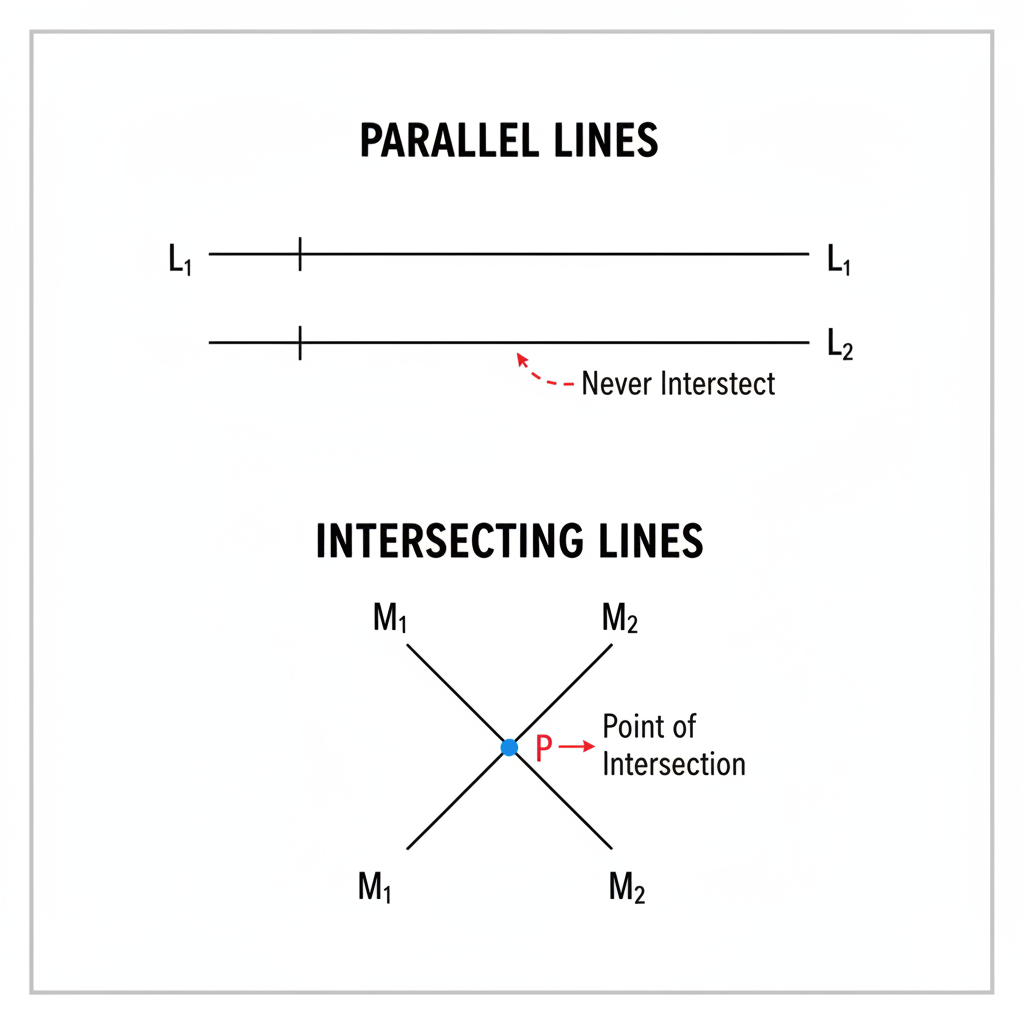 ⚠️ This picture may have spelling mistakes. Trust the words in the lesson.
In the image above:
- The two blue lines are parallel. Notice they are the same distance apart and don't touch.
- The red line and the green line are intersecting. They meet at a point.
Identifying Lines in the Real World
You can find examples of parallel and intersecting lines all around you!
- Parallel: The edges of a door, shelves in a bookcase, lanes on a straight highway, the sides of a rectangular window.
- Intersecting: The blades of scissors when they are open, the hands on a clock (at most times), the corner of a room where two walls meet the floor.
Quick Recap
So, remember:
- Intersecting lines cross each other at one point.
- Parallel lines never cross and are always the same distance apart.
Keep an eye out for these lines in your world!
Keep learning, free
Create a free Syllabax account to unlock practice questions and games for this topic.
Visual Learning Enhanced! 🚀
To help you master this topic, we use Advanced Syllabax AI to generate detailed diagrams and visual models.
Note on Visuals: The AI sometimes makes spelling errors in image labels. Please refer to the lesson text for the correct terminology.