Physical & chemical properties[CHEMISTRY]
Watch this topic in 60 seconds
Free preview · Lesson 1
Understanding Physical & chemical properties[CHEMISTRY]
Understanding Physical and Chemical Properties
Welcome to our exploration of the fascinating world of matter! Everything around you – your pencil, the air you breathe, the water you drink, even you yourself – is made of matter. Matter has characteristics that we can observe and measure, and these characteristics are called properties. In chemistry, we broadly categorize these properties into two main types: physical properties and chemical properties.
What are Physical Properties?
Think of physical properties as the “look and feel” characteristics of a substance. These are properties that you can observe or measure without changing the substance into a different substance. It's like describing a friend – you might talk about their height, hair color, or how they feel (happy, sad, energetic). You're describing them as they are, not what they *do* when something happens to them.
Common Physical Properties:
- Color: The hue of a substance (e.g., the bright red of a strawberry, the dull gray of lead).
- Odor: The smell of a substance (e.g., the sweet scent of a rose, the sharp smell of vinegar).
- Texture: How something feels to the touch (e.g., the smooth surface of glass, the rough texture of sandpaper).
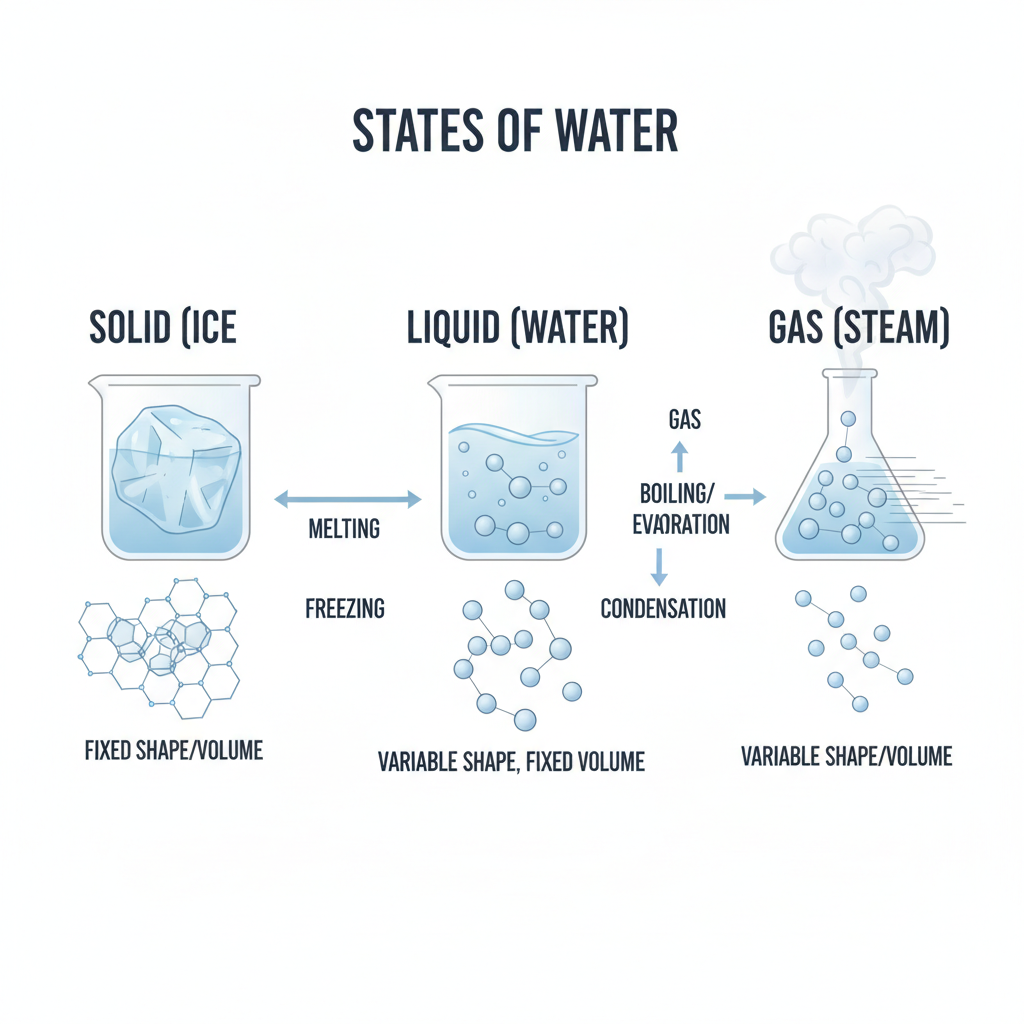
- State of Matter: Whether a substance is a solid, liquid, or gas at a given temperature and pressure. Think of water: it can be ice (solid), liquid water, or steam (gas).
- Density: This tells us how much “stuff” (mass) is packed into a certain amount of space (volume). Imagine a small, heavy rock versus a large, light sponge. The rock is denser.
- Melting Point: The temperature at which a solid turns into a liquid. Ice melts into water at 0°C (32°F).
- Boiling Point: The temperature at which a liquid turns into a gas. Water boils into steam at 100°C (212°F).
- Solubility: How well a substance dissolves in another substance, usually a liquid. Sugar dissolves easily in water, making it soluble. Sand does not dissolve in water, making it insoluble.
- Malleability: The ability of a solid to be hammered or bent into thin sheets without breaking. Metals like gold are very malleable. Think of a gold foil – it's incredibly thin!
- Ductility: The ability of a solid to be stretched into a thin wire. Copper is very ductile, which is why it's used in electrical wires.
- Hardness: How resistant a substance is to being scratched or dented. Diamond is extremely hard, while butter is very soft.
- Electrical Conductivity: How well a substance allows electricity to flow through it. Metals like copper are good conductors; rubber is an insulator (it doesn't conduct electricity well).
- Thermal Conductivity: How well a substance allows heat to flow through it. A metal spoon in hot soup gets hot quickly (good thermal conductor), while a wooden spoon stays cool (poor thermal conductor).
Analogy: Imagine you have a brand-new LEGO brick. You can describe its color (red), its shape (a square), its size, and how it feels (smooth). These are all physical properties. You haven't changed the LEGO brick itself; you've just described it.
When we measure physical properties, the substance remains the same. If you melt ice (solid water) into liquid water, it's still H₂O. If you dissolve sugar in water, you can still recover the sugar by evaporating the water. The identity of the substance doesn't change.
What are Chemical Properties?
Chemical properties, on the other hand, describe how a substance behaves when it interacts with other substances or when energy is applied to it, leading to a change in its chemical identity. It's about what a substance *can do* or how it *reacts*.
Analogy: Going back to your LEGO brick. A chemical property would be describing what happens if you try to melt the LEGO brick with a hot flame. It would burn and turn into ash – a completely different substance! You're no longer describing the LEGO brick; you're describing its ability to react (burn) and change into something new.
Common Chemical Properties:
- Flammability: The ability of a substance to burn or ignite easily. Wood is flammable; rocks are not.
- Reactivity: How readily a substance undergoes a chemical reaction. Sodium (a metal) is highly reactive with water, causing an explosion! This is very different from gold, which is very unreactive.
- Oxidation: The ability of a substance to react with oxygen. Iron rusts when it reacts with oxygen in the air, changing from shiny metal to reddish-brown rust.
- Combustibility: Similar to flammability, it describes the ability to burn. Fuels like gasoline are highly combustible.
- Ability to rust: Specifically, the tendency of metals like iron to form oxides when exposed to oxygen and moisture.
- Toxicity: The degree to which a substance can harm living organisms. Many cleaning products are toxic if ingested.
- Heat of combustion: The amount of heat released when a substance burns completely.
- pH: Measures how acidic or basic a substance is. Acids (like lemon juice) and bases (like baking soda) have different chemical properties related to their pH.
When a chemical property is observed, a chemical change occurs. This means the substance's chemical formula changes, and new substances are formed. For example, when iron rusts, it changes from pure iron (Fe) to iron oxide (Fe₂O₃), which has very different properties.
Another Analogy: Think about baking a cake. You start with ingredients like flour, eggs, sugar, and milk (these have their own physical and chemical properties). When you bake them, they undergo chemical changes. The heat causes chemical reactions, transforming the batter into a cake. The cake is a new substance with new properties – it's no longer a liquid batter!
Key Differences: Physical vs. Chemical Properties
The main distinction lies in whether the substance's identity changes during observation or measurement:
- Physical Property: Observe/measure WITHOUT changing the substance into something else. (e.g., measuring the length of a stick).
- Chemical Property: Describes the potential for a substance to undergo a chemical change, resulting in a new substance. (e.g., describing how easily a stick can burn).
It's important to remember that many substances can exhibit both physical and chemical properties. For example, water (H₂O) is:
- Physically: Colorless, odorless, liquid at room temperature, freezes at 0°C, boils at 100°C, can dissolve salt (soluble).
- Chemically: Can react with sodium metal (very reactive), can be electrolyzed into hydrogen and oxygen (undergoes chemical change).
Why are these Properties Important?
Understanding physical and chemical properties helps us:
- Identify substances: Different substances have unique sets of properties.
- Predict behavior: Knowing properties helps predict how a substance will act in different situations (e.g., will it dissolve, will it burn, will it react?).
- Choose materials: Engineers and scientists use properties to select the right materials for specific jobs (e.g., using a conductor for wires, an insulator for handles).
- Ensure safety: Knowing chemical properties like flammability or toxicity is crucial for safe handling and storage.
Mastering the concepts of physical and chemical properties is a fundamental step in understanding chemistry. Keep observing the world around you and think about the properties of the matter you encounter!
Keep learning, free
Create a free Syllabax account to unlock practice questions and games for this topic.
Visual Learning Enhanced! 🚀
To help you master this topic, we use Advanced Syllabax AI to generate detailed diagrams and visual models.
Note on Visuals: The AI sometimes makes spelling errors in image labels. Please refer to the lesson text for the correct terminology.