Learning Journey
Watch this topic in 60 seconds
Free preview · Lesson 1
Understanding Composite shapes (Perimeter & Area)
Unlocking Composite Shapes: Perimeter & Area Adventures!
Hey 7th Graders! Get ready to become shape detectives! In our world, shapes aren't always perfect squares or circles. Look around you! Your classroom often has an 'L' shaped counter, or a park might have a strangely shaped flower bed. These are called composite shapes. They're like the ultimate puzzle masters, made by sticking together simpler shapes we already know, like rectangles, squares, and triangles!
Think of it like building with LEGOs. You start with simple blocks (squares, rectangles), but when you put them together, you can create an amazing castle, a spaceship, or even a giant robot! A composite shape is just a 'building' made from these basic 'blocks'. Understanding them helps us in real life, from measuring a room for new carpet to figuring out how much fence you need for an oddly shaped garden.
Part 1: The Grand Tour - Understanding Perimeter of Composite Shapes
What is Perimeter?
Let's start with something you might already know! Perimeter is simply the total distance around the outside edge of a shape. Imagine you're an ant walking along the very edge of a shape, like walking all the way around your classroom's walls. The total distance you walk is the perimeter.
- Analogy: Think about putting a fence around your backyard. The total length of that fence is the perimeter of your yard. If your yard is a perfect square, you measure one side and multiply by four. If it's a rectangle, you add up the lengths of all four sides.
Perimeter of Simple Shapes (A Quick Refresh):
- Rectangle: Add up all four sides (or 2 x length + 2 x width).
- Square: 4 x side length (since all sides are equal).
- Triangle: Add up the lengths of its three sides.
Perimeter of Composite Shapes - The "Walk Around" Method
Now, what about our LEGO-built shapes? Finding the perimeter of a composite shape is super similar to finding it for simple shapes, but with a tiny twist. You still just add up the lengths of all the outer sides. The trick is to make sure you've identified *every single outer edge* and haven't missed any or counted any inner lines!
- Analogy: Imagine that little ant again, but now it's walking around an 'L' shaped cookie. It needs to walk along every part of the crust. It doesn't walk across the middle of the cookie; only the very outside!
Steps for Finding Perimeter of Composite Shapes:
- Identify All Outer Sides: Look carefully at the shape and mentally trace its outer boundary. These are the sides you need to add.
- Find Missing Lengths: Sometimes, a composite shape might not have all its side lengths labeled. You'll need to use the lengths that ARE given to figure out the missing ones. Often, this involves simple addition or subtraction. For example, if you have an 'L' shape, and one long vertical side is 10 cm, and a shorter vertical part is 4 cm, the remaining vertical part must be 10 cm - 4 cm = 6 cm.
- Add Them Up: Once you have all the outer side lengths, simply add them all together. Don't forget your units (like cm, meters, feet)!
Example: Let's say you have an L-shaped room. You measure all the sides that touch the hallway or other rooms. You simply add those measurements together. You wouldn't measure the imaginary line where the two rectangular parts of the 'L' meet inside the room.
Part 2: Covering the Ground - Understanding Area of Composite Shapes
What is Area?
While perimeter is about the distance around, area is about the amount of flat surface a shape covers. It's like asking how much 'stuff' can fit inside the shape. Area is always measured in 'square units', like square centimeters (cm²), square meters (m²), or square feet (ft²).
- Analogy: Think about how much carpet you need to cover the floor of your bedroom. That amount of carpet is the area of your room! Or how much paint you need to cover a wall.
Area of Simple Shapes (A Quick Refresh):
- Rectangle: Length × Width
- Square: Side × Side (or side²)
- Triangle: ½ × Base × Height (Remember, the height must be perpendicular to the base!)
Area of Composite Shapes - The "Divide and Conquer" Method
This is where understanding composite shapes truly shines! Since there isn't one single, magic formula for an 'L-shape' or a 'T-shape', we use a smart strategy. We break down the complicated composite shape into the simpler shapes we DO know how to calculate (like rectangles, squares, or triangles).
- Analogy: Imagine you have a giant, oddly shaped pizza. You can't just use one round pizza cutter for the whole thing! Instead, you might cut it into a few rectangles and triangles that you can easily eat. To find the total amount of pizza, you'd add up the amount from each piece.
Steps for Finding Area of Composite Shapes:
- Decompose (Break Apart): This is the most important step! Draw one or more imaginary (or real!) lines to divide your composite shape into simpler, recognizable shapes. You're essentially cutting your complex LEGO creation back into its basic blocks.
- Calculate Individual Areas: Find the area of each of the smaller, simpler shapes you just created. Use the formulas you already know (length x width for rectangles, ½ base x height for triangles, etc.). Make sure you're using the correct dimensions for EACH smaller shape.
- Combine: Add up all the individual areas you calculated. The total sum is the total area of your original composite shape!
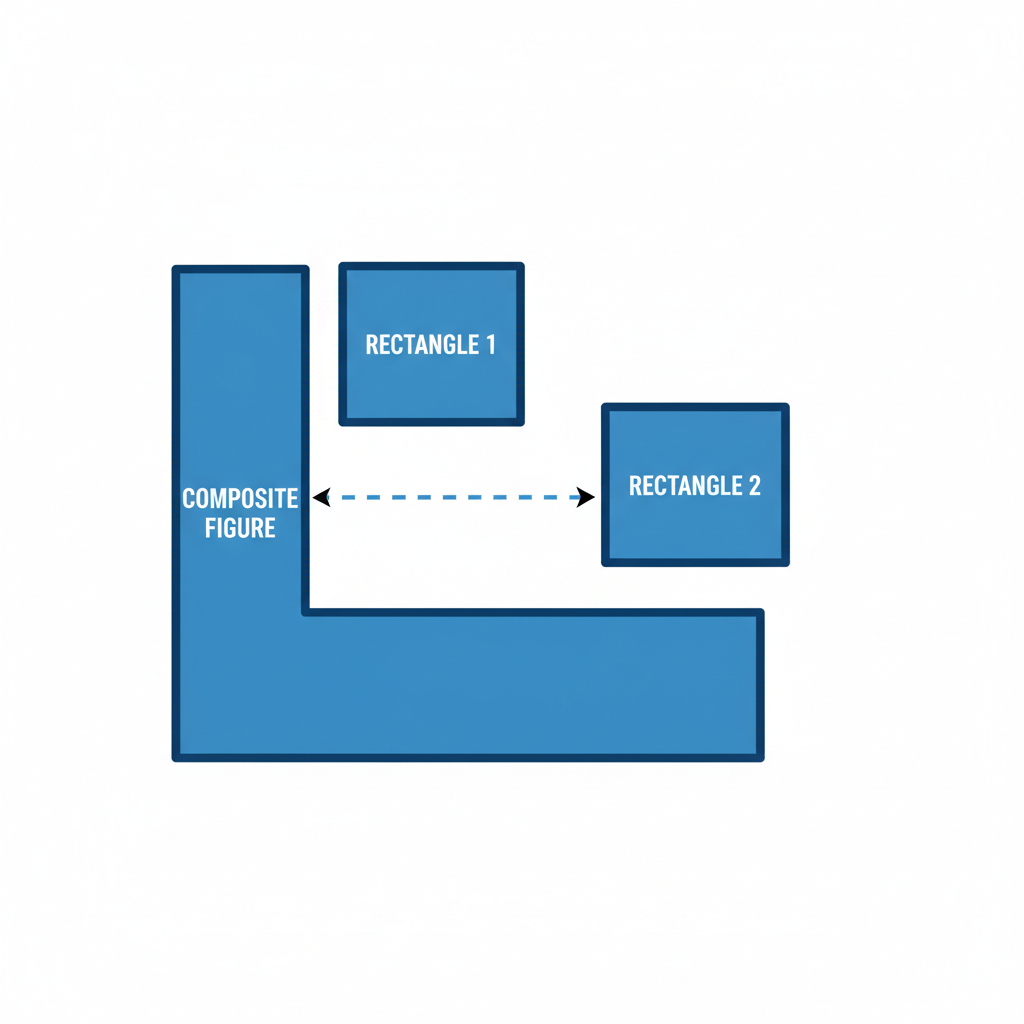 ⚠️ This picture may have spelling mistakes. Trust the words in the lesson.
Example: Let's go back to our L-shaped room. To carpet it, you wouldn't just use one formula. You'd imagine a line that splits the 'L' into two separate rectangles. Then, you'd calculate the carpet needed for the first rectangle, then for the second rectangle, and finally, add those two amounts together to get the total carpet needed for the whole L-shaped room.
Crucial Tips & Reminders for Both Perimeter and Area:
- Units are Your Best Friends: Always remember the units! Perimeter is in linear units (cm, m, km, inches, feet, miles). Area is in square units (cm², m², km², in², ft², mi²). Mixing these up is a common mistake!
- Draw It Out: Whenever you're working with composite shapes, drawing the shape (even a rough sketch) and labeling all the dimensions is incredibly helpful. For area, draw the lines showing how you're breaking it apart.
- Check Your Work: Does your answer make sense? If you're finding the area of a shape that looks small, and your answer is a huge number, you might have made a mistake. Always do a quick mental check!
- Practice Makes Perfect: The more you practice breaking down and calculating these shapes, the easier it will become!
Congratulations, shape detective! You now have the foundational tools to tackle composite shapes. Whether you're designing a park, planning a garden, or simply trying to figure out how much paint you need for a tricky wall, these skills will come in handy!
Keep learning, free
Create a free Syllabax account to unlock practice questions and games for this topic.
Visual Learning Enhanced! 🚀
To help you master this topic, we use Advanced Syllabax AI to generate detailed diagrams and visual models.
Note on Visuals: The AI sometimes makes spelling errors in image labels. Please refer to the lesson text for the correct terminology.