Polygons (Area & Perimeter)
Watch this topic in 60 seconds
Free preview · Lesson 1
Understanding Polygons (Area & Perimeter)
Understanding Polygons: Area and Perimeter for 8th Graders
Welcome, future mathematicians! Today, we're going on an exciting journey into the world of polygons. Don't let the fancy name scare you – polygons are just a special type of shape, and you see them everywhere around you, every single day!
What Exactly is a Polygon? Think Building Blocks!
Imagine you have a bunch of straight sticks and some glue. If you connect these sticks end-to-end to create a completely closed shape, you've made a polygon! That's the simplest way to think about it.
- Closed Shape: This means there are no gaps. All the 'sticks' meet up perfectly. Think of it like a fence around a yard – there shouldn't be any holes for a pet to escape!
- Straight Sides: Polygons only have straight lines for their edges. No curves allowed! So, a circle is NOT a polygon, but a square is.
- At least Three Sides: You can't make a closed shape with just two straight lines, right? You need at least three to 'close the loop'. The simplest polygon is a triangle, which has three sides.
Analogy: Think of polygons like different kinds of cookies you can make with straight-edged cookie cutters. You can have square cookies, triangular cookies, or even star-shaped cookies (if the star is made of straight lines). You can't make a polygon cookie with a circular cutter!
Meet the Polygon Family: Different Shapes, Different Names
Polygons are named based on how many sides they have:
- Triangle: 3 sides (Tri- means three, like a tricycle)
- Quadrilateral: 4 sides (Quad- means four, like a quad bike) - Squares, rectangles, and diamonds are all types of quadrilaterals!
- Pentagon: 5 sides (Pent- means five, like a pentagram)
- Hexagon: 6 sides (Hex- means six, like a honeycomb cell)
- Heptagon: 7 sides
- Octagon: 8 sides (Oct- means eight, like an octopus)
- And so on!
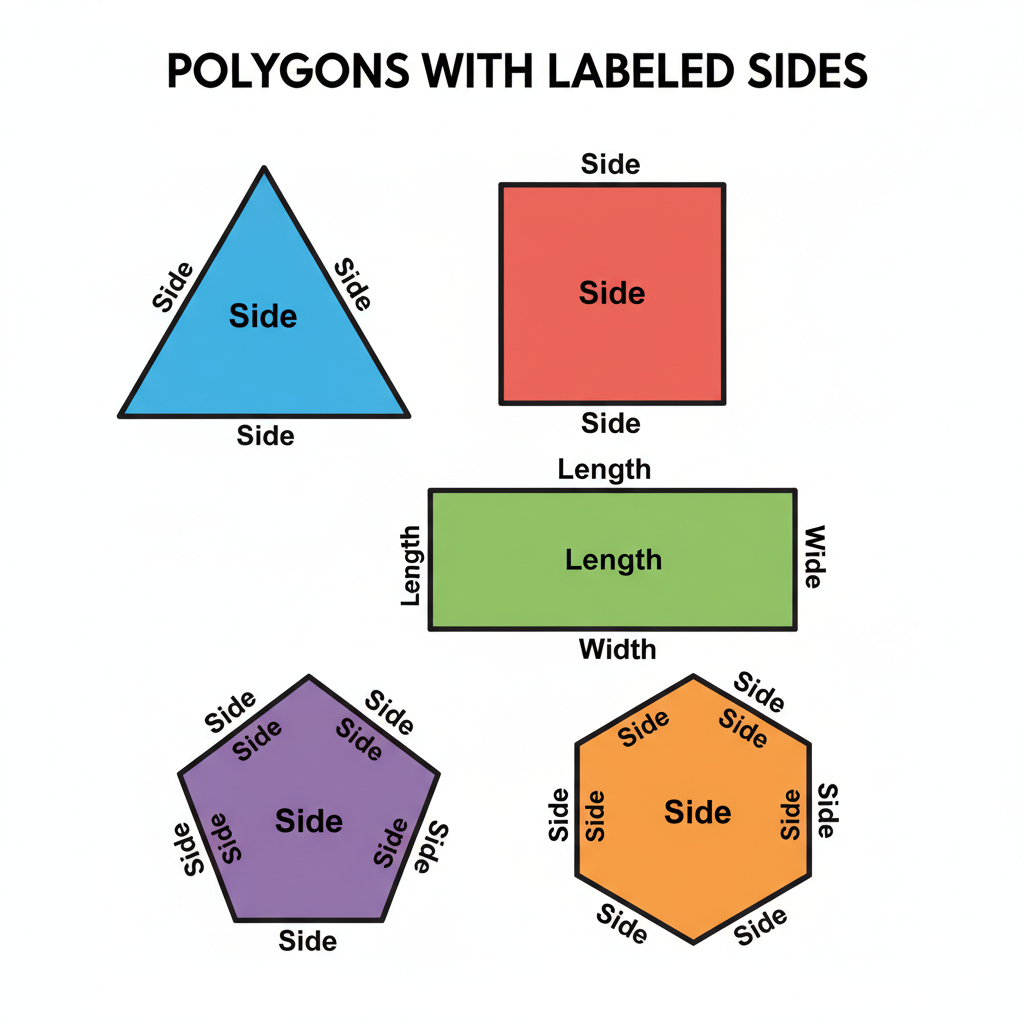 ⚠️ This picture may have spelling mistakes. Trust the words in the lesson.
Perimeter: The Walk Around the Edge!
Imagine you have a backyard, and you want to put a fence all the way around it to keep your pet safe. The total length of that fence would be the backyard's perimeter.
In simple terms, the perimeter is the total distance around the outside edge of any polygon.
How to Calculate Perimeter: Just Add 'Em Up!
Calculating the perimeter is super straightforward for any polygon: you just add the lengths of all its sides together!
Analogy: If you walk along the edges of a park, the total distance you walked is the perimeter of the park. You just add up the lengths of each path segment you took.
Example 1: A Rectangle
Let's say you have a rectangular garden that is 10 feet long and 5 feet wide. A rectangle has two long sides and two short sides.
- Side 1: 10 feet
- Side 2: 5 feet
- Side 3: 10 feet (opposite Side 1)
- Side 4: 5 feet (opposite Side 2)
Perimeter = 10 + 5 + 10 + 5 = 30 feet.
You can also use a formula for rectangles: Perimeter = 2 × (Length + Width) or P = 2L + 2W. So, P = 2(10 + 5) = 2(15) = 30 feet.
Example 2: A Square
A square is a special kind of rectangle where all four sides are the same length. If a square table has sides of 3 feet each:
Perimeter = 3 + 3 + 3 + 3 = 12 feet.
Or, since all sides are equal, you can use the formula: Perimeter = 4 × Side (P = 4s). So, P = 4 × 3 = 12 feet.
Example 3: An Irregular Polygon
What if the shape isn't a neat rectangle or square? No problem! You still just add up all the side lengths. Imagine a pentagon (5 sides) with sides measuring 4 cm, 6 cm, 5 cm, 7 cm, and 3 cm.
Perimeter = 4 + 6 + 5 + 7 + 3 = 25 cm.
Units for Perimeter: Since perimeter is a length, its units are simple length units: centimeters (cm), meters (m), inches (in), feet (ft), etc.
Area: The Space Inside!
Now, let's think about that backyard again. Once you have your fence (perimeter) up, you might want to plant grass inside the yard. The amount of grass seeds you'd need would depend on the size of the ground *inside* the fence. That 'inside space' is what we call the area.
In simple terms, area is the amount of flat surface (or space) a polygon covers.
How to Calculate Area: It Depends on the Shape!
Unlike perimeter, where you just add, calculating area requires different formulas for different shapes. Think of it like choosing the right tool for the job!
Analogy: If perimeter is the frosting around the edge of a cake, then area is all the delicious cake batter filling the pan! You measure the frosting by its length, but the cake batter by how much space it takes up.
Example 1: A Rectangle
For our rectangular garden that was 10 feet long and 5 feet wide, to find the area (how much grass you can plant):
Area = Length × Width (A = L × W)
Area = 10 feet × 5 feet = 50 square feet.
Notice the unit: 'square feet'. This is because you're multiplying a length by a length (feet × feet = square feet).
Example 2: A Square
For the square table with sides of 3 feet each:
Area = Side × Side (A = s²)
Area = 3 feet × 3 feet = 9 square feet.
Again, notice the 'square feet' unit.
Example 3: A Triangle (The Half-Rectangle Trick!)
Triangles are a bit different. Imagine you have a rectangle. If you cut it diagonally from one corner to the opposite corner, you'd get two identical triangles! This means a triangle's area is half of a rectangle's area.
The 'base' of a triangle is one of its sides (usually the bottom), and the 'height' is the perpendicular distance from the base to the opposite corner (the 'peak' of the triangle).
Area = ½ × Base × Height (A = ½bh)
Let's say a triangular sail has a base of 6 meters and a height of 4 meters.
Area = ½ × 6 meters × 4 meters
Area = ½ × 24 square meters = 12 square meters.
Units for Area: Since area measures flat space, its units are always 'square units': square centimeters (cm²), square meters (m²), square inches (in²), square feet (ft²), etc. This 'square' tells you how many 1x1 unit squares would fit inside the shape.
Why Do We Care About Area and Perimeter? Real-World Superpowers!
This isn't just stuff you learn in a classroom; it's incredibly useful in real life!
- Building and Construction: Architects and builders use perimeter to figure out how much trim or molding they need for a room, and area to calculate how much flooring, paint, or roof shingles are required.
- Gardening: Gardeners use perimeter for fencing and area to know how much soil or fertilizer to buy for a flower bed.
- Decorating: When you want to hang a border around your room, you need its perimeter. If you want to buy a rug, you need to know the area of your floor.
- Sports: The boundaries of a soccer field define its perimeter. The playing surface inside those boundaries is its area.
So, the next time you see a stop sign (an octagon!), a soccer field, or even your phone screen, you'll know you're looking at a polygon, and you'll understand the fundamental ideas of its area and perimeter. Keep practicing, and you'll become a master of shapes!
Keep learning, free
Create a free Syllabax account to unlock practice questions and games for this topic.
Visual Learning Enhanced! 🚀
To help you master this topic, we use Advanced Syllabax AI to generate detailed diagrams and visual models.
Note on Visuals: The AI sometimes makes spelling errors in image labels. Please refer to the lesson text for the correct terminology.