More Likely, Less Likely
Watch this topic in 60 seconds
Free preview · Lesson 1
Understanding More Likely, Less Likely
Exploring "More Likely" and "Less Likely": What Are the Chances?
Hello, young explorers! Have you ever wondered about what might happen next? Like, "Will it rain today?" or "Will I get my favorite snack?" Sometimes we have a good idea of what's going to happen, and sometimes it's a total surprise!
In this lesson, we're going to become super scientists of chances! We'll learn how to talk about events using special words like "more likely" and "less likely." It's like predicting the future, but with a little math and a lot of common sense!
What Does "Likely" Mean?
Think about the word "likely." It means something has a good chance of happening. If you say, "It's likely I'll eat dinner tonight," you mean it will probably happen because you usually eat dinner every night, right?
The Probability Scale: From Impossible to Certain!
Imagine a straight line, like a number line, but instead of numbers, it has words. At one end, we have things that CANNOT happen. At the other end, we have things that MUST happen. And in the middle, we have things that MIGHT happen.
Let's look at this special line:
- Impossible: This means it absolutely, positively cannot happen. No way, no how!
- Analogy: It's impossible for a cat to fly to the moon by itself today. Cats don't have wings or spaceships!
- Certain: This means it absolutely, positively WILL happen. It's a sure thing!
- Analogy: It's certain that the sun will rise tomorrow morning. It always does!
Most things in life fall somewhere between impossible and certain. That's where "more likely" and "less likely" come in!
"More Likely": When Something Has a Good Chance!
When we say something is "more likely," it means it has a better chance of happening than not happening. There are more ways for it to happen than for it not to happen.
Analogy 1: The Cookie Jar
Imagine you have a cookie jar. Inside, there are 8 chocolate chip cookies and only 2 oatmeal cookies. If you close your eyes and pick one cookie, which kind do you think you're more likely to pick? You guessed it – a chocolate chip cookie! Why? Because there are many more chocolate chip cookies than oatmeal cookies. They have a better chance of being chosen.
Analogy 2: Rainy Day vs. Sunny Day
Let's say you live in a city where it rains almost every day in the spring. If you look out the window on a spring morning, it's "more likely" to be rainy than sunny. Why? Because rain happens much more often at that time of year.
When an event is "more likely," it means the odds are leaning towards it happening. It's not a guarantee, but it's a pretty good bet!
 ⚠️ This picture may have spelling mistakes. Trust the words in the lesson.
"Less Likely": When Something Has a Small Chance!
Now, let's flip it around. When we say something is "less likely," it means it has a smaller chance of happening. There are fewer ways for it to happen compared to other possibilities.
Analogy 1: Back to the Cookie Jar
Using our cookie jar example with 8 chocolate chip cookies and 2 oatmeal cookies, picking an oatmeal cookie is "less likely." There are only two chances to get an oatmeal cookie compared to eight chances for a chocolate chip cookie. It could still happen, but it doesn't have as good a chance.
Analogy 2: Finding a Rare Coin
Imagine you're walking down the street. Is it "more likely" that you'll see a regular penny, or "less likely" that you'll find a super rare, ancient gold coin? It's much "less likely" to find the gold coin because those are very rare, while pennies are common.
When an event is "less likely," it means it probably won't happen, but it's not impossible. It's just not very probable.
"Equally Likely": A Fair Chance for Everyone!
Sometimes, events have the exact same chance of happening. We call this "equally likely."
Analogy: Flipping a Coin
If you flip a coin, what are the chances of getting "heads" compared to "tails"? They are "equally likely"! There's one side for heads and one side for tails. Each has the same, fair chance of landing face up.
Analogy: Spinner with Equal Sections
Imagine a spinner for a board game that is perfectly divided into two equal halves – one red, one blue. If you spin it, landing on red is "equally likely" as landing on blue. Neither color has an advantage.
Putting It All Together: The Probability Spectrum
Let's imagine our probability line again, with all our new words:
Impossible <---------- Less Likely <---------- Equally Likely <---------- More Likely <---------- Certain
- If something is closer to Impossible, it's Less Likely to happen.
- If something is closer to Certain, it's More Likely to happen.
- If something is right in the middle, it's Equally Likely.
Real-World Challenges: Let's Practice!
Let's think about everyday situations:
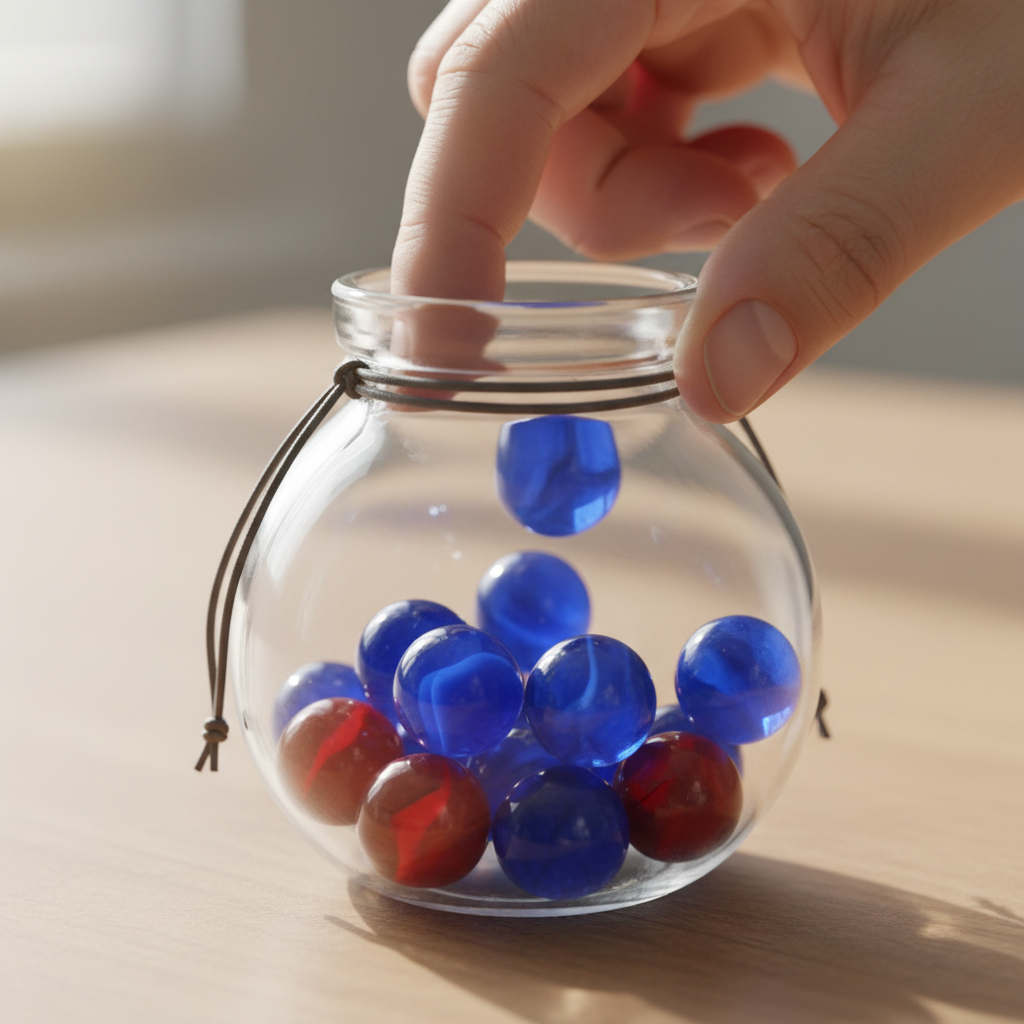
- You have a bag with 10 red marbles and 1 green marble.
- Picking a red marble is more likely. (Many reds!)
- Picking a green marble is less likely. (Only one green!)
- It's the middle of summer in a very hot country.
- It's more likely to be sunny and hot.
- It's less likely to snow. (Unless you're in the mountains in winter, of course!)
- You have a fair six-sided dice.
- Rolling a 1 is equally likely as rolling a 6. (Each has one chance out of six.)
- Rolling an odd number (1, 3, 5) is equally likely as rolling an even number (2, 4, 6). (Three chances for each!)
- Rolling a number less than 5 (1, 2, 3, 4) is more likely than rolling a 6. (Four chances vs. one chance!)
Understanding "more likely" and "less likely" helps us make predictions, understand games, and even think about the weather. It's all about figuring out the chances!
Key Takeaways!
Remember these important points:
- "More likely" means an event has a higher chance of happening.
- "Less likely" means an event has a lower chance of happening.
- We can also have "impossible" (will not happen), "certain" (will definitely happen), and "equally likely" (same chance).
- We use these words to describe the probability or chance of something occurring.
- Looking at how many ways an event can happen compared to other possibilities helps us decide if it's more or less likely.
Keep practicing, and you'll be a probability pro in no time!
Keep learning, free
Create a free Syllabax account to unlock practice questions and games for this topic.
Visual Learning Enhanced! 🚀
To help you master this topic, we use Advanced Syllabax AI to generate detailed diagrams and visual models.
Note on Visuals: The AI sometimes makes spelling errors in image labels. Please refer to the lesson text for the correct terminology.