Place value & face value (Understanding Numbers)
Watch this topic in 60 seconds
Free preview · Lesson 1
Understanding Place value & face value (Understanding Numbers)
Understanding Numbers: Place Value & Face Value (Grade 3)
Welcome, young mathematicians! Today, we're going on an exciting adventure into the world of numbers. We're going to learn about two very important ideas that help us understand numbers better: place value and face value. Think of these as secret codes that unlock the true meaning of each digit in a number!
What is a Digit?
First, let's remember what a digit is. Digits are the building blocks of all the numbers we use. They are the symbols: 0, 1, 2, 3, 4, 5, 6, 7, 8, and 9. We use these ten digits to create every number, from the smallest to the biggest!
Face Value: What a Digit Looks Like
Imagine you have a special sticker with the number '7' on it. No matter where you put that sticker – on your pencil box, on your backpack, or on your math book – the sticker itself still says '7'. It always looks like a '7'.
Face value is just like that sticker! The face value of a digit is simply the digit itself. It's the number the digit represents on its own, without thinking about where it is in a larger number.
- The face value of the digit '5' is always 5.
- The face value of the digit '1' is always 1.
- The face value of the digit '0' is always 0.
Let's look at a number like 345. If we talk about the 'face value' of the digits:
- The face value of the digit '3' is 3.
- The face value of the digit '4' is 4.
- The face value of the digit '5' is 5.
Easy, right? The face value is just the number you see!
Place Value: Where a Digit Lives
Now, let's talk about place value. This is where the magic happens! In a number, each digit has a special 'place' where it lives. This place tells us how much that digit is worth. Think of a house! A house can have different rooms: a kitchen, a bedroom, a living room. Each room has a purpose, right? In numbers, the 'places' are like rooms, and each place has a different value.
We usually read numbers from right to left, and the places get bigger as we move left. Let's start with the places we know:
The Ones Place
The place on the far right is the ones place. Any digit in the ones place is worth just that many ones. For example, in the number 7:
The digit 7 is in the ones place. So, its value is 7 ones, which is just 7.
In the number 23:
The digit 3 is in the ones place. Its value is 3 ones, or 3.
The Tens Place
Next to the ones place, to the left, is the tens place. A digit in the tens place is worth ten times its face value! Imagine you have 3 bags, and each bag has 10 marbles inside. How many marbles do you have? You have 3 groups of 10 marbles, which is 30 marbles!
So, if a digit is in the tens place, we multiply its face value by 10.
Let's look at the number 23 again:
- The digit 3 is in the ones place. Its value is 3.
- The digit 2 is in the tens place. Its face value is 2. Its value is 2 tens, which is 2 x 10 = 20.
So, the number 23 is made up of 2 tens and 3 ones (20 + 3 = 23).
The Hundreds Place
Moving further left, we have the hundreds place. A digit in the hundreds place is worth one hundred times its face value! Imagine you have 5 boxes, and each box has 100 building blocks inside. How many blocks do you have in total? You have 5 groups of 100 blocks, which is 500 blocks!
If a digit is in the hundreds place, we multiply its face value by 100.
Let's look at the number 345:
- The digit 5 is in the ones place. Its value is 5.
- The digit 4 is in the tens place. Its face value is 4. Its value is 4 tens, which is 4 x 10 = 40.
- The digit 3 is in the hundreds place. Its face value is 3. Its value is 3 hundreds, which is 3 x 100 = 300.
So, the number 345 is made up of 3 hundreds, 4 tens, and 5 ones (300 + 40 + 5 = 345).
Visualizing Place Value
We can use blocks to help us see place value. Imagine:
- A single small cube represents 1 one.
- A rod made of 10 small cubes represents 1 ten.
- A flat square made of 100 small cubes represents 1 hundred.
Let's look at the number 123:
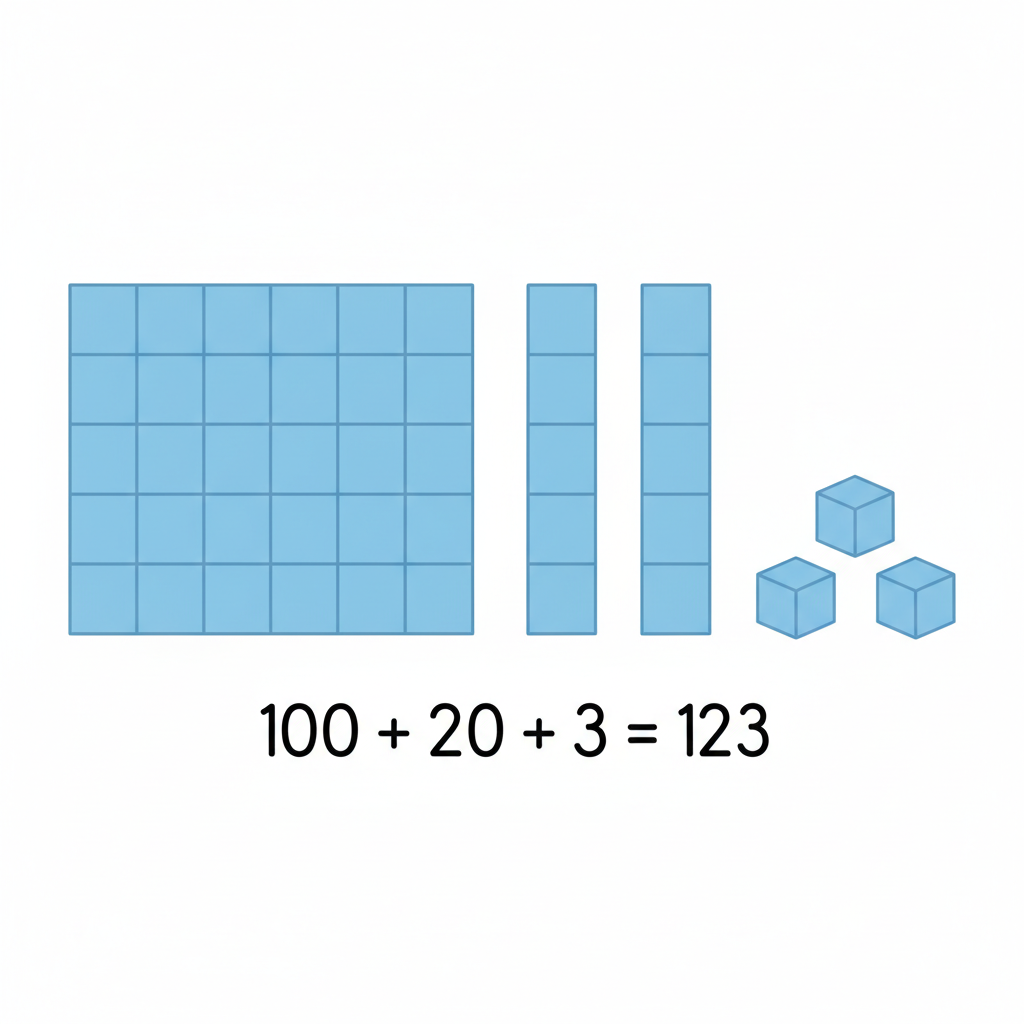
We have 1 hundred flat, 2 ten rods, and 3 ones cubes. This makes 100 + 20 + 3 = 123.
Now let's look at the number 205:
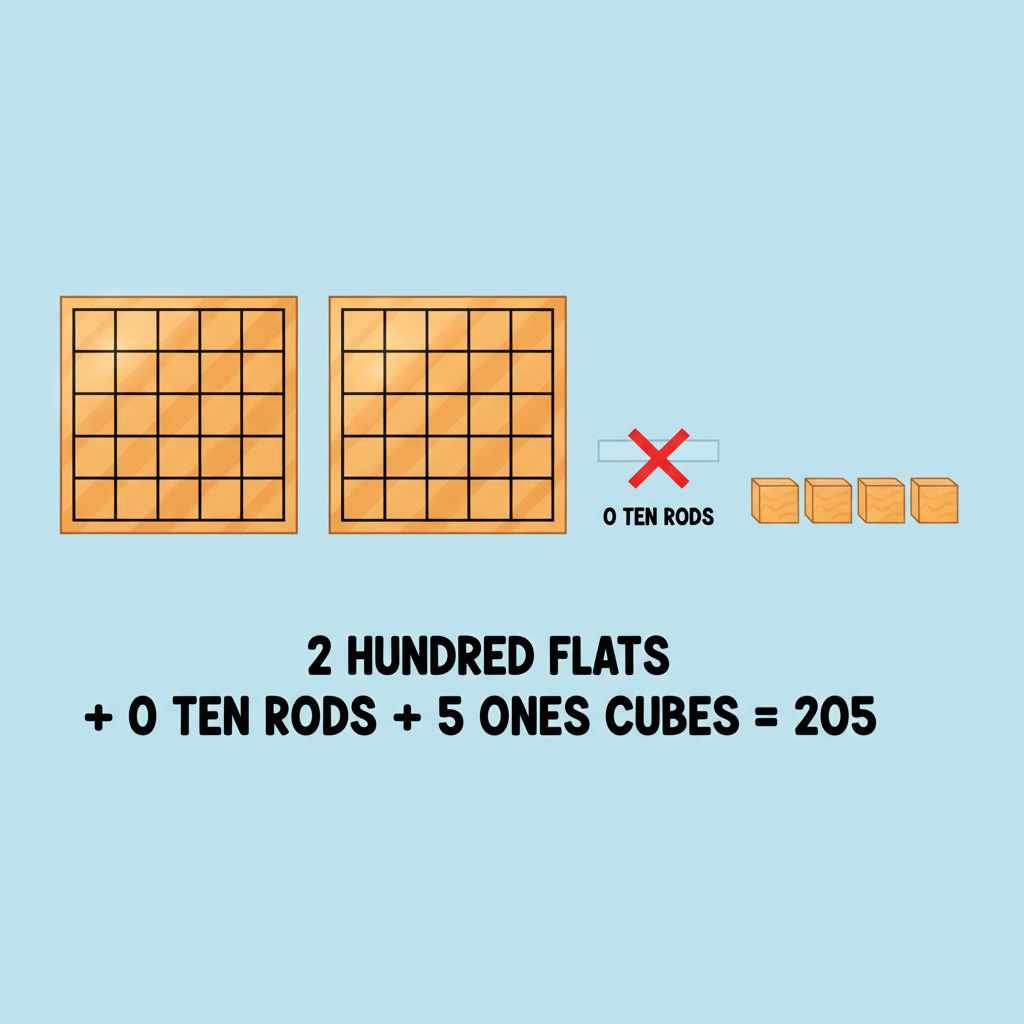
We have 2 hundred flats, 0 ten rods (that's why there are no rods shown!), and 5 ones cubes. This makes 200 + 0 + 5 = 205.
Place Value vs. Face Value: The Big Difference!
It's super important to remember the difference:
- Face Value: What the digit *looks like*. The digit itself.
- Place Value: What the digit is *worth* based on its position (ones, tens, hundreds, etc.).
Let's take the number 444:
- The face value of each digit is 4.
- However, their place values are different!
- The '4' on the right is in the ones place, so its value is 4 ones (4).
- The '4' in the middle is in the tens place, so its value is 4 tens (40).
- The '4' on the left is in the hundreds place, so its value is 4 hundreds (400).
See how the same digit can have a completely different value depending on where it lives in the number?
Summary
Understanding place value and face value helps us read, write, and understand numbers much better. Remember:
- Digits are 0-9.
- Face Value is the digit itself.
- Place Value tells you how much a digit is worth based on its position (ones, tens, hundreds).
Keep practicing, and you'll become a number expert in no time!
Keep learning, free
Create a free Syllabax account to unlock practice questions and games for this topic.
Visual Learning Enhanced! 🚀
To help you master this topic, we use Advanced Syllabax AI to generate detailed diagrams and visual models.
Note on Visuals: The AI sometimes makes spelling errors in image labels. Please refer to the lesson text for the correct terminology.