Theoretical Probability
Watch this topic in 60 seconds
Free preview · Lesson 1
Understanding Theoretical Probability
Understanding Theoretical Probability: What Are the Chances?
Welcome, 10th-grade learners, to the fascinating world of Theoretical Probability! Don't let the name intimidate you – we're going to break down this concept into simple, understandable terms using lots of everyday examples and analogies. By the end of this lesson, you'll be able to understand and calculate the likelihood of events happening in a predictable, 'perfect' world.
What is Probability? The Idea of 'Chance'
Imagine you're trying to decide whether to bring an umbrella to school. You look outside, see dark clouds, and think, 'There's a good chance it will rain.' Or maybe you're playing a board game and need to roll a '6' to win. You think, 'What are the chances I'll roll a 6?'
Probability is simply the mathematical way of measuring how likely something is to happen. It's all about quantifying 'chance.' It helps us make predictions and understand the world around us better, from weather forecasts to game strategies.
Core Concepts: Experiments, Outcomes, and Events
Before we can calculate probabilities, we need to understand a few basic terms:
1. Experiment
An experiment in probability is any process or action that has a well-defined set of possible results. Think of it as doing something where you don't know the exact outcome beforehand, but you know all the *possible* outcomes.
- Analogy: Imagine you're flipping a coin. The act of flipping the coin is the experiment. You don't know if it will land on heads or tails until it happens.
- Analogy: Rolling a standard six-sided die. The act of rolling the die is the experiment.
- Analogy: Picking a marble from a bag without looking. This is also an experiment.
2. Outcome
An outcome is one of the possible results of an experiment. It's what actually happens when you perform the experiment.
- Analogy: If you flip a coin, the outcomes are 'Heads' or 'Tails'. There are only two possible outcomes.
- Analogy: If you roll a six-sided die, the outcomes are 1, 2, 3, 4, 5, or 6. There are six possible outcomes.
- Analogy: If you pick a marble from a bag containing red, blue, and green marbles, the outcomes could be 'Red Marble', 'Blue Marble', or 'Green Marble'.
3. Event
An event is a specific outcome or a collection of outcomes that we are interested in. It's what we are trying to find the probability of.
- Analogy: When flipping a coin, an event could be 'getting Heads'.
- Analogy: When rolling a die, an event could be 'rolling an even number' (which includes outcomes 2, 4, 6) or 'rolling a 3'.
- Analogy: When picking a marble, an event could be 'picking a red marble' or 'picking a blue or green marble'.
The Sample Space: All Possible Outcomes
The sample space (often denoted by 'S') is the set of *all possible outcomes* of an experiment. It's like making a complete list of everything that could possibly happen.
- Analogy: If your experiment is choosing a flavor of ice cream from vanilla, chocolate, strawberry, and mint, your sample space is {vanilla, chocolate, strawberry, mint}.
- Analogy: For flipping a coin, the sample space S = {Heads, Tails}.
- Analogy: For rolling a six-sided die, the sample space S = {1, 2, 3, 4, 5, 6}.
Understanding the sample space is crucial because it tells us the 'total number of possible outcomes,' which is a key part of our probability formula.
Theoretical Probability Formula: The Heart of It All
Now that we know what experiments, outcomes, events, and sample spaces are, we can introduce the star of the show: the formula for Theoretical Probability!
Theoretical Probability is the probability of an event happening based on our knowledge of all possible outcomes, assuming all outcomes are equally likely. It's what *should* happen in a perfect, fair situation, not necessarily what *will* happen in one specific try.
The formula is:
P(Event) = (Number of Favorable Outcomes) / (Total Number of Possible Outcomes in the Sample Space)
Let's break this down:
- P(Event): This is shorthand for 'The Probability of the Event occurring'.
- Number of Favorable Outcomes: This is how many outcomes in your sample space satisfy the conditions of your event. These are the outcomes you are 'rooting for'.
- Total Number of Possible Outcomes: This is the total count of all unique outcomes in your sample space.
Let's see some examples!
Example 1: Flipping a Coin
- Experiment: Flipping a fair coin.
- Sample Space (S): {Heads, Tails}. Total possible outcomes = 2.
- Event A: Getting Heads.
- Number of Favorable Outcomes for Event A: 1 (just 'Heads').
- P(Heads) = 1/2
This means there's a 1 in 2 chance, or a 50% chance, of getting heads. Makes sense, right?
Example 2: Rolling a Die
- Experiment: Rolling a fair six-sided die.
- Sample Space (S): {1, 2, 3, 4, 5, 6}. Total possible outcomes = 6.
- Event B: Rolling an even number.
- Favorable Outcomes for Event B: {2, 4, 6}. Number of favorable outcomes = 3.
- P(Even Number) = 3/6 = 1/2
So, there's a 1 in 2 chance of rolling an even number.
Example 3: Marbles in a Bag
Imagine a bag containing 5 red marbles, 3 blue marbles, and 2 green marbles. You reach in and pick one marble without looking.
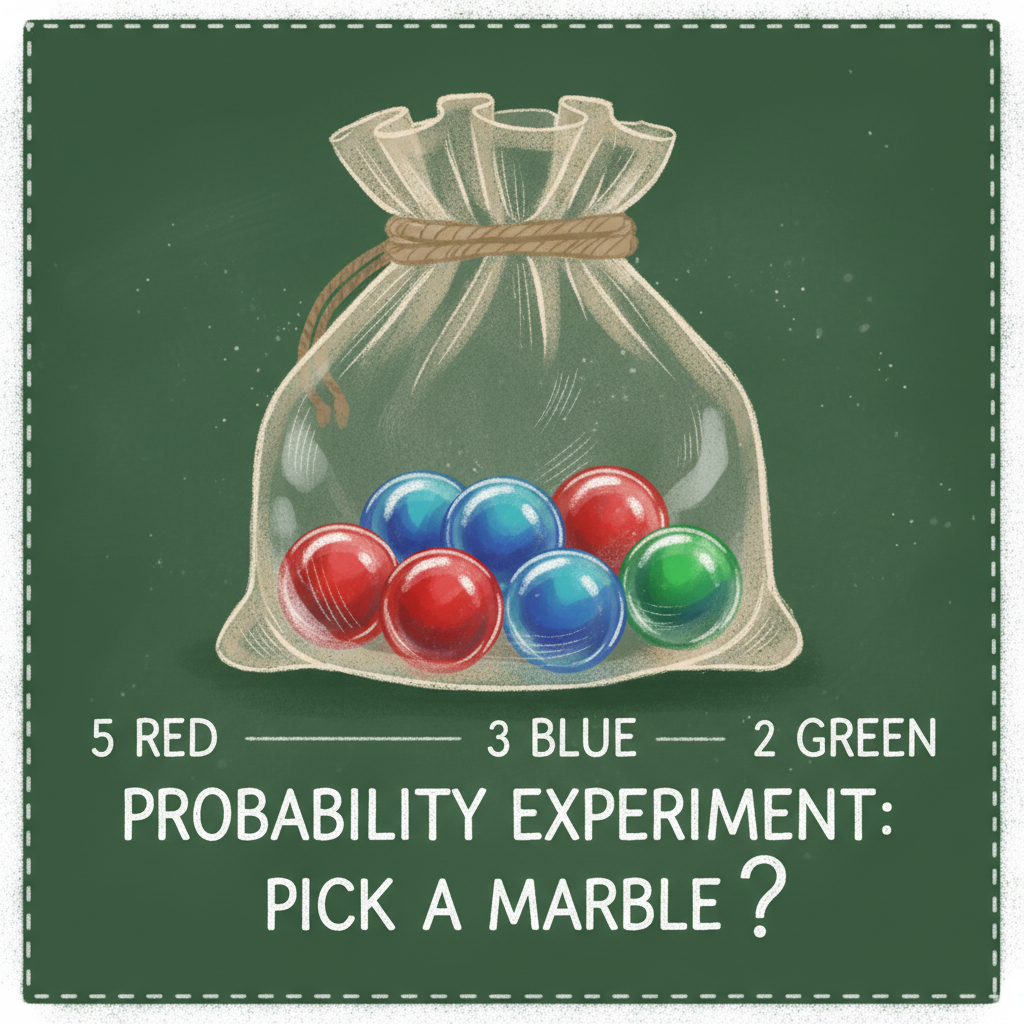
Let's calculate some probabilities:
- Total Number of Possible Outcomes: 5 (red) + 3 (blue) + 2 (green) = 10 marbles. So, 10 possible outcomes.
- Event C: Picking a red marble.
- Number of Favorable Outcomes for Event C: 5 (since there are 5 red marbles).
- P(Red Marble) = 5/10 = 1/2
- Event D: Picking a blue marble.
- Number of Favorable Outcomes for Event D: 3.
- P(Blue Marble) = 3/10
- Event E: Picking a green marble.
- Number of Favorable Outcomes for Event E: 2.
- P(Green Marble) = 2/10 = 1/5
Notice that if you add up the probabilities of picking a red, blue, or green marble: 1/2 + 3/10 + 1/5 = 5/10 + 3/10 + 2/10 = 10/10 = 1. This is an important property!
Key Properties of Probability
Here are some fundamental truths about probability:
Probability is always between 0 and 1:
- A probability of 0 means the event is impossible (it will never happen).
- A probability of 1 means the event is certain (it will always happen).
- Most probabilities fall somewhere in between, expressed as fractions, decimals, or percentages. (e.g., 0.5 or 50% for 1/2).
Analogy: You'll never get a probability of 2 (or 200%). That would be like saying there's a 200% chance of rain – it just doesn't make sense! And you won't get a negative probability either; chances can't be less than nothing.
The sum of probabilities of all possible outcomes in a sample space is 1: If you list every single possible thing that could happen and add up their individual probabilities, the total will always be 1 (or 100%). This makes sense because *something* definitely has to happen.
Theoretical vs. Experimental Probability (A Quick Note)
It's important to remember that we are discussing Theoretical Probability. This is what *should* happen in a perfect, ideal world where everything is perfectly fair (like a perfectly balanced coin or a perfectly shaped die).
Experimental Probability, which you might encounter later, is what *actually* happens when you perform an experiment many times. For example, if you flip a coin 10 times, you might get 6 heads and 4 tails. The experimental probability of heads would be 6/10. As you perform the experiment more and more times, the experimental probability usually gets closer to the theoretical probability.
Bringing It All Together
Theoretical probability gives us a powerful tool to predict the likelihood of events without having to actually perform the experiment. It's foundational to many areas of math, science, and even daily decision-making. By understanding the sample space and identifying favorable outcomes, you can calculate the chances of anything from drawing a specific card to winning a simple game.
Keep practicing identifying experiments, outcomes, events, and sample spaces, and applying the simple formula, and you'll be a probability pro in no time!
Keep learning, free
Create a free Syllabax account to unlock practice questions and games for this topic.
Visual Learning Enhanced! 🚀
To help you master this topic, we use Advanced Syllabax AI to generate detailed diagrams and visual models.
Note on Visuals: The AI sometimes makes spelling errors in image labels. Please refer to the lesson text for the correct terminology.