Parliament, President, Prime Minister – Indian polity & Governance
Watch this topic in 60 seconds
Free preview · Lesson 1
Parliament, President, Prime Minister – Indian polity & Governance (Foundational)
Indian Polity & Governance: FoundationalParliament, President, and Prime Minister: Foundational Concepts
Introduction to Indian Polity
The Indian political system is a parliamentary democracy, which means that the government is formed by the political party or coalition of parties that commands a majority in the Parliament. The Parliament, President, and Prime Minister are key institutions that shape the governance of India.
The Parliament
What is Parliament?
Parliament is the supreme legislative body of India. It consists of the President and the two Houses: the Rajya Sabha (Council of States) and the Lok Sabha (House of the People).
Lok Sabha (House of the People)
The Lok Sabha is the lower house of Parliament. Its members are directly elected by the people of India through a system of universal adult franchise. The maximum strength of the Lok Sabha is 543, including members representing states and union territories.
- Members are elected for a term of 5 years.
- The Lok Sabha can be dissolved by the President on the advice of the Prime Minister.
Rajya Sabha (Council of States)
The Rajya Sabha is the upper house of Parliament. Its members are indirectly elected by the elected members of the State Legislative Assemblies. The Rajya Sabha represents the states and union territories of India. The maximum strength of the Rajya Sabha is 250, with 12 members nominated by the President.
- It is a permanent body and is not subject to dissolution.
- One-third of its members retire every two years.
Functions of the Parliament
The Parliament performs several essential functions:
- Legislative Function: Making laws for the country.
- Financial Function: Approving the budget and controlling government finances.
- Control over the Executive: Holding the government accountable through questions, debates, and no-confidence motions.
- Constitutional Function: Amending the Constitution.
The President of India
What is the Role of the President?
The President is the Head of State of India. The President is a symbol of the unity, integrity, and solidarity of the nation. While the President holds a largely ceremonial role, their assent is required for all laws passed by the Parliament to come into effect.
- Elected indirectly by an electoral college consisting of elected members of both Houses of Parliament and the Legislative Assemblies of the states.
- Serves a term of 5 years.
Powers of the President
The President has:
- Executive Powers: All executive actions of the government are taken in the President's name.
- Legislative Powers: Summoning, proroguing, and dissolving Parliament; giving assent to bills.
- Judicial Powers: Granting pardons, reprieves, respites, or remissions of punishment.
- Emergency Powers: Declaring a state of emergency under certain conditions.
The Prime Minister of India
Who is the Prime Minister?
The Prime Minister is the Head of Government and the leader of the political party or coalition that commands a majority in the Lok Sabha. The Prime Minister is the real executive authority in India.
- Appointed by the President.
- Leads the Council of Ministers, which forms the Cabinet.
Functions of the Prime Minister
The Prime Minister:
- Heads the Council of Ministers and allocates portfolios to ministers.
- Advises the President on important matters.
- Represents India in international forums.
- Plays a crucial role in policy-making and governance.
Council of Ministers
The Council of Ministers assists and advises the Prime Minister in the exercise of their functions. It comprises Cabinet Ministers, Ministers of State, and Deputy Ministers.
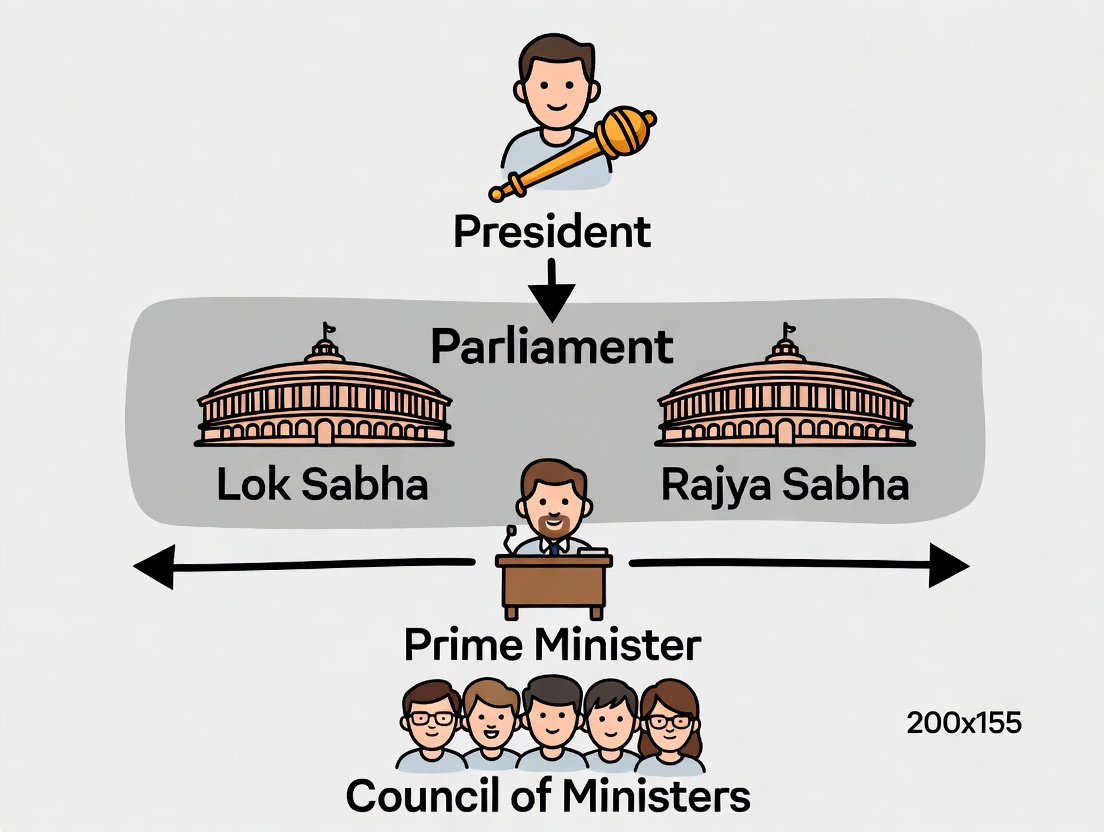 ⚠️ This picture may have spelling mistakes. Trust the words in the lesson.
Keep learning, free
Create a free Syllabax account to unlock practice questions and games for this topic.
Visual Learning Enhanced! 🚀
To help you master this topic, we use Advanced Syllabax AI to generate detailed diagrams and visual models.
Note on Visuals: The AI sometimes makes spelling errors in image labels. Please refer to the lesson text for the correct terminology.