Computer History: Early Ideas
Watch this topic in 60 seconds
Free preview · Lesson 1
Understanding Computer History: Early Ideas
Computer History: Early Ideas – How We Started Counting!
Hey amazing 4th graders! Have you ever wondered how we got the super-smart computers and tablets we use today? It all started a very, very long time ago with some simple but brilliant ideas about how to count and solve problems. Before there were any computers at all, people needed ways to keep track of things, just like you need to count how many cookies you have left!
The First "Computers": Your Fingers and Toes!
Imagine living in a time thousands of years ago, before pencils, paper, or even numbers like we know them! How would you count your sheep, your apples, or your friends? The very first 'tools' people used to count were right on their own bodies: their fingers and toes! It's like having ten little counting buddies on your hands. If you wanted to count how many toys you had, you'd touch one finger for each toy. Easy peasy!
But what if you had more than ten things? What if you had twenty sheep? You'd run out of fingers and toes pretty quickly! So, people started looking for other ways to count bigger numbers.
Counting with Nature: Stones and Sticks
When fingers and toes weren't enough, people looked around for other things to help them count. They picked up stones, pebbles, or made marks on sticks or cave walls. Each stone could represent one sheep, or one basket of berries. This was a big step! Instead of just using their bodies, they were using tools from the world around them to help them keep track of numbers.
Think of it like this: If you have a big jar of jelly beans, and you want to know how many there are, you might put one pebble in a separate pile for every ten jelly beans you count. When you have ten pebbles, you know you've counted 100 jelly beans! This simple idea of using objects to represent numbers was very important.
 ⚠️ This picture may have spelling mistakes. Trust the words in the lesson.
The Amazing Abacus: A Super Counting Machine!
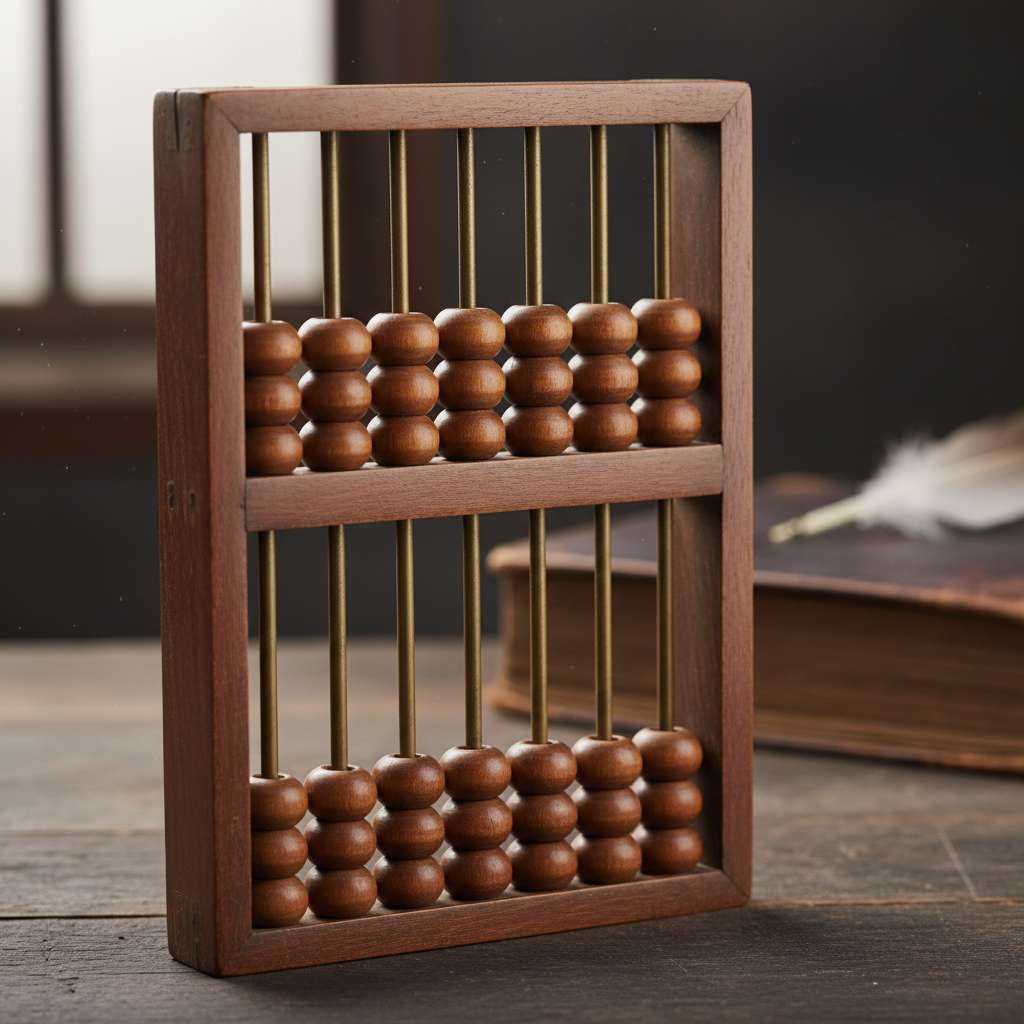
As people needed to count even bigger numbers and do more difficult math, like adding and subtracting large amounts, they invented a truly clever device called the abacus. The abacus is like a super-smart bead counter! It's usually a frame with rods, and on each rod, there are beads that can slide up and down.
Imagine your mom or dad counting money at the store. They don't just use their fingers for hundreds of dollars, right? The abacus helped people do calculations much faster and more accurately than just counting on fingers or with stones. Each rod on the abacus represents a different 'place' value, like ones, tens, hundreds, thousands, just like in the numbers you write.
For example, if you slide one bead on the first rod, it might mean '1'. If you slide one bead on the second rod, it might mean '10'. It's a bit like playing with LEGOs where each different colored block has a special value. By moving the beads around, you can add, subtract, multiply, and even divide!
The abacus was invented thousands of years ago in different parts of the world, like ancient China and Mesopotamia. It was one of the very first 'machines' designed specifically to help people calculate. It showed everyone that a special tool could make math much easier and faster.
 ⚠️ This picture may have spelling mistakes. Trust the words in the lesson.
The Big Idea: Machines Can Help Us Think!
The journey from counting on fingers to using an abacus was a huge leap! It taught people a very important lesson: machines and tools could be designed to help our brains do difficult tasks, especially with numbers. This idea, that a machine could 'think' or calculate for us, was the tiny seed that grew into all the amazing computers we have today.
These early ideas weren't about electric wires or computer chips, but they were about solving problems. People observed a need (counting too many things!), then invented a tool (stones, then the abacus) to meet that need. Every time someone thought of a new way to count or calculate, they were laying down a tiny brick in the long, long road that eventually led to your tablet, your laptop, and all the incredible technology around you!
So, next time you use a calculator or play a game on a computer, remember the simple but powerful ideas that started it all: our fingers, some pebbles, and the clever abacus! These were the first steps in a long and exciting history of making machines that help us think and create.
Keep learning, free
Create a free Syllabax account to unlock practice questions and games for this topic.
Visual Learning Enhanced! 🚀
To help you master this topic, we use Advanced Syllabax AI to generate detailed diagrams and visual models.
Note on Visuals: The AI sometimes makes spelling errors in image labels. Please refer to the lesson text for the correct terminology.