Decimal operations (Decimals)
Watch this topic in 60 seconds
Free preview · Lesson 1
Understanding Decimal operations (Decimals)
Mastering Decimals: Your Guide to Everyday Math!
Hey there, future math whiz! Have you ever wondered how we talk about amounts that aren't quite whole numbers? Like when you buy something for $3.75, or when a recipe calls for 0.5 cups of sugar, or when an athlete runs a race in 10.2 seconds? That's where decimals come in! Decimals are super important in everyday life, helping us understand parts of whole numbers with precision. Think of them like special numbers that let us be really specific about fractions.
What Exactly IS a Decimal? (It's Easier Than You Think!)
Imagine you have a giant chocolate bar. If you break it into 10 equal pieces, and you eat 3 of those pieces, you've eaten 3/10 of the bar. In decimal language, that's 0.3 of the bar. The '0' means you haven't eaten a whole bar yet, and the '.3' tells you how much of the next bar you've had. The little dot between the whole number and the part-of-a-whole number is called the decimal point.
Decimals are just another way to write fractions, especially fractions with denominators like 10, 100, 1,000, and so on. For example:
- 1/10 is written as 0.1 (one tenth)
- 3/100 is written as 0.03 (three hundredths)
- 75/100 is written as 0.75 (seventy-five hundredths)
The Power of Place Value: Where Every Digit Counts!
Just like in whole numbers (where the 5 in 50 is different from the 5 in 500), the position of a digit after the decimal point really matters. It tells us how big or small that 'part' is. Think of it like this:
To the left of the decimal point, you have the whole numbers:
- ...Hundreds, Tens, Ones .
To the right of the decimal point, you have the 'parts' of a whole:
- . Tenths, Hundredths, Thousandths...
So, in the number 12.345:
- The '1' is in the Tens place (worth 10)
- The '2' is in the Ones place (worth 2)
- The '.' is the decimal point
- The '3' is in the Tenths place (worth 3/10 or 0.3)
- The '4' is in the Hundredths place (worth 4/100 or 0.04)
- The '5' is in the Thousandths place (worth 5/1000 or 0.005)
It's like having different sized boxes: a 'tenths' box holds pieces that are 1/10th of the whole, a 'hundredths' box holds pieces that are 1/100th of the whole, and so on. The further right you go, the smaller the pieces get!
Adding Decimals: Lining Up Your Coins!
Adding decimals is a lot like adding whole numbers, but with one super important rule: always line up the decimal points! Think about it like adding money. If you have
Steps for Adding Decimals:
- Line 'em up! Write the numbers one below the other, making sure the decimal points are perfectly aligned.
- Fill in the blanks (optional but helpful). If one number has fewer digits after the decimal point than another, you can add zeros to the end to make them the same length. This doesn't change the value of the number (e.g., 0.5 is the same as 0.50 or 0.500) but it makes lining up easier.
- Add like whole numbers. Start from the rightmost digit and add column by column, carrying over just like you would with whole numbers.
- Place the decimal point. Bring the decimal point straight down into your answer.
Example: Add 2.75 + 1.2
  2.75
+ 1.20  (We added a zero to 1.2 to make it 1.20)
------
  3.95
So, 2.75 + 1.2 = 3.95. Easy, right?
Subtracting Decimals: Taking Away Your Change!
Subtracting decimals follows the exact same golden rule as adding them: line up the decimal points! Imagine you have
Steps for Subtracting Decimals:
- Line 'em up! Write the numbers one below the other, with decimal points aligned.
- Fill in the blanks (often necessary). Add zeros to the end of the top number if it has fewer decimal places than the bottom number. This is crucial for borrowing!
- Subtract like whole numbers. Start from the rightmost digit and subtract column by column, borrowing from the left if needed.
- Place the decimal point. Bring the decimal point straight down into your answer.
Example: Subtract 4.5 from 8.35
  8.35
- 4.50  (We added a zero to 4.5 to make it 4.50)
------
  3.85
So, 8.35 - 4.5 = 3.85.
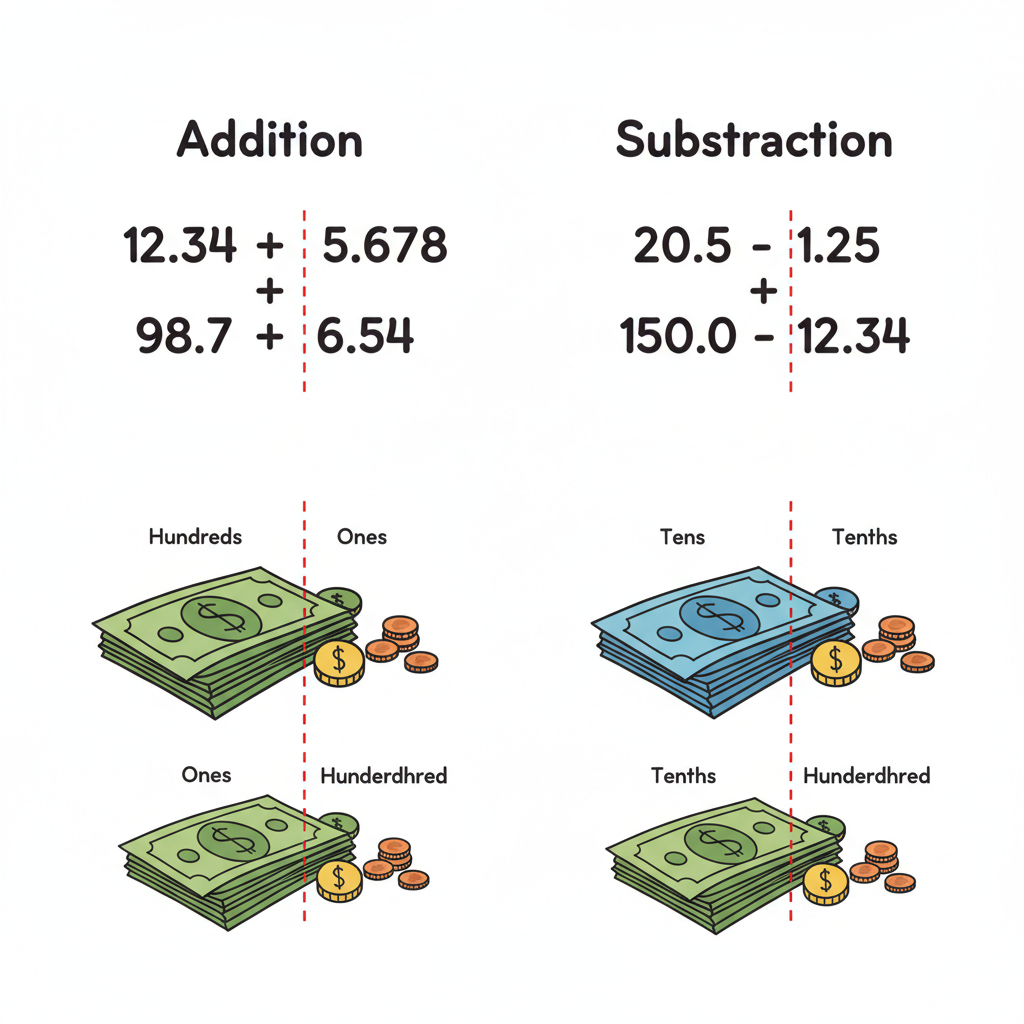 ⚠️ This picture may have spelling mistakes. Trust the words in the lesson.
Multiplying Decimals: Counting the Jumps!
Multiplying decimals is a little different because you don't line up the decimal points at first. Instead, you multiply them almost as if they were whole numbers, and then you figure out where the decimal point goes in the final answer.
Steps for Multiplying Decimals:
- Ignore the decimals (for now). Multiply the numbers as if they were whole numbers. Don't worry about the decimal points yet!
- Count the total decimal places. Go back to your original numbers and count how many digits are *after* the decimal point in both numbers combined.
- Place the decimal point in the product. Starting from the far right of your answer from step 1, count left the same number of places you counted in step 2. That's where your decimal point goes!
Example: Multiply 0.3 x 0.4
- Ignore decimals: 3 x 4 = 12
- Count decimal places:
- 0.3 (1 digit after decimal)
- 0.4 (1 digit after decimal)
- Total: 1 + 1 = 2 decimal places
- Place decimal: Take '12' and move the decimal 2 places to the left from the right. .12
So, 0.3 x 0.4 = 0.12.
Another Example: Multiply 2.5 x 1.3
- Ignore decimals: 25 x 13 = 325
- Count decimal places:
- 2.5 (1 digit after decimal)
- 1.3 (1 digit after decimal)
- Total: 1 + 1 = 2 decimal places
- Place decimal: Take '325' and move the decimal 2 places to the left from the right. 3.25
So, 2.5 x 1.3 = 3.25. See how easy it is once you get the hang of it?
Dividing Decimals: Making it Whole and Sharing Fairly!
Dividing decimals can look a bit tricky at first, especially when there's a decimal in the number you're dividing by (the divisor). But don't worry, there's a clever trick to make it simple: make the divisor a whole number!
Steps for Dividing Decimals:
- Make the divisor a whole number. If your divisor (the second number, outside the division symbol) has a decimal, move its decimal point to the far right until it's a whole number.
- Move the dividend's decimal point. You MUST do the exact same thing to the dividend (the first number, inside the division symbol). If you moved the divisor's decimal 2 places to the right, move the dividend's decimal 2 places to the right. Add zeros to the dividend if you run out of digits.
- Place the decimal point in the quotient. Once you've moved the dividend's decimal point, immediately place the decimal point in your answer (the quotient) directly above its new position.
- Divide like whole numbers. Now, simply divide as you would with whole numbers.
Example: Divide 4.8 by 0.6
- Make divisor whole: 0.6 becomes 6 (moved decimal 1 place right).
- Move dividend's decimal: 4.8 becomes 48 (moved decimal 1 place right).
- Place decimal in quotient: Above the new position for '48'.
- Divide: 48 ÷ 6 = 8.
So, 4.8 ÷ 0.6 = 8.
Another Example: Divide 1.25 by 0.5
      ____
0.5 | 1.25
- Make divisor whole: Move decimal in 0.5 one place right to get 5.
- Move dividend's decimal: Move decimal in 1.25 one place right to get 12.5.
- Place decimal in quotient: Put the decimal point right above the new position in 12.5.
- Divide:
      2.5
    ____
 5 | 12.5
     -10
     ---
       2 5
      -2 5
      ----
         0
So, 1.25 ÷ 0.5 = 2.5.
Putting It All Together!
Decimals are fundamental to so much of what we do every day – from calculating costs at the store to measuring ingredients for baking, or even tracking sports statistics. By understanding these basic operations, you've unlocked a powerful tool for understanding the world around you. Keep practicing, and soon, working with decimals will feel as natural as counting whole numbers!
Keep learning, free
Create a free Syllabax account to unlock practice questions and games for this topic.
Visual Learning Enhanced! 🚀
To help you master this topic, we use Advanced Syllabax AI to generate detailed diagrams and visual models.
Note on Visuals: The AI sometimes makes spelling errors in image labels. Please refer to the lesson text for the correct terminology.