Understanding Samples and Populations
Watch this topic in 60 seconds
Free preview · Lesson 1
Understanding Understanding Samples and Populations
Unlocking the Secrets of Big Groups: Understanding Samples and Populations (Grade 7)
Hey there, future super-statisticians! Have you ever wondered how people figure out what a huge group of people thinks without asking every single person? Or how they know if a giant batch of cookies tastes good without eating them all? The secret lies in something called Samples and Populations!
It might sound fancy, but it's actually super simple and something you probably already do in your everyday life. Let's break it down with some fun examples!
What is a Population? Imagine the WHOLE Pie!
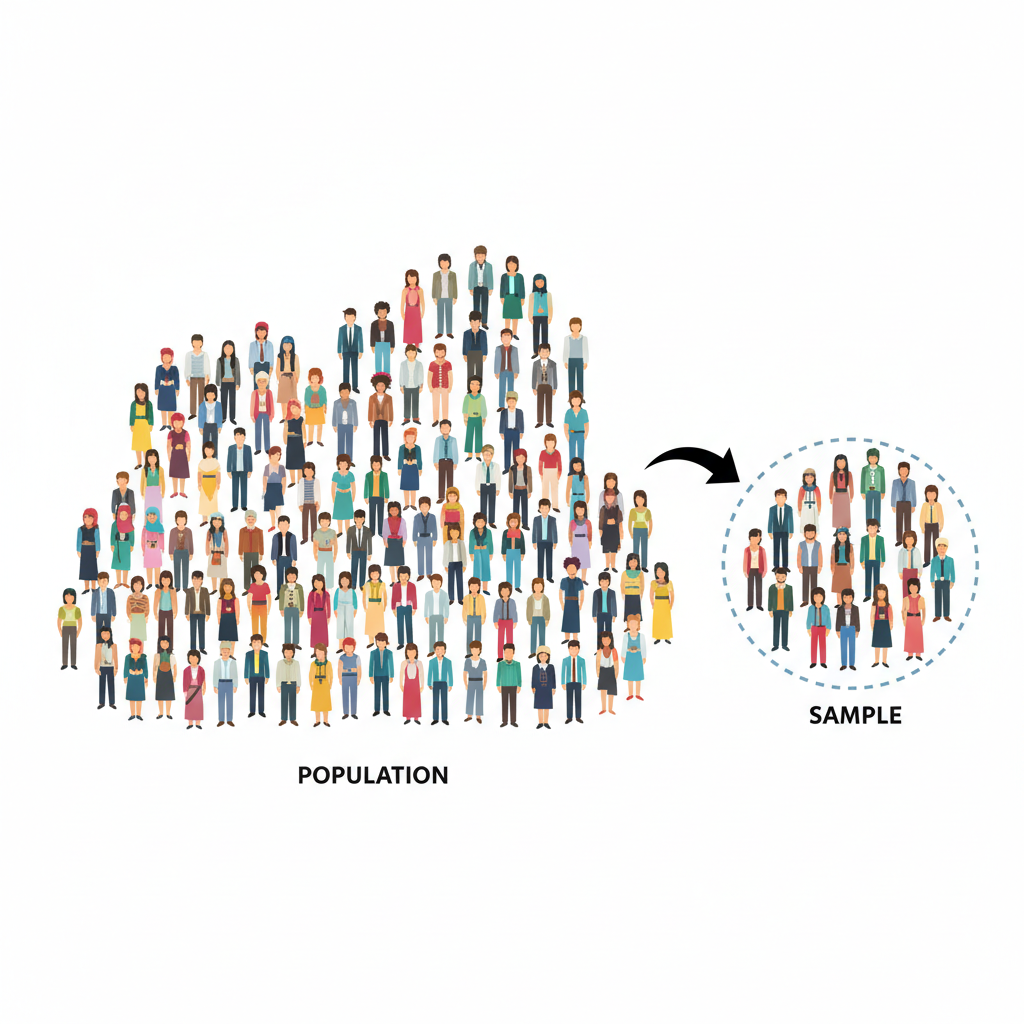
Think about a population like the entire group you're interested in. It's everyone or everything that fits a certain description. No one is left out! If you want to know something about all the 7th graders in your school, then all the 7th graders in your school make up your population.
Analogy Time!
- The Cookie Jar: Imagine a giant cookie jar filled with 100 cookies. If you want to know about all the cookies in that jar, then those 100 cookies are your population.
- The Forest: If you're a scientist studying a specific type of tree in a forest, the population would be every single tree of that type in the entire forest.
- Your School: If your principal wants to know what all the students in your school think about the lunch menu, then every single student in the school is the population.
A population is the complete collection of individuals or objects that you want to study. It's usually a large group, sometimes even impossibly large to count or measure directly.
What is a Sample? Taking a Bite of the Pie!
Now, what if that cookie jar has a million cookies? Or the forest has tens of thousands of trees? It would take forever (or be impossible!) to count or examine every single one. That's where a sample comes in!
A sample is just a smaller, manageable part of the population. It's like taking a tiny peek or a small taste to get an idea about the whole thing. We study the sample, and then we use what we learn from it to make educated guesses (or inferences) about the entire population.
More Analogy Time!
- The Cookie Jar (Revisited): Instead of eating all 100 cookies, you take just one or two cookies from the jar to taste. Those one or two cookies are your sample. If they taste good, you might guess the rest are good too!
- The Forest (Revisited): The scientist can't examine every tree. So, they pick maybe 100 trees from different parts of the forest to study. Those 100 trees are their sample.
- Your School (Revisited): Your principal can't ask every student about lunch. So, they might ask 20 students from different grades. Those 20 students form the sample.
The key idea is that the sample should be like a miniature version of the population. It should represent the bigger group accurately.
Why Do We Use Samples? Because Life's Too Short (and Too Big!)
Why bother with samples? Why not just study the whole population every time? Great question!
- Too Large: Populations can be HUGE. Imagine trying to count every fish in the ocean or ask every person in your state their favorite color. It's simply not practical.
- Too Expensive: Collecting data from millions of people or objects costs a lot of money, time, and resources.
- Too Time-Consuming: Even if you had the money, it would take ages to get information from everyone. Sometimes you need answers quickly!
- Destructive Testing: Sometimes, to test an item, you have to destroy it (like testing if a light bulb works until it burns out). You can't destroy *all* the light bulbs, so you test a sample!
So, samples are super useful tools that help us learn about big groups without having to check every single member.
Good Samples vs. Bad Samples: The "Mini-Me" Effect
Just taking *any* sample isn't always enough. For your sample to be useful, it needs to be a representative sample. Think of it like this: your sample should be a "mini-me" of the entire population. It should have the same characteristics and diversity as the bigger group.
Example of a Representative Sample:
Let's say your school has 50% boys and 50% girls. If you take a sample of 20 students to ask about school sports, a representative sample would have about 10 boys and 10 girls. It wouldn't be very representative if you only asked 20 boys, would it? You'd miss out on what the girls think!
Examples of Bad (Biased) Samples:
- The Cookie Jar: If you only pick the burnt cookies from the bottom of the jar as your sample, you'll think all the cookies are burnt, even if most are perfect! That's a biased sample.
- The Forest: If the scientist only studies trees right next to a busy road, but the rest of the forest is far from roads, their sample might not tell them about the trees deeper in the forest.
- Your School: If the principal only asks students who are in the drama club about the lunch menu, their sample might not represent what students who love sports or science think.
A biased sample is one that doesn't accurately reflect the population. It's like looking through a funhouse mirror – everything is distorted, and you don't get a true picture.
To get a good, representative sample, people often use random sampling techniques. This means every member of the population has an equal chance of being chosen for the sample. It's like drawing names out of a hat!
Putting It All Together: A Quick Recap!
So, remember these main ideas:
- A Population is the entire group you're interested in.
- A Sample is a smaller, manageable part of that population.
- We use samples because studying entire populations can be too big, expensive, or time-consuming.
- A good sample is a representative sample, meaning it looks like a miniature version of the population and gives a fair picture of the whole group.
Understanding samples and populations is a powerful skill! It helps you think critically about surveys, news reports, and even your own observations. Keep an eye out for how these ideas pop up in the world around you!
Keep learning, free
Create a free Syllabax account to unlock practice questions and games for this topic.
Visual Learning Enhanced! 🚀
To help you master this topic, we use Advanced Syllabax AI to generate detailed diagrams and visual models.
Note on Visuals: The AI sometimes makes spelling errors in image labels. Please refer to the lesson text for the correct terminology.