Expanded & short form (Number Sense)
Watch this topic in 60 seconds
Free preview · Lesson 1
Understanding Expanded & short form (Number Sense)
Understanding Numbers: Expanded and Short Form
Hello, super mathematicians! Today, we're going on an exciting adventure into the world of numbers. We're going to learn how numbers can be written in different ways, like putting on different outfits! We'll explore two main ways: the short form (which is like a quick, everyday outfit) and the expanded form (which is like a detailed, fancy outfit that shows all the important parts).
What is the Short Form?
The short form is the way we usually see and write numbers. It's the most common way! Think of it like saying someone's name, like 'Alex'. It's short, sweet, and gets the job done.
For example, when you see the number 537, that's the short form. It's easy to read and recognize.
What is the Expanded Form?
The expanded form is like taking that number and stretching it out, showing you exactly how much each digit is worth based on its position. Imagine a delicious sandwich. The short form is just saying 'sandwich'. The expanded form is telling you: 'It's a sandwich with 1 slice of ham, 2 slices of cheese, and 3 slices of lettuce.' You're breaking it down into its parts!
Let's take our number 537 again. In the expanded form, we break it down like this:
- The 5 is in the hundreds place. So, it's worth 500 (five hundred).
- The 3 is in the tens place. So, it's worth 30 (thirty).
- The 7 is in the ones place. So, it's worth 7 (seven).
When we add these together, we get 500 + 30 + 7, which equals 537. So, the expanded form of 537 is 500 + 30 + 7.
Why is Expanded Form Useful?
Expanded form is super helpful because it shows us the 'value' of each digit. The value of a digit depends on where it sits in the number. It's like the importance of a player in a game – a player in the 'goalie' position is very different from a player in the 'forward' position, even if they are both players!
Let's look at another example: the number 1,249.
- The 1 is in the thousands place, so it's worth 1000.
- The 2 is in the hundreds place, so it's worth 200.
- The 4 is in the tens place, so it's worth 40.
- The 9 is in the ones place, so it's worth 9.
So, the expanded form of 1,249 is 1000 + 200 + 40 + 9.
Understanding Place Value
The key to writing numbers in expanded form is understanding place value. Place value tells us the worth of a digit based on its position. Think of a tall building. The top floor (like the thousands place) is worth more than the ground floor (like the ones place).
| Place Value | Digit in 1,249 | Value |
|---|---|---|
| Thousands | 1 | 1000 |
| Hundreds | 2 | 200 |
| Tens | 4 | 40 |
| Ones | 9 | 9 |
Each place is worth 10 times more than the place to its right! It's like a ladder where each step is 10 times higher than the one before it.
More Practice!
Let's try a few more examples to really make this stick. Imagine you have a giant jar of jellybeans!
Example 1: The Jellybean Jar
You have a jar with 600 jellybeans. In short form, it's 600. In expanded form, it's 600. (Since there are no tens or ones, we just write the value of the hundreds digit).
Example 2: A Bigger Jar!
Now imagine a bigger jar with 78 jellybeans.
- The 7 is in the tens place, so it's worth 70.
- The 8 is in the ones place, so it's worth 8.
The expanded form is 70 + 8.
Example 3: Even Bigger!
What about 3,052 jellybeans?
- The 3 is in the thousands place, so it's worth 3000.
- The 0 is in the hundreds place, so it's worth 0.
- The 5 is in the tens place, so it's worth 50.
- The 2 is in the ones place, so it's worth 2.
The expanded form is 3000 + 0 + 50 + 2. Sometimes, when a digit is 0, we can skip writing its value in the expanded form, so 3000 + 50 + 2 is also correct!
Visualizing Expanded Form
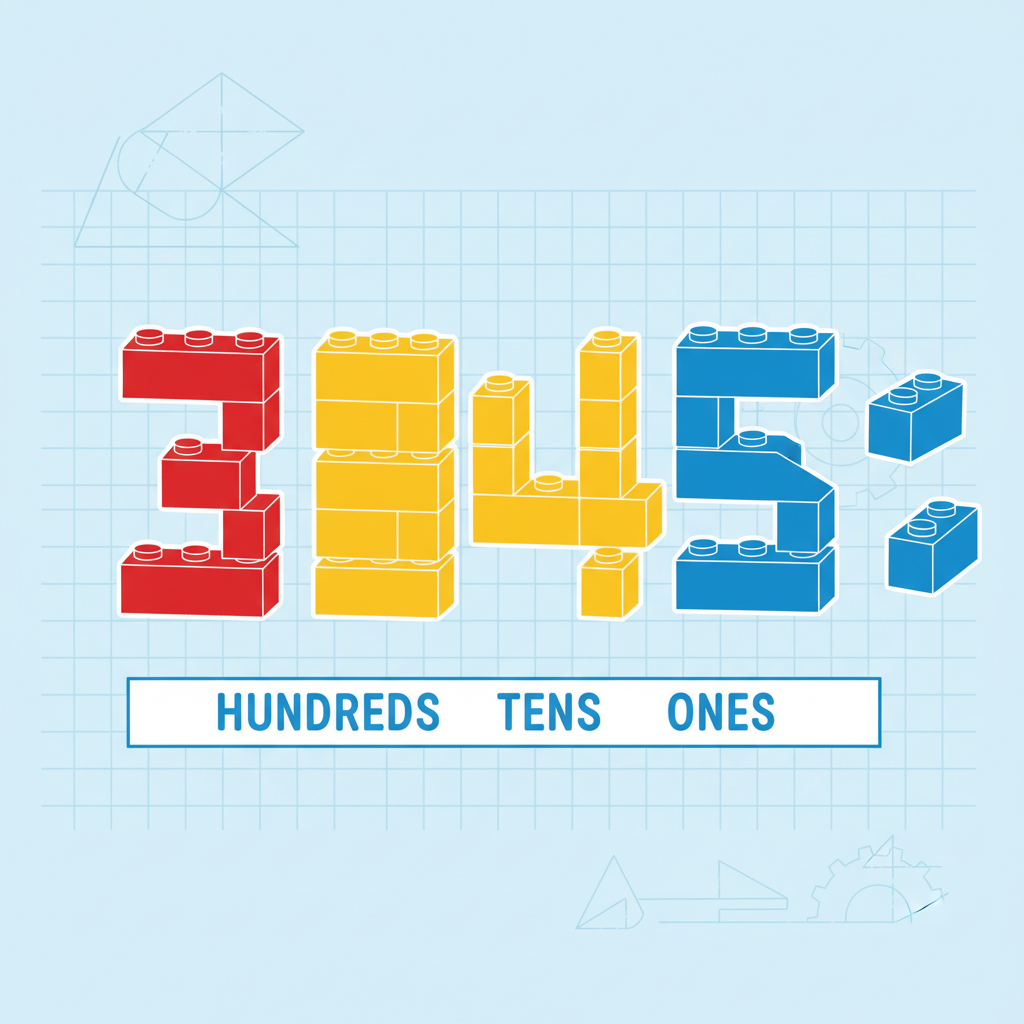
Sometimes it helps to see numbers built up. Imagine LEGO bricks!
Let's build the number 345:
- We need 3 hundreds blocks (each worth 100). That's 3 x 100 = 300.
- We need 4 tens blocks (each worth 10). That's 4 x 10 = 40.
- We need 5 ones blocks (each worth 1). That's 5 x 1 = 5.
So, 345 is the same as 300 + 40 + 5.
Key Differences
Remember the difference:
- Short form: The number as you usually see it (e.g., 789).
- Expanded form: The number broken down into the value of each digit added together (e.g., 700 + 80 + 9).
It's like the difference between a complete outfit (short form) and listing out every single piece of clothing you're wearing and why it's important (expanded form).
Keep practicing, and soon you'll be a master of both short and expanded forms!
Keep learning, free
Create a free Syllabax account to unlock practice questions and games for this topic.
Visual Learning Enhanced! 🚀
To help you master this topic, we use Advanced Syllabax AI to generate detailed diagrams and visual models.
Note on Visuals: The AI sometimes makes spelling errors in image labels. Please refer to the lesson text for the correct terminology.