Everyday uses (CHEMISTRY)
Watch this topic in 60 seconds
Free preview · Lesson 1
Understanding Everyday uses (CHEMISTRY)
Everyday Uses of Chemistry: The Invisible Science All Around Us!
Have you ever wondered why your favorite cookies taste so delicious, how your clothes get clean in the washing machine, or why a balloon floats up into the sky? The answer to all these amazing things, and so much more, is chemistry!
What is Chemistry, Anyway?
Chemistry is the science that studies matter and how it changes. Think of it as being a detective for the tiny, invisible building blocks that make up everything around us. These building blocks are called atoms, and they love to join up with other atoms to make new things called molecules.
Imagine atoms are like LEGO bricks. You can have red bricks, blue bricks, yellow bricks, and they all have different shapes and sizes. Chemistry is like learning how these LEGO bricks connect and what amazing structures you can build with them!
Atoms: The Tiny Building Blocks
Everything you can see, touch, smell, and taste is made of atoms. Even the air you breathe is made of atoms! The most common atoms we encounter every day are:
- Oxygen (O): We need this to breathe and live.
- Hydrogen (H): A super-light atom that's part of water.
- Carbon (C): The basic building block of all living things, from plants to people!
- Nitrogen (N): Makes up most of the air we breathe.
These atoms are so tiny, you'd need a super-duper microscope to see even one!
Molecules: Atoms Holding Hands
Atoms don't usually like to be alone. They prefer to hold hands with other atoms to form molecules. Think of molecules as small teams of LEGO bricks connected together.
- Water (H2O): This is probably the most important molecule! It's made of two hydrogen atoms (H) holding hands with one oxygen atom (O). It's like a team of two tiny H bricks and one big O brick.
- Carbon Dioxide (CO2): This molecule is made of one carbon atom (C) holding hands with two oxygen atoms (O). It's what we breathe out and what plants use to grow.
- Sugar (like Glucose, C6H12O6): These are much bigger molecules, made of lots of carbon, hydrogen, and oxygen atoms all connected! They give us energy.
Chemistry helps us understand how these molecules are built and how they interact with each other.
Chemistry in Your Kitchen: More Than Just Cooking!
Your kitchen is a chemistry lab in disguise!
Baking and Cooking
When you bake cookies, chemistry is happening!
- Mixing Ingredients: When you mix flour, eggs, sugar, and butter, you're mixing different molecules.
- Heat Changes Things: When you put the cookie dough in the oven, the heat causes chemical reactions. The molecules rearrange themselves, making the cookies rise, turn golden brown, and smell delicious! This is called the Maillard reaction, which creates those yummy flavors and colors.
- Baking Soda/Powder: These special ingredients create gas bubbles (carbon dioxide!) when heated, making cakes and cookies fluffy. It's like adding tiny balloons to your batter!
Think of cooking as a chemistry experiment where you get to eat the results!
Cleaning Up
How does soap get things clean?
- Soap Molecules: Soap molecules have a special design. One end loves water (hydrophilic) and the other end loves grease and dirt (hydrophobic).
- Trapping Dirt: When you wash dishes or clothes, the grease-loving ends grab onto the dirt and oil, while the water-loving ends connect with the water. Then, the water washes away the soap and the trapped dirt! It's like a tiny cleaning crew that grabs the mess and takes it down the drain.
Detergents and cleaning sprays use similar chemistry to break down stains and make things sparkle.
Chemistry in Your Bathroom: From Toothpaste to Medicine
Toothpaste
Your toothpaste is a chemistry wonder!
- Fluoride: Many toothpastes contain fluoride, a special chemical that makes your tooth enamel (the hard outer layer of your teeth) stronger and helps prevent cavities. It's like giving your teeth a protective shield!
- Abrasives: Tiny particles in toothpaste help scrub away plaque and food bits without scratching your teeth.
- Foaming Agents: These create the foam you see, helping to spread the toothpaste all over your teeth.
Medicines
All medicines, from a simple pain reliever to complex antibiotics, are products of chemistry. Scientists study molecules and how they interact with our bodies to create drugs that can help us feel better when we're sick or injured.
For example, when you take an aspirin for a headache, specific molecules in the aspirin go to work to block the signals that cause pain.
Chemistry in Your Home: Everyday Objects
Plastics
Plastics are amazing materials made through chemistry. They are formed when very long chains of molecules link together.
- Versatility: Because chemists can change the way these molecules link, they can create plastics that are hard and strong (like in toys), flexible (like in balloons), or clear (like in water bottles).
- Durability: Many plastics are resistant to water and don't easily break down, which is why they are used in so many products.
Batteries
How do your toys, remotes, and flashlights get power?
- Chemical Reactions: Batteries work because of controlled chemical reactions happening inside them. These reactions create a flow of tiny charged particles called electrons, which is electricity!
- Energy Storage: Batteries are like little energy storage containers, holding chemical energy that can be converted into electrical energy when needed.
Paper
Even something as simple as paper involves chemistry. It's made from wood fibers (cellulose) that are chemically treated and pressed together. The way these fibers bond affects how strong and smooth the paper is.
Chemistry in the Air and Outdoors
Balloons and Hot Air
Why do some balloons float?
- Density: Hot air is less dense (lighter) than cool air. When you heat air inside a balloon, the air molecules spread out and become lighter than the same amount of cooler air outside. This makes the balloon rise!
- Helium Balloons: Balloons filled with helium gas also float. Helium atoms are naturally lighter than the nitrogen and oxygen atoms that make up most of the air around us.
Plants and Photosynthesis
Plants are amazing chemists! They use a process called photosynthesis to make their own food.
- Ingredients: Plants take in carbon dioxide (CO2) from the air, water (H2O) from the soil, and energy from sunlight.
- Making Food: Using the energy from sunlight, they chemically change these ingredients into sugar (their food) and oxygen (O2), which they release back into the air. It's like a tiny solar-powered food factory!
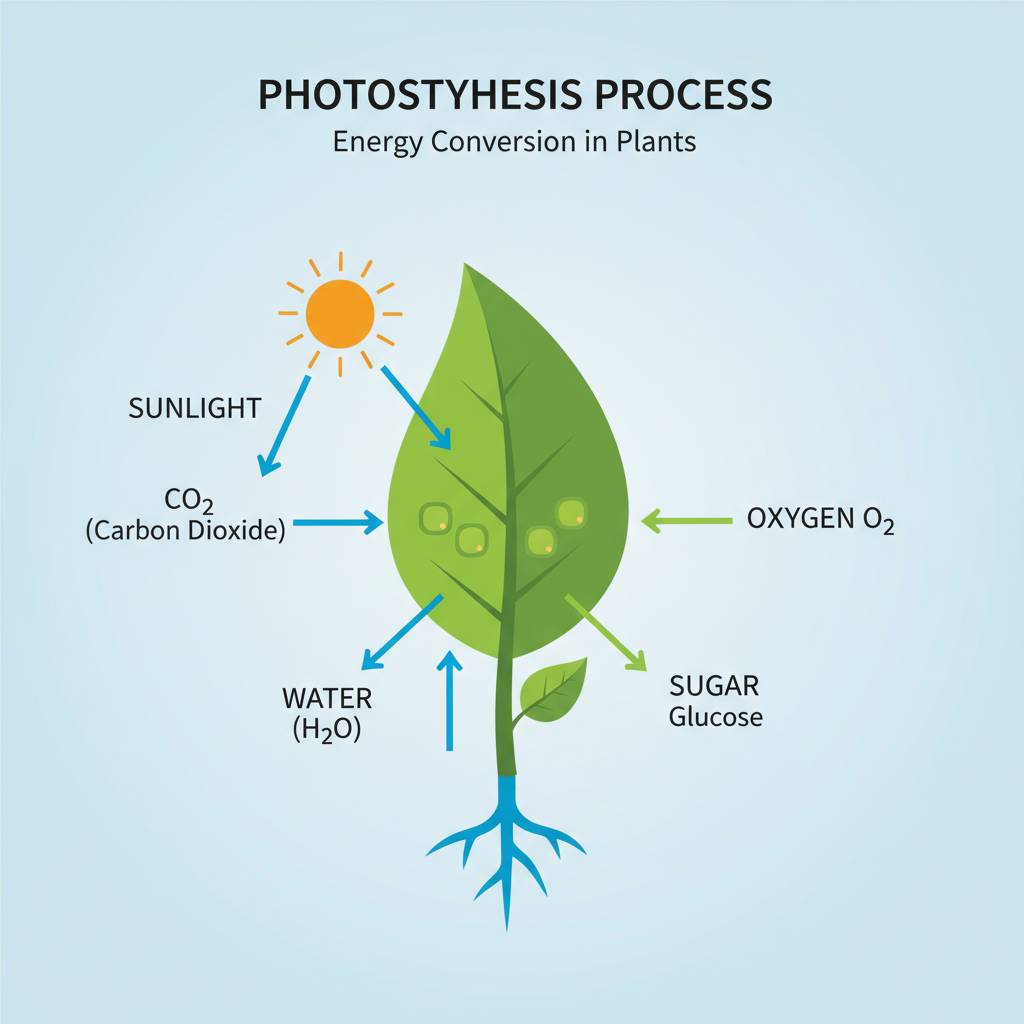 ⚠️ This picture may have spelling mistakes. Trust the words in the lesson.
Conclusion
Chemistry is not just a subject in school; it's the science that explains how and why things happen in our everyday lives. From the food we eat to the clothes we wear, from the medicines that heal us to the technology that powers our homes, chemistry is working behind the scenes, making our world function. So next time you see something amazing happening, remember that chemistry is probably the reason why!
Keep learning, free
Create a free Syllabax account to unlock practice questions and games for this topic.
Visual Learning Enhanced! 🚀
To help you master this topic, we use Advanced Syllabax AI to generate detailed diagrams and visual models.
Note on Visuals: The AI sometimes makes spelling errors in image labels. Please refer to the lesson text for the correct terminology.