Types of angles (acute, obtuse, right, straight, reflex) [Basic Geometry]
Watch this topic in 60 seconds
Free preview · Lesson 1
Understanding Types of angles (acute, obtuse, right, straight, reflex) [Basic Geometry]
Angles: The Shapes' Corners!
Hello young mathematicians! Get ready to dive into the exciting world of angles. Angles are everywhere – in the corners of your room, in the hands of a clock, and even in the way a skateboard ramps up. Today, we're going to learn about different types of angles and how to spot them!
What is an Angle?
Imagine two lines or rays that start at the same point. That special point where they meet is called the **vertex**. The space or 'opening' between these two rays is what we call an **angle**. Think of it like a door opening. The hinge is the vertex, and how far the door opens is the angle.
We measure angles in degrees, using a special tool called a protractor. A full circle is 360 degrees (360°), which is like going all the way around a merry-go-round!
Types of Angles: Meet the Gang!
Just like people, angles come in different shapes and sizes. Let's meet some of the most common types:
1. Right Angle: The 'Perfect Corner'
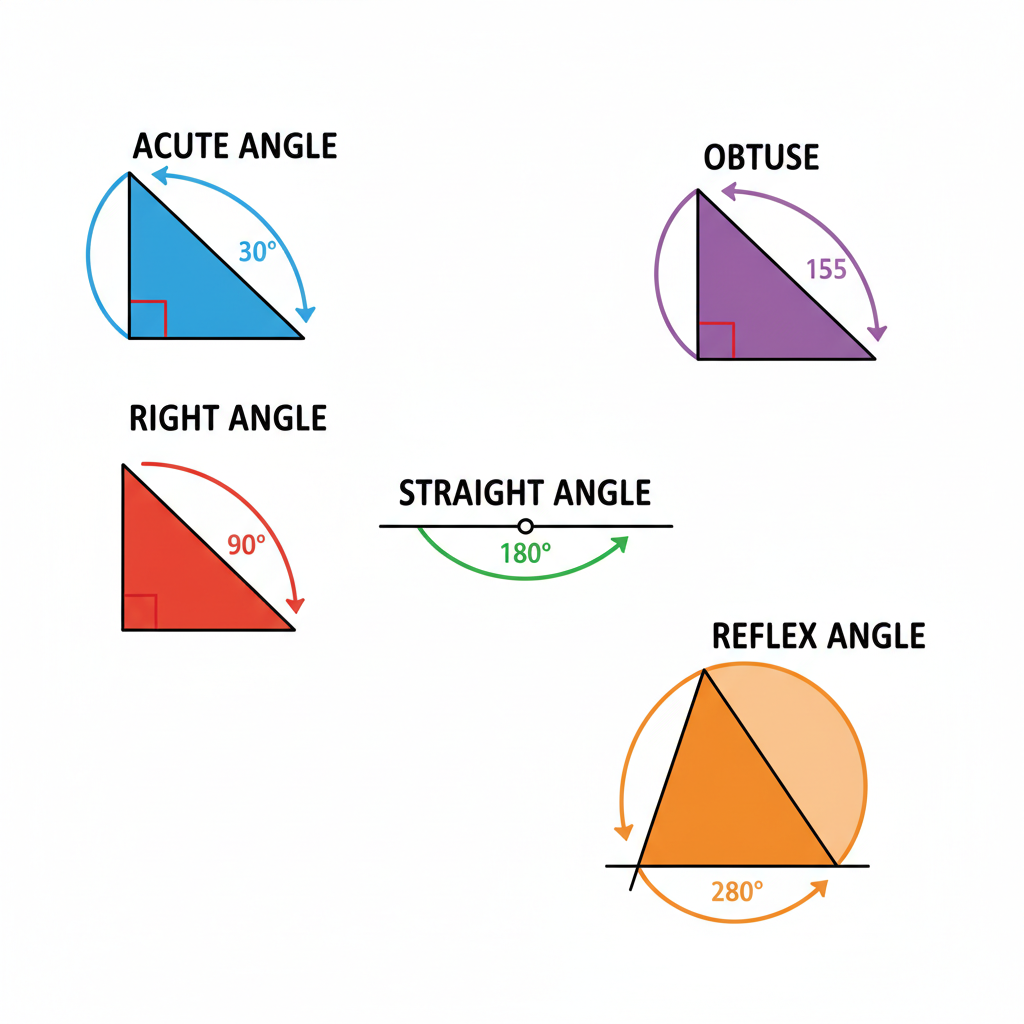
A right angle is like the corner of a square or a perfectly made sandwich. It's exactly 90 degrees (90°). It makes an 'L' shape. You can often spot right angles in buildings, book pages, and the intersection of roads that meet squarely.
2. Acute Angle: The 'Tiny Angle'
An acute angle is smaller than a right angle. It's less than 90 degrees (< 90°). Think of a small slice of pizza or a very pointy shoe. It's a 'cute' little angle, which is why it's called 'acute'!
3. Obtuse Angle: The 'Wide Angle'
An obtuse angle is bigger than a right angle but smaller than a straight angle. It's more than 90 degrees (> 90°) but less than 180 degrees (< 180°). Think of a reclining chair or a ramp that's not too steep but more than flat. It's wider than a right angle.
4. Straight Angle: The 'Flat Line'
A straight angle looks just like a straight line! It's exactly 180 degrees (180°). It's like walking in a perfectly straight path and not turning at all. If you were to open a door completely flat against a wall, that would be a straight angle.
5. Reflex Angle: The 'Big Opener'
A reflex angle is the biggest kind of angle, measuring more than 180 degrees (> 180°) but less than 360 degrees (< 360°). It's the 'outside' angle. Imagine the space between the hands of a clock at 5:00. The smaller angle between them is obtuse, but the much larger angle going the other way around is a reflex angle.
Here's a picture to help you visualize:
Putting it All Together!
Let's do a quick recap:
- Right Angle: Exactly 90° (like a corner)
- Acute Angle: Less than 90° (like a tiny slice)
- Obtuse Angle: More than 90° but less than 180° (like an open door)
- Straight Angle: Exactly 180° (like a flat line)
- Reflex Angle: More than 180° but less than 360° (like a big sweep)
Angles are all around us, helping us understand the shapes and spaces we see every day. Keep your eyes open for them!
Keep learning, free
Create a free Syllabax account to unlock practice questions and games for this topic.
Visual Learning Enhanced! 🚀
To help you master this topic, we use Advanced Syllabax AI to generate detailed diagrams and visual models.
Note on Visuals: The AI sometimes makes spelling errors in image labels. Please refer to the lesson text for the correct terminology.