Types: static, sliding, rolling[PHYSICS]
Watch this topic in 60 seconds
Free preview · Lesson 1
Understanding Types: static, sliding, rolling[PHYSICS]
Understanding Types of Friction: Static, Sliding, and Rolling
Welcome, young scientists, to a fascinating exploration of forces that touch our lives every second! Today, we're diving into the world of friction. Friction is a force that opposes motion or intended motion between surfaces in contact. Think of it as the 'stickiness' or 'resistance' between things when they try to move past each other.
Why is Friction Important?
Imagine a world without friction. Walking would be impossible – your shoes would just slide everywhere! Cars wouldn't be able to brake, and holding a pencil would feel like trying to grip a greased stick. Friction is actually our friend in many ways; it allows us to walk, drive, write, and hold objects without them slipping away.
Friction exists because no surface is perfectly smooth. Even surfaces that look smooth to our eyes are actually rough at a microscopic level. These tiny bumps and ridges on one surface catch on the bumps and ridges of another surface, creating resistance.
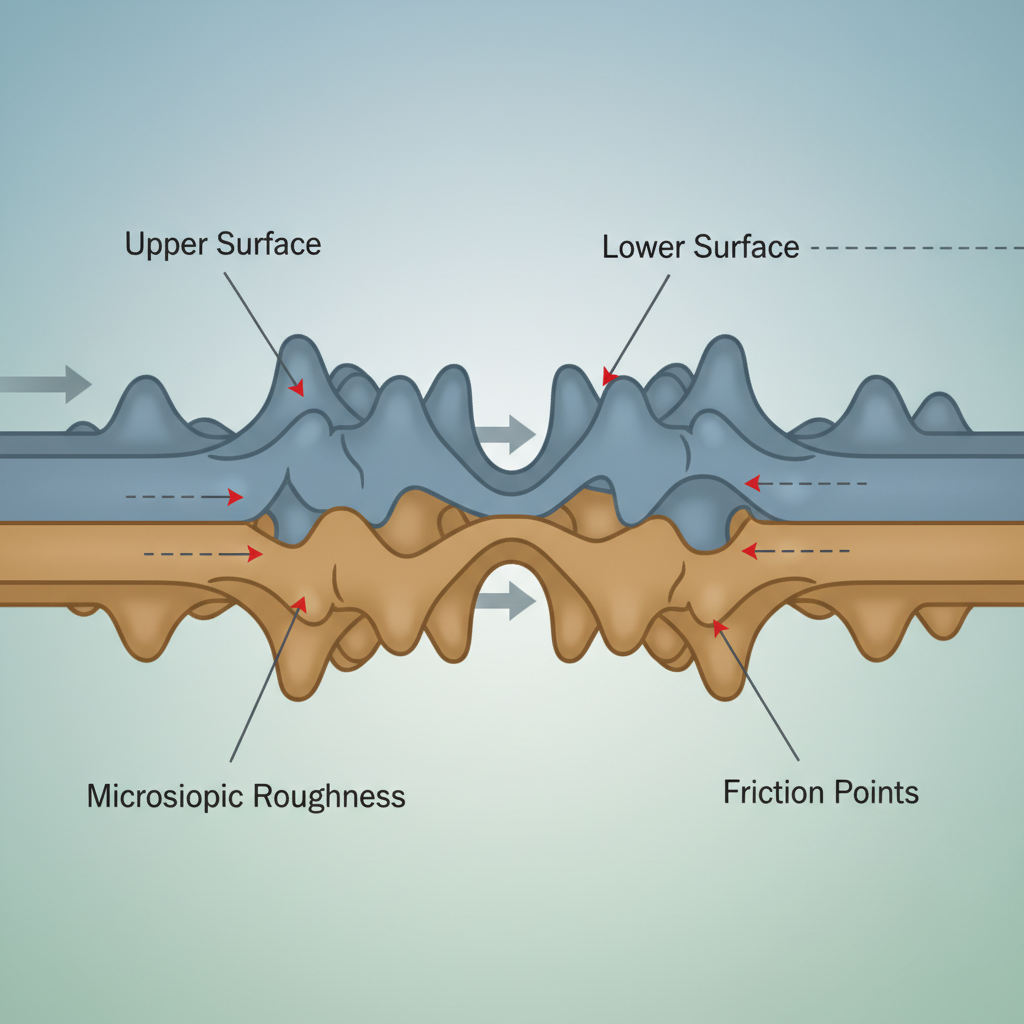 ⚠️ This picture may have spelling mistakes. Trust the words in the lesson.
Three Main Types of Friction
Friction can be categorized into different types based on how the surfaces are interacting. We'll focus on three common types:
1. Static Friction: The Unmoving Guard
Static friction is the force that prevents an object from starting to move when a force is applied. It's like a tiny, invisible guard holding the object in place. This force only acts when the object is at rest and there's an attempt to move it.
Analogy: Imagine you're trying to push a heavy box across the floor. At first, you push, but the box doesn't budge. That's static friction! It's the force working against your push, keeping the box still. The harder you push (up to a certain point), the stronger the static friction force becomes, matching your push to keep the box stationary.
Key Idea: Static friction is a variable force. It can be small if you barely push, or it can be quite large if you push hard. However, there's a maximum amount of static friction. If your push exceeds this maximum, the object will start to move.
Example: A book resting on a table. If you gently tap the book, it won't move. Static friction is holding it in place. If you push harder and harder, static friction increases to oppose your push. Only when your push is strong enough to overcome the maximum static friction will the book start to slide.
2. Sliding Friction: The Constant Drag
Sliding friction (also called kinetic friction) is the force that opposes motion when two surfaces are sliding past each other. This is the friction you experience when the box you were trying to push finally starts moving and you feel resistance as you push it along the floor.
Analogy: Think about pushing that same heavy box, but this time it's moving. You still have to push to keep it moving, right? That resistance you feel while the box is sliding is sliding friction. It's like dragging something heavy across a rough surface – there's a constant drag trying to slow it down.
Key Idea: Sliding friction is generally considered to be a relatively constant force (as long as the surfaces and the force pressing them together remain the same). It's usually less than the maximum static friction. This is why it's often easier to keep an object moving than to get it started.
Example: Sliding a book across a table. Once the book is moving, you feel resistance. If you push with the same force, the speed of the book might stay roughly the same because the sliding friction is opposing your push. When you stop pushing, sliding friction will eventually bring the book to a stop.
3. Rolling Friction: The Easy Roll
Rolling friction is the force that opposes motion when an object rolls over a surface. This type of friction is significantly less than both static and sliding friction.
Analogy: Imagine trying to drag that heavy box across the floor (sliding friction). Now, imagine putting the box on a rolling cart or placing logs underneath it and rolling it. It's much, much easier, isn't it? That ease is due to the dramatically reduced resistance from rolling friction.
How it works: When an object rolls, the point of contact between the rolling object and the surface is constantly changing. Instead of one large area of surfaces scraping against each other (like in sliding), it's a series of tiny compressions and releases at the point of contact. This process is much more efficient at overcoming resistance.
Key Idea: Rolling friction is the weakest of the three types. It's why wheels are so incredibly useful! They allow us to move heavy objects with much less effort.
Example: A ball rolling down a ramp. A car moving down the road. Shopping carts, roller skates, and bicycles all rely on rolling friction to function effectively.
Comparing the Forces
Let's summarize the strength of these friction forces:
- Maximum Static Friction: The strongest resistance to *starting* motion.
- Sliding Friction: The resistance to *continuing* motion. It's less than maximum static friction.
- Rolling Friction: The resistance to *rolling* motion. It's the weakest of the three.
Think of it like this: Trying to push a stubborn mule (maximum static friction) is the hardest. Once the mule starts walking, it's easier to keep it walking (sliding friction). If the mule were on wheels, it would be the easiest to move (rolling friction).
In Summary
Friction is a fundamental force that affects how objects move (or don't move!).
- Static friction prevents motion from starting.
- Sliding friction opposes motion when objects are already moving against each other.
- Rolling friction opposes motion when an object rolls over a surface, and it's the easiest to overcome.
Understanding these types helps us appreciate why things behave the way they do in our physical world!
Keep learning, free
Create a free Syllabax account to unlock practice questions and games for this topic.
Visual Learning Enhanced! 🚀
To help you master this topic, we use Advanced Syllabax AI to generate detailed diagrams and visual models.
Note on Visuals: The AI sometimes makes spelling errors in image labels. Please refer to the lesson text for the correct terminology.