Learning Journey
Watch this topic in 60 seconds
Free preview · Lesson 1
Understanding Types of changes[CHEMISTRY]
Understanding Changes: Physical vs. Chemical Changes
Welcome to our exciting exploration of how things change! Everything around us is constantly transforming, from the ice melting in your drink to the toast popping out of the toaster. In chemistry, we talk about two main ways things can change: physical changes and chemical changes.
What is a Physical Change?
Imagine you have a piece of paper. You can tear it into smaller pieces, fold it into a paper airplane, or even crumple it up. No matter what you do, it's still paper, right? It might look different, but its fundamental nature, what it's made of, hasn't changed.
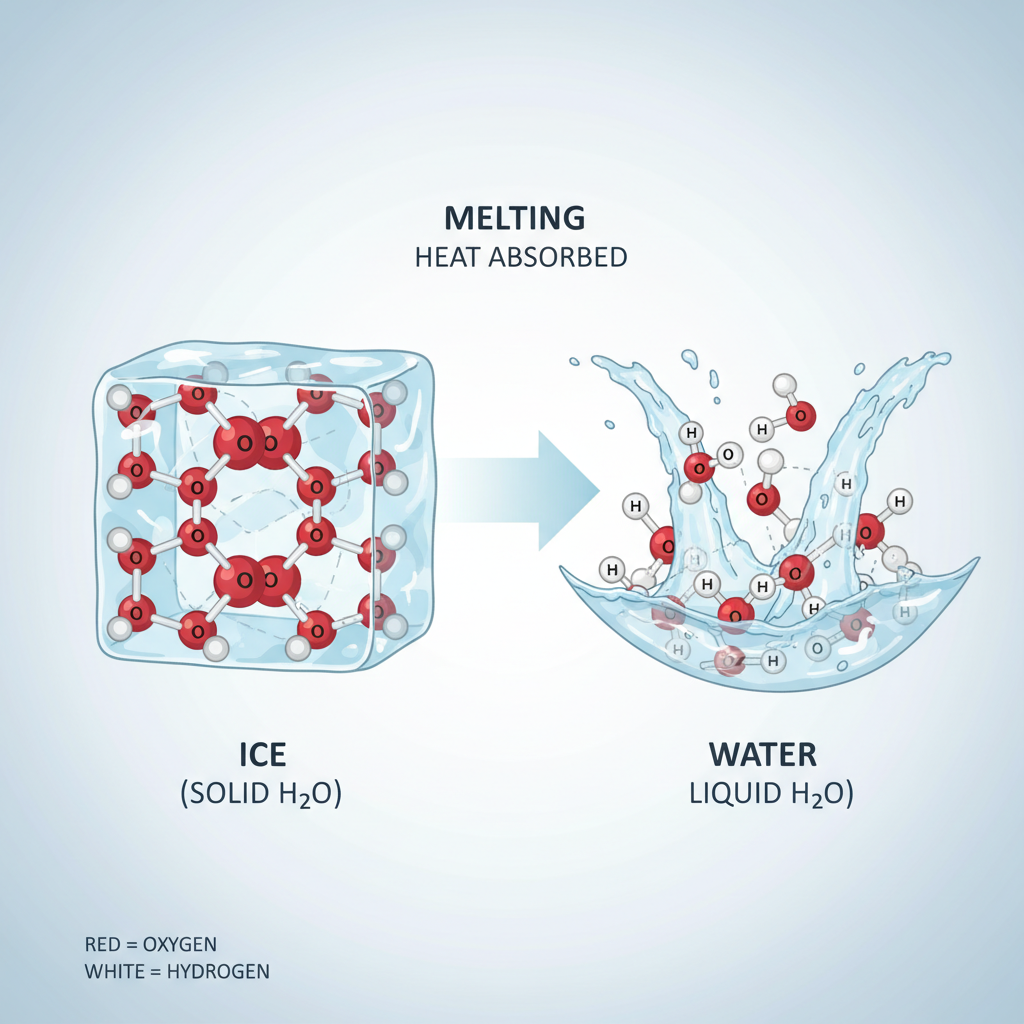
That's the essence of a physical change! A physical change is a change in the form or appearance of a substance, but not in its chemical identity. The molecules themselves stay the same.
Examples of Physical Changes:
- Melting: When ice (solid water) melts into liquid water, it's still H2O. It just changed its state from solid to liquid. Think of it like changing clothes – you're still the same person!
- Freezing: The opposite of melting. Liquid water turns into ice. Still H2O.
- Boiling/Evaporating: Liquid water turns into water vapor (a gas). It's still H2O, just spread out more. Like steam from a hot shower.
- Cutting: Cutting a cake into slices doesn't change the fact that it's cake.
- Bending: Bending a metal spoon changes its shape, but it's still a metal spoon.
- Dissolving: When you dissolve sugar in water, the sugar molecules spread out among the water molecules. You can often get the sugar back by evaporating the water. It's like mixing two different colored beads together – they're mixed, but they're still individual beads.
- Breaking: Dropping a glass breaks it into pieces, but each piece is still glass.
Key Idea: In a physical change, the substance itself remains the same. You can often reverse a physical change.
What is a Chemical Change?
Now, let's think about something different. What happens when you bake a cake? You start with flour, eggs, sugar, and butter. After you mix them and bake them, you get a cake! It smells different, tastes different, and looks completely different. You can't just un-bake the cake to get your original ingredients back, can you?
This is a chemical change! A chemical change, also known as a chemical reaction, is a process that involves the rearrangement of atoms and molecules to form new substances with different properties. The original substance is transformed into something entirely new.
Examples of Chemical Changes:
- Burning: When wood burns, it turns into ash, smoke, and gases. These are completely new substances. It's like transforming LEGO bricks into entirely different shapes that you can't easily take apart to rebuild the original structure.
- Rusting: When iron is exposed to air and moisture, it forms rust (iron oxide). Rust is a totally different substance than iron.
- Cooking: As we saw with the cake, cooking changes the chemical composition of food. Frying an egg changes the proteins in the egg.
- Digestion: Your body breaks down food into simpler substances through chemical reactions so you can use the energy.
- Photosynthesis: Plants use sunlight to convert carbon dioxide and water into sugar and oxygen. A brand new process creating new materials!
- Fireworks: The colors and explosions in fireworks are the result of rapid chemical reactions.
- Spoiling: When food spoils, bacteria cause chemical changes that break down the food into different, often smelly, substances.
Key Idea: In a chemical change, new substances are formed. Chemical changes are often difficult or impossible to reverse.
Indicators of a Chemical Change
How can you tell if a chemical change has happened? Here are some clues:
- Production of Gas: You might see bubbles forming (like when baking soda reacts with vinegar).
- Formation of a Precipitate: Sometimes, when two liquids are mixed, a solid forms and settles at the bottom. This solid is called a precipitate.
- Color Change: A distinct change in color that isn't just mixing colors. For example, leaves changing color in the fall.
- Temperature Change: The mixture gets hotter (exothermic reaction) or colder (endothermic reaction) without an external heat source.
- Production of Light or Sound: Like fireworks or a loud pop.
Physical vs. Chemical Changes: A Summary
Let's recap the main differences:
| Feature | Physical Change | Chemical Change |
|---|---|---|
| What happens? | Change in form or appearance. | Formation of new substances. |
| Are new substances formed? | No. | Yes. |
| Can it be reversed? | Often yes. | Usually no. |
| Examples | Melting, cutting, dissolving. | Burning, rusting, cooking. |
Think of it like building with LEGOs:
- Physical Change: Taking apart a LEGO creation and rebuilding it into a different shape. You still have the same LEGO bricks.
- Chemical Change: Imagine the LEGO bricks magically transforming into entirely new, different colored bricks. You can't get the original bricks back.
Understanding these types of changes is fundamental to understanding the world of chemistry!
Keep learning, free
Create a free Syllabax account to unlock practice questions and games for this topic.
Visual Learning Enhanced! 🚀
To help you master this topic, we use Advanced Syllabax AI to generate detailed diagrams and visual models.
Note on Visuals: The AI sometimes makes spelling errors in image labels. Please refer to the lesson text for the correct terminology.