Theoretical Probability Basics
Watch this topic in 60 seconds
Free preview · Lesson 1
Understanding Theoretical Probability Basics
Understanding Theoretical Probability: What Are the Chances?
Welcome, future probability whizzes! Have you ever wondered what the chances are of something happening? Like, what's the likelihood that it will rain tomorrow? Or what's the probability that you'll roll a '6' on a standard dice? This is where the fascinating world of probability comes in! At its core, probability is all about predicting how likely an event is to occur. It helps us make educated guesses and understand the world around us better, from playing games to making important decisions.
What is Probability? Simple as Pie!
Imagine you have a pie. Some slices are apple, some are cherry. If you close your eyes and pick a slice, what are the chances you'll get an apple slice? Probability helps us answer questions like these. It's a number that tells us how likely something is to happen. This number is always between 0 and 1 (or 0% and 100%).
- 0 (or 0%) means something is impossible. If your pie only has cherry slices, the probability of picking an apple slice is 0.
- 1 (or 100%) means something is certain. If your pie only has apple slices, the probability of picking an apple slice is 1.
- Anything in between means it's possible, but not guaranteed. The closer to 1, the more likely; the closer to 0, the less likely.
Unpacking the Basics: Key Terms You Need to Know
1. Outcome: What Can Happen?
An outcome is a single possible result of an experiment or situation. Think of it as one specific thing that *could* happen. Let's use some analogies:
- Coin Flip: If you flip a coin, the outcomes are "Heads" or "Tails." You can't get anything else!
- Rolling a Dice: If you roll a standard six-sided dice, the outcomes are the numbers 1, 2, 3, 4, 5, or 6.
- Picking a Card: If you pick one card from a standard deck, an outcome could be "King of Spades" or "7 of Hearts."
Each individual possibility is an outcome.
2. Sample Space: The Big Picture of All Possibilities
The sample space is the collection of ALL possible outcomes for an experiment. It's like a complete list of everything that could happen. Imagine it as a giant container holding every single outcome.
- Coin Flip: The sample space is {Heads, Tails}. There are 2 possible outcomes.
- Rolling a Dice: The sample space is {1, 2, 3, 4, 5, 6}. There are 6 possible outcomes.
- Spinner with Colors: If you have a spinner with Red, Blue, Green, Yellow, the sample space is {Red, Blue, Green, Yellow}. There are 4 possible outcomes.
- Marbles in a Bag: If you have 3 red marbles and 2 blue marbles in a bag, the sample space for picking one marble is {Red, Red, Red, Blue, Blue}. There are 5 total possible outcomes.
Knowing the total number of possible outcomes in the sample space is crucial for calculating probability.
3. Event: What Are We Interested In?
An event is one specific outcome or a group of outcomes that we are interested in. It's the "thing" we want to find the probability of. An event is always a subset of the sample space.
- Coin Flip: An event could be "getting Heads."
- Rolling a Dice: An event could be "rolling an even number" (outcomes: 2, 4, 6) or "rolling a 3."
- Marbles in a Bag: An event could be "picking a blue marble."
The outcomes that satisfy the conditions of our event are called favorable outcomes. These are the outcomes we are "rooting for!"
The Magic Formula: Theoretical Probability
Now that we know the key terms, we can define Theoretical Probability. This type of probability is what we *expect* to happen based on mathematical reasoning and the nature of the situation, rather than by actually performing an experiment (which is called experimental probability). Think of it as what *should* happen if everything is fair and random.
The formula for theoretical probability is straightforward:
P(Event) = (Number of Favorable Outcomes) / (Total Number of Possible Outcomes in the Sample Space)
We often write "P(Event)" as a shorthand for "The Probability of the Event."
Let's break down the formula with an example:
Example: Rolling a fair six-sided die. What is the probability of rolling a 4?
- Identify the Event: Rolling a 4.
- Identify Favorable Outcomes: There is only one way to roll a 4 (the side with '4' on it). So, Number of Favorable Outcomes = 1.
- Identify Sample Space and Total Possible Outcomes: The sample space is {1, 2, 3, 4, 5, 6}. So, Total Number of Possible Outcomes = 6.
- Apply the Formula: P(Rolling a 4) = 1 / 6.
So, there's a 1 in 6 chance of rolling a 4.
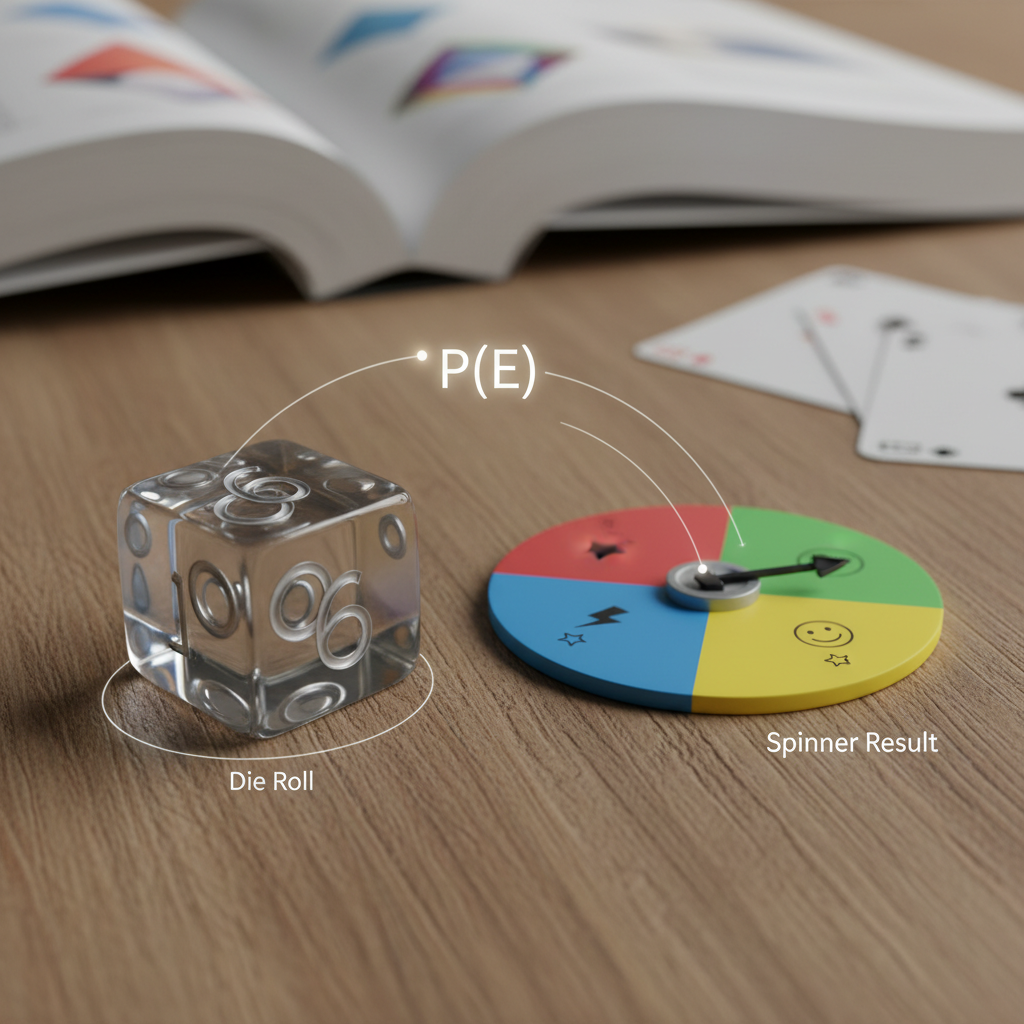
Another Example: Rolling a fair six-sided die. What is the probability of rolling an even number?
- Identify the Event: Rolling an even number.
- Identify Favorable Outcomes: The even numbers on a die are 2, 4, and 6. So, Number of Favorable Outcomes = 3.
- Identify Sample Space and Total Possible Outcomes: The sample space is {1, 2, 3, 4, 5, 6}. So, Total Number of Possible Outcomes = 6.
- Apply the Formula: P(Rolling an even number) = 3 / 6 = 1 / 2.
This means there's a 1 in 2 chance, or a 50% chance, of rolling an even number. This makes sense, as half the numbers on a die are even, and half are odd.
More Analogies to Solidify Your Understanding
The Candy Jar Analogy:
Imagine a big, clear jar filled with candies. There are 5 red candies, 3 blue candies, and 2 yellow candies. You close your eyes and pick one candy.
- Sample Space: All the candies in the jar. Total Possible Outcomes = 5 (red) + 3 (blue) + 2 (yellow) = 10 candies.
- Event 1: Picking a Red Candy. Favorable Outcomes = 5 (the red candies). P(Red) = 5/10 = 1/2.
- Event 2: Picking a Blue Candy. Favorable Outcomes = 3 (the blue candies). P(Blue) = 3/10.
- Event 3: Picking a Green Candy. Favorable Outcomes = 0 (there are no green candies!). P(Green) = 0/10 = 0. This is an impossible event.
- Event 4: Picking any color candy (red, blue, or yellow). Favorable Outcomes = 10 (all the candies). P(Any color) = 10/10 = 1. This is a certain event.
The Spinner Analogy:
Consider a spinner divided into 8 equal sections. 3 sections are colored Red, 2 are Blue, 2 are Green, and 1 is Yellow.
- Sample Space: All 8 sections. Total Possible Outcomes = 8.
- Event 1: Landing on Red. Favorable Outcomes = 3. P(Red) = 3/8.
- Event 2: Landing on Blue. Favorable Outcomes = 2. P(Blue) = 2/8 = 1/4.
- Event 3: Landing on Purple. Favorable Outcomes = 0. P(Purple) = 0/8 = 0. Impossible!
Why is Theoretical Probability Important?
Theoretical probability gives us a baseline, a prediction of what *should* happen in a perfect, fair world. It helps us understand if games are fair, or if a situation is balanced. For example, if you play a game where the theoretical probability of winning is very low, you know it's a risky bet. If the probability of winning is high, you might feel more confident. It's a fundamental concept in statistics and helps lay the groundwork for understanding more complex topics later on.
Remember, the key to mastering theoretical probability is understanding the definitions of outcomes, sample space, and events, and then applying that simple formula: Favorable Outcomes divided by Total Possible Outcomes. Keep practicing, and you'll be calculating chances like a pro in no time!
Keep learning, free
Create a free Syllabax account to unlock practice questions and games for this topic.
Visual Learning Enhanced! 🚀
To help you master this topic, we use Advanced Syllabax AI to generate detailed diagrams and visual models.
Note on Visuals: The AI sometimes makes spelling errors in image labels. Please refer to the lesson text for the correct terminology.