Finding the Median
Watch this topic in 60 seconds
Free preview · Lesson 1
Understanding Finding the Median
Hello, Math Explorers! Let's Find the Middle!
Imagine you and your friends line up from shortest to tallest. Who is standing exactly in the middle? That "middle person" is like the Median in math! The median is a super important way to understand a group of numbers, helping us find what's typical or central without being fooled by super big or super small numbers.
What is the Median? The "Middle Child" of Numbers
Think of the median as the "middle child" of a family of numbers. If you put all the numbers in order, from smallest to biggest, the median is the number right in the middle. It's like finding the exact center of a string of beads once they are all lined up neatly.
Why do we care about the middle? Sometimes, a few very big or very small numbers can trick us. For example, if you're talking about how much money people earn, one very rich person might make the "average" (mean) look very high, even if most people don't earn that much. The median gives us a fairer idea of what's typical.
Step 1: Always Order Your Numbers! (The Golden Rule)
This is the MOST important step. Before you do anything else, you HAVE to put your numbers in order. Think of it like organizing your books on a shelf by size, or lining up your friends by height. You can't find the middle if everything is jumbled!
- Smallest to Biggest: Always arrange them from the least value to the greatest value.
Let's say you have these numbers: 7, 2, 9, 4, 6.
If you don't order them, which one is in the middle? It's hard to tell! But if you order them:
2, 4, 6, 7, 9
Now it's much easier to see the middle!
Case 1: Finding the Median When You Have an ODD Number of Data Points (Numbers)
This is the easiest case! If you have an odd number of items (like 3, 5, 7, 9, etc.), there will always be just ONE number exactly in the middle once they are ordered.
How to Find it:
- Order the Numbers: Arrange all your numbers from smallest to biggest.
- Count and Point: Count how many numbers you have. If it's an odd number, you can start pointing from both ends. Point to the smallest number, then the biggest. Then the next smallest, then the next biggest, and so on. The number you end up pointing to in the very middle is your median!
Example Time! (Odd Case)
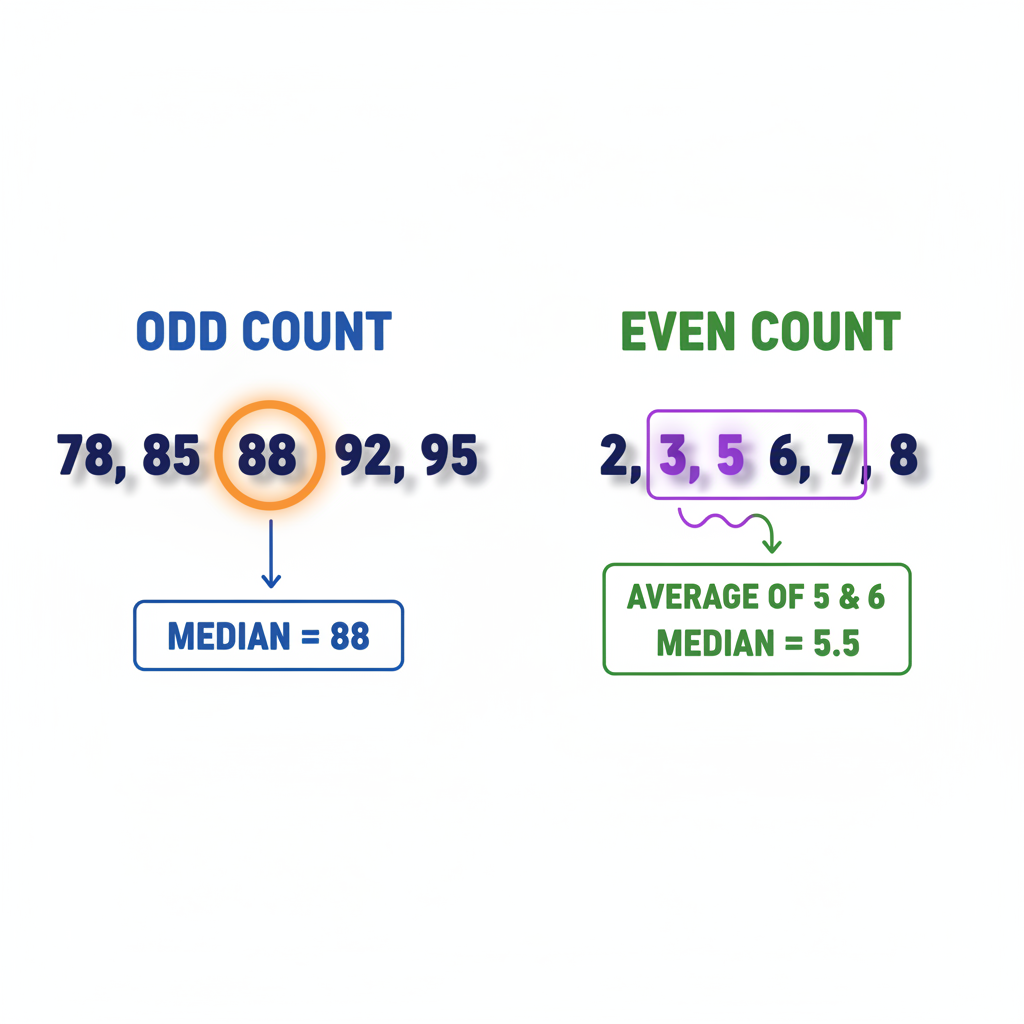
Let's find the median of the following test scores: 85, 92, 78, 95, 88.
Step 1: Order the Numbers
78, 85, 88, 92, 95
Step 2: Count and Point
We have 5 numbers, which is an odd number. Let's find the middle:
78, 85, 88, 92, 95
Imagine your fingers "walking" towards the middle:
- Finger 1 on 78, Finger 2 on 95
- Finger 1 on 85, Finger 2 on 92
- Both fingers meet on 88!
So, the median is 88. Simple as that!
Case 2: Finding the Median When You Have an EVEN Number of Data Points (Numbers)
What if you have an even number of items (like 2, 4, 6, 8, etc.)? In this case, there isn't just one single number directly in the middle. Instead, you'll have TWO numbers right in the middle.
How to Find it:
- Order the Numbers: Again, arrange all your numbers from smallest to biggest.
- Find the Two Middle Numbers: Count how many numbers you have. Since it's an even number, you'll find two numbers in the very center when you "walk" your fingers in from both ends.
- Calculate the Average: This is the special step for even numbers! Once you have your two middle numbers, you need to find their average. To do this, you add the two middle numbers together and then divide by 2. This average is your median.
Think of it like two friends sharing a sandwich. They combine their parts and then divide it equally to find the "middle" taste they both experience.
Example Time! (Even Case)
Let's find the median of the following number of books read in a month: 3, 7, 2, 8, 5, 6.
Step 1: Order the Numbers
2, 3, 5, 6, 7, 8
Step 2: Find the Two Middle Numbers
We have 6 numbers, which is an even number. Let's find the two middle ones:
2, 3, 5, 6, 7, 8
When your fingers "walk" towards the middle, they will stop on 5 and 6.
Step 3: Calculate the Average
Now we add these two middle numbers and divide by 2:
(5 + 6) / 2
11 / 2
5.5
So, the median is 5.5. Notice that 5.5 isn't even in our original list of numbers, and that's perfectly normal for the median of an even set!
Why is the Median Important? A Fairer Picture!
The median is great because it's not easily tricked by very large or very small numbers (what we call "outliers"). If someone in your class got an unbelievably high score, or a very low score, the median would still give you a good idea of what most students scored, because it only cares about the position of the numbers.
Think of it like this: if you have 5 friends, and 4 of them have 1 dollar, but one friend has 100 dollars, the "average" (mean) money would be (1+1+1+1+100)/5 = 104/5 =
Let's Recap the Journey to the Middle!
- The median is the middle number in an ordered list of numbers.
- ALWAYS put your numbers in order from smallest to biggest first!
- If you have an odd number of data points, there will be one number right in the middle. That's your median!
- If you have an even number of data points, there will be two numbers in the middle. You need to add them together and divide by 2 to find your median.
You're now an expert at finding the middle ground with numbers! Great job, math explorer!
Keep learning, free
Create a free Syllabax account to unlock practice questions and games for this topic.
Visual Learning Enhanced! 🚀
To help you master this topic, we use Advanced Syllabax AI to generate detailed diagrams and visual models.
Note on Visuals: The AI sometimes makes spelling errors in image labels. Please refer to the lesson text for the correct terminology.